

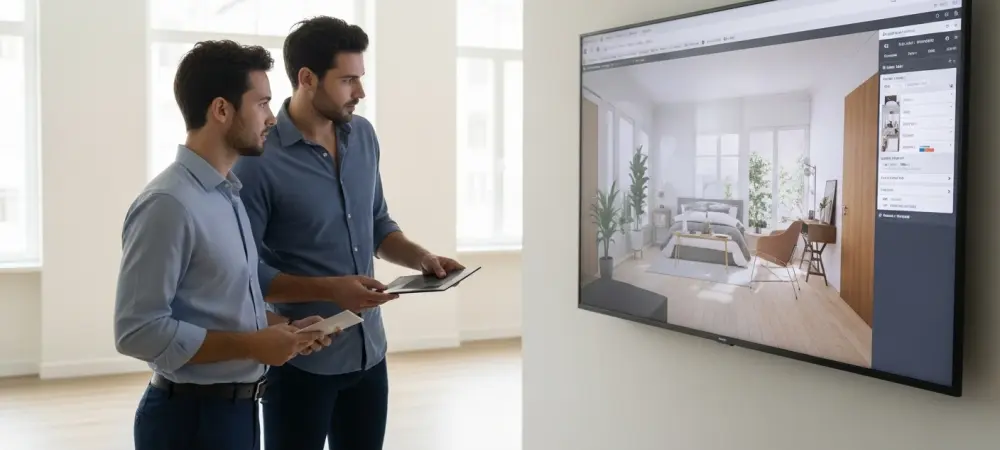
The era of evaluating properties through flat, uninspiring photographs is rapidly coming to an end as digital intelligence breathes life into every square inch of the physical world. The traditional real estate listing often presents a fragmented mosaic of flat photographs and disconnected floor plans that fails to convey the true soul of a property. While high-definition imagery became an industry standard years ago, it lacks the depth required for a buyer to truly inhabit a space before stepping through the front door. This limitation forces potential homeowners to rely on imagination rather than information, often leading to a jarring disconnect during physical viewings.
The market is entering an era where space is no longer just captured; it is computed, allowing the physical world to be translated into a dynamic, interactive digital environment. This shift bridges the gap between imagination and reality by treating architecture as data rather than mere pixels. By turning rooms into intelligent models, technology allows stakeholders to interact with properties in a way that reflects human perception and physical logic.
The Spatial Gap: Why Current Property Marketing Falls Short
Despite the rise of virtual tours and digital staging, the real estate market continues to struggle with a fundamental lack of spatial coherence. Most current AI tools treat property photos as isolated snapshots, leading to visual hallucinations where a sofa appears in one corner in a wide shot but vanishes or shifts size in the close-up. These discrepancies do more than look unprofessional; they erode buyer trust and complicate the critical decision-making process.
As buyers increasingly rely on digital first impressions, the need for a unified spatial operating system has become a necessity for modern brokerages. Without a consistent digital representation, the mental energy required to piece together a floor plan from disparate images creates unnecessary friction. This friction often results in longer listing times and hesitant offers, as the digital narrative fails to align with the physical truth of the structure.
From Isolated Pixels to Multi-View Spatial Consistency
The true breakthrough in Spatial AI, pioneered by innovators like Harvard-incubated Edensign, lies in achieving geometric continuity across an entire property. Instead of staging a single room, this technology creates a persistent digital layer where every architectural element remains fixed in its logical position. This ensures that if a kitchen island is visible from the living room, its dimensions and placement remain identical from every possible perspective.
This evolution transforms virtual staging from a mere cosmetic enhancement into a reliable tool for spatial reasoning, allowing users to verify layouts with mathematical precision. By maintaining this multi-view consistency, agents provide a cohesive experience that mimics the stability of the real world. This technical rigor eliminates the “funhouse mirror” effect of traditional AI-generated content, fostering a sense of permanence and reliability in the digital twin.
The Shift from Standalone Apps to Embedded Industry Infrastructure
Adoption of Spatial AI is rapidly moving from a niche novelty used by tech-savvy agents to a foundational layer of the Multiple Listing Service ecosystem. Major brokerage networks, including Compass and Keller Williams, are already integrating these spatial tools to streamline the design-to-transaction lifecycle. This institutional backing suggests that spatial intelligence is becoming the new baseline for professional real estate, moving away from static documents toward unified interfaces.
Furthermore, organizations like the National Association of Realtors have recognized that high-quality spatial data improves market efficiency. By embedding these tools into existing workflows, the industry reduces the overhead associated with manual photography and physical staging. This transformation suggests that the future of property sales will depend less on fragmented apps and more on a single, authoritative digital layer that serves as the source of truth for every listing.
Expert Perspectives on the Design-to-Transaction Lifecycle
George Zheng and other industry leaders emphasize that the value of Spatial AI extends far beyond the initial sale of a residence. By creating a computable version of a home, professionals offer pre-renovation visualizations and layout optimizations that help buyers see the latent potential in fixer-upper properties. This data-driven approach allows for more accurate appraisals and renovation estimates, providing a level of transparency that was previously impossible.
This shift empowers buyers to become creators, visualizing how their own lifestyles fit into a structure before the closing papers are signed. Professionals now use these spatial models to coordinate with contractors and designers, ensuring that the vision presented during the marketing phase was technically feasible. Consequently, the digital twin became a living document that guided the property throughout its entire ownership journey.
Strategies for Integrating Spatial AI into Modern Real Estate Workflows
To capitalize on this technological shift, industry professionals moved beyond using AI for simple photo editing and instead focused on holistic spatial storytelling. Successful implementation involved capturing properties with computable intent, ensuring that digital staging solved specific problems like awkward transitions or lighting challenges. By adopting unified platforms, agents provided a consistent narrative that guided buyers from the first online click to the final walkthrough with zero cognitive dissonance.
The integration of these systems ultimately allowed for more democratic access to architectural expertise, as advanced visualization became available for properties at every price point. This transition reinforced the idea that the real estate transaction was no longer just a transfer of physical keys but a transfer of a complete digital asset. As a result, the industry established a new standard where the digital representation of a home was as reliable as the structure itself.