

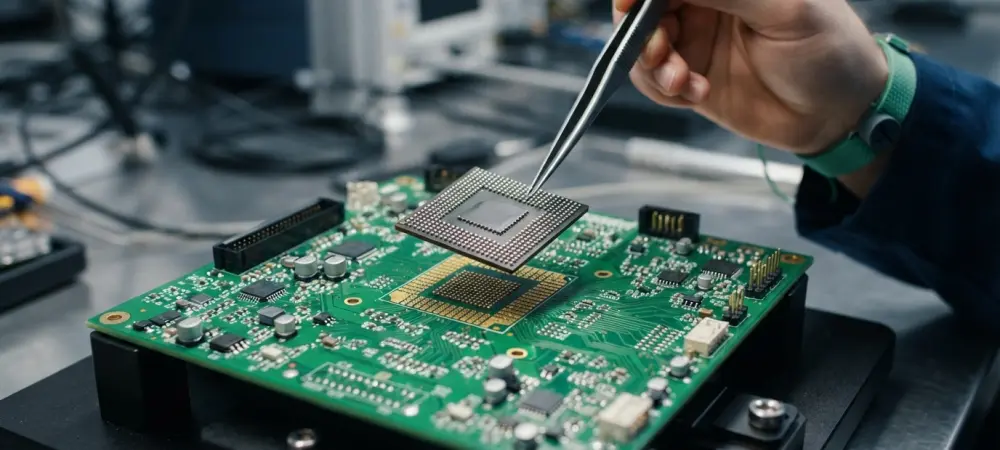
The difference between a robot executing a fluid motion and one suffering from jittery, uncoordinated movements often comes down to the physical layer of its communication system. Faraday Technology’s introduction of an enhanced 10/100 Ethernet PHY IP specifically for EtherCAT marks a significant shift in how industrial hardware handles data. This isn’t just another incremental update; it is a specialized solution for Application-Specific Integrated Circuits (ASICs) that prioritizes the extreme synchronization required for multi-axis machines. By targeting the UMC process, Faraday provides the building blocks for a new generation of robots that can think and move with unprecedented accuracy.
This advancement serves as a critical bridge for manufacturers aiming to modernize their hardware without compromising on stability. As the current landscape in 2026 demands faster production cycles, the ability to integrate real-time networking directly into custom silicon becomes a competitive necessity. The focus on the UMC process ensures that the technology remains accessible to a wide range of chip designers who are looking to scale their automation solutions. By refining the physical interaction between the network and the processor, Faraday has set a high standard for the foundational components of modern robotics.
The New Benchmark for Microsecond Precision
In the world of high-precision manufacturing, the margin for error is measured in microns and microseconds. Traditional networking hardware often struggles with timing inconsistencies, known as jitter, which can cause robotic joints to stutter or drift during complex operations. Faraday’s new IP addresses this by optimizing the way signals are converted and transmitted at the physical layer. This ensures that every command sent from a controller reaches its destination with perfect timing, allowing for the kind of fluid, high-speed movement required in semiconductor assembly or medical robotics.
The integration of this technology into the UMC manufacturing process allows for a seamless transition from design to production. Because this IP is tailored for industrial use, it avoids the overhead associated with general-purpose networking chips that are not optimized for the rigid timing of factory floors. Engineers can now rely on a dedicated hardware path that prioritizes the integrity of motion control data over the high-volume, low-priority traffic common in office environments. This shift toward specialized physical layers is what will enable the next leap in robotic agility and precision.
Beyond Best-Effort Networking in the Smart Factory
In a standard office environment, a millisecond of latency is imperceptible, but on a high-speed production line, it can lead to mechanical failure or safety hazards. Traditional Ethernet operates on a “best-effort” delivery model, which is inherently unpredictable because it prioritizes data volume over arrival time. Industrial robotics demands determinism—the guarantee that data will arrive at a precise, fixed interval. As the industry moves toward more complex, data-heavy automation, the need for hardware that supports on-the-fly processing and sub-microsecond synchronization has become a critical bottleneck.
Faraday’s IP addresses this by bridging the gap between standard connectivity and the rigorous demands of the modern smart factory. By implementing hardware-level features that support protocols like EtherCAT, the IP allows for data frames to be processed while they are still moving through the network. This eliminates the delay caused by buffering entire packets at each node. Consequently, factory managers can implement larger, more interconnected systems without fearing that the network will collapse under the weight of its own communication overhead, ensuring a steady and reliable flow of information.
Technical Pillars of Faraday’s EtherCAT PHY IP
The effectiveness of this new IP rests on three core technical advancements designed to optimize industrial performance. Faraday’s solution is engineered to support the EtherCAT Distributed Clocks mechanism, achieving a synchronization accuracy of less than 0.1 microseconds. By maintaining transmission times below 100 microseconds, the IP ensures that multi-jointed robotic arms move in perfect harmony. This deterministic approach eliminates the unpredictable timing errors that often plague conventional networking hardware in high-demand environments.
Furthermore, factories are electrically noisy environments where solenoid valves and high-voltage machinery can easily disrupt data signals. Faraday utilizes a hybrid design of digital signal processing and analog circuitry to harden the chip against electromagnetic interference. This ensures that communication remains stable even in the presence of significant electrical fast transients. To reduce the risk for manufacturers, the PHY IP has undergone rigorous testing, passing the ETG.7000 specification for EtherCAT conformance and meeting IEC 61000-4 standards for electrostatic discharge and voltage surges.
Expert Perspectives: Reducing Development Risk
Industry leaders emphasize that the value of this IP extends beyond its technical specs into the realm of strategic project management. Faraday COO Flash Lin has highlighted that integrating pre-validated IP allows manufacturers to simplify their entire system development lifecycle significantly. By addressing hardware-level resilience and protocol compliance at the silicon stage, developers avoid the catastrophic costs associated with failed certifications late in the production cycle. This proactive approach to design ensures that projects stay on schedule and within budget.
Expert analysis suggests that this security-by-design approach to physical layer hardware is becoming the gold standard for reducing time-to-market in the competitive robotics sector. Instead of spending months troubleshooting signal integrity issues on the factory floor, engineers can focus on the higher-level software and mechanical features that differentiate their products. This shift from reactive problem-solving to proactive silicon validation has changed how industrial equipment is brought to life. It minimizes the financial risks inherent in developing custom chips while ensuring that the final product is rugged enough for real-world use.
Strategies for Implementing Next-Generation Industrial Connectivity
For organizations looking to leverage these advancements, the framework for integration should prioritize deterministic hardware for multi-axis control. When designing ASICs for high-precision tasks, engineers must select PHY IP that supports hardware-based synchronization natively. Utilizing Faraday’s EtherCAT-optimized solution allows for cycle times below 50 microseconds, which is essential for the coordinated motion control required in 2026. This level of hardware integration provides a more stable foundation than software-based workarounds.
Moreover, manufacturers should design for hybrid connectivity ecosystems where wired EtherCAT and wireless solutions like Private 5G coexist. Utilizing Faraday’s IP ensures that the wired backbone of the factory remains robust while allowing for the integration of mobile assets like autonomous mobile robots. As Faraday expands its portfolio into 10/100/1000BASE-T1 and Single Pair Ethernet, developers prepared for a transition toward software-defined architectures. Planning for these upcoming standards ensured that industrial systems remained compatible with the high-speed data requirements of future autonomous factory systems. The transition toward these advanced PHY solutions addressed the fundamental limitations of traditional networking. By prioritizing hardware-level resilience, developers mitigated the most persistent obstacles in automation.