

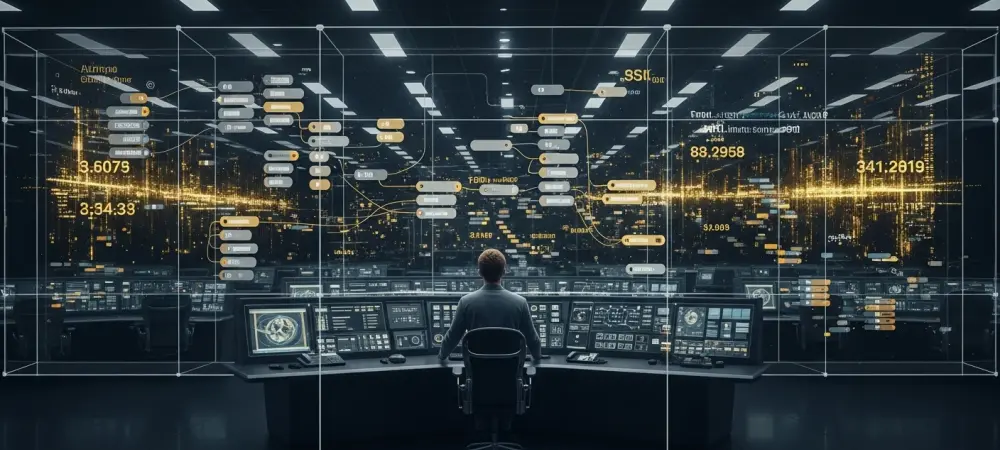
When an algorithmic glitch cascades through a global network at the speed of light, the traditional thirty-minute response window for IT personnel feels more like an eternity. For decades, the technology industry harbored a fascination with “lights-out” autonomy—a vision of pristine data centers where digital systems maintain themselves in perfect, silent isolation. Today, as Artificial Intelligence transitions from a supportive role to the very nervous system of our infrastructure, we are finding that the most resilient systems are not those that eliminate humans entirely. Instead, the most robust environments are those that position human judgment as the ultimate fail-safe, bridging the gap between cold machine logic and the complex, unpredictable reality of the physical world.
This evolution marks a departure from the binary choice of manual labor versus total automation. In the current landscape, the stakes for maintaining this balance have never been higher; a single unmonitored automated error can vaporize millions in market value or compromise sensitive data before a supervisor even receives an alert. The “nut graph” of our current predicament is simple: as AI capabilities expand, the human role must evolve from a manual operator to a strategic architect and ethical guardian. Success is no longer measured by how many tasks are handed over to the machine, but by how effectively those tasks are governed to prevent catastrophic systemic drift.
The Fallacy: Why the Dark Data Center Is Not the Goal
The romanticized notion of a fully autonomous data center often collapses under the weight of real-world unpredictability. While it is true that machines do not experience fatigue or boredom, they are fundamentally limited by the data they were trained on, making them vulnerable to “black swan” events—scenarios that have no historical precedent. If a machine makes a mistake in a silent server room and no human is there to catch it, the impact is not theoretical; it directly crashes the bottom line. By removing the human element, organizations inadvertently remove the only component capable of exercising common sense and contextual reasoning during a crisis.
Modern infrastructure management is shifting toward a philosophy where human oversight is a feature, not a bug. Relying solely on automation creates a brittle environment where subtle errors can compound over time, leading to massive failures that are difficult to trace. True resilience stems from a hybrid model where AI handles the frantic pace of data ingestion while humans provide the stabilizing influence of long-term strategic thinking. This ensures that the digital infrastructure remains responsive to human needs rather than operating on a purely mathematical trajectory that might diverge from business goals.
Strategic Shifts: Moving Toward Controlled Augmentation
Industry leaders are now pivoting toward a model of “controlled augmentation” to replace the outdated dream of total autonomy. This approach acknowledges that while AI can process telemetry data at scales a human brain cannot comprehend, it lacks the wisdom to understand the nuances of a sudden strategic pivot. The objective is to maximize the processing speed of algorithms while maintaining a firm human grip on the steering wheel. This creates a synergy where the AI acts as a force multiplier, allowing a small team of experts to manage sprawling global architectures that would have previously required hundreds of technicians.
By treating AI as an advanced toolset rather than a replacement for staff, companies can ensure that their technical debt does not spiral out of control. Controlled augmentation involves setting clear “lanes” for the AI, allowing it to navigate within pre-defined parameters while flagging anything unusual for manual review. This keeps the human staff mentally engaged with the system’s health rather than becoming passive observers who are unable to intervene when a crisis finally strikes. It turns the relationship into a partnership where both parties play to their respective strengths.
Division of Labor: Where Machines Lead and Humans Govern
To achieve a functional balance, organizations must draw a clear line between computational tasks and qualitative judgment. AI is uniquely suited for environments defined by high-volume data and repetitive patterns, such as predictive maintenance. By synthesizing hardware signals to forecast failures, AI transitions maintenance from reactive cycles to proactive planning. It can spot a failing cooling fan or a degrading SSD weeks before a human would notice a change in performance metrics, allowing for scheduled replacements that do not disrupt the flow of business.
Conversely, human oversight remains indispensable for navigating high-impact scenarios involving financial or reputational risk. Humans provide the ethical compass and the ability to solve unprecedented problems where historical data offers no roadmap. When a security breach occurs that utilizes a completely new attack vector, an AI might be confused by the lack of training data, whereas a seasoned security analyst can use intuition to isolate the threat. This division of labor ensures that the machine handles the “what” and the “how,” while the human remains the master of the “why” and the “should.”
Safeguards: Combating Automation Bias and Ensuring Transparency
One of the most insidious risks of deep integration is “automation bias,” the tendency for human operators to trust machine outputs blindly. When a system is correct 99% of the time, the human brain begins to disengage, assuming the 1% will never happen. To maintain a credible balance, organizations are implementing technical guardrails like Explainable AI (XAI), which forces the system to provide the rationale behind its decisions. This transparency is vital because it allows humans to quickly audit an AI’s logic and spot flaws in the reasoning before they result in operational downtime. Establishing “challenge mechanisms”—such as mandatory secondary reviews for high-stakes AI recommendations—prevents the erosion of human expertise. If an AI suggests shutting down a primary server node, the system should require a human to sign off after reviewing a brief, plain-English explanation of the risks. These checkpoints serve as cognitive anchors, keeping the team sharp and ensuring that the “human in the loop” is not just a figurehead but an active participant. Trust in automation must be earned through consistent transparency and forensic-level logging of every automated action.
Operating Models: From HITL to Advisory Modes
Establishing a balanced environment requires a structured operating model tailored to specific risk levels within the enterprise. The “Human-in-the-loop” (HITL) framework serves as the gold standard for high-impact changes, requiring explicit human approval before any action is taken. This is most common in sensitive areas like financial transactions or core database migrations. For more routine tasks, “Human-on-the-loop” (HOTL) allows for autonomous execution with the provision that a supervisor can intervene instantly if the telemetry starts to trend in a dangerous direction.
Many organizations just beginning their journey found success in “Advisory Mode,” where the AI acts as a consultant, drafting plans that humans then execute manually. This allowed teams to build confidence in the AI’s suggestions without giving up control of the actual infrastructure. Success in these models was not merely measured by short-term cost savings but by improved service level agreements and the successful reallocation of human talent from tedious toil to high-value strategic initiatives. The shift moved the workforce away from “putting out fires” and toward designing the fire-resistant structures of the future. The path forward involved a fundamental re-skilling of the technical workforce, moving away from manual configuration toward algorithmic governance. Organizations began to implement cross-disciplinary teams where ethicists and data scientists worked alongside traditional sysadmins to define the boundaries of automated behavior. By establishing these rigorous frameworks, businesses successfully transformed AI from a source of anxiety into a reliable engine for growth. The transition proved that while technology could handle the data, only humans could provide the direction, ensuring that the next generation of digital infrastructure remained both powerful and profoundly accountable.