

In an era where the packaging industry faces relentless pressure to improve efficiency and adapt to ever-changing demands, Yaskawa Motoman has emerged as a trailblazer with groundbreaking advancements in automation technology. At a major industry event in Las Vegas this year, the company showcased a suite of innovative solutions that integrate artificial intelligence (AI) and robotics to redefine how packaging operations function. From intelligent systems that enhance adaptability to user-friendly tools designed for seamless integration, their approach addresses the core challenges of modern production environments. This display of cutting-edge technology not only highlights Yaskawa Motoman’s leadership in the field but also sets a new standard for what automation can achieve in terms of precision and scalability. As the packaging sector grapples with complex tasks and frequent changeovers, these developments signal a transformative shift toward smarter, more responsive systems that promise to reshape the landscape of industrial automation.
Redefining Efficiency with AI-Driven Robotics
Yaskawa Motoman’s latest innovations place a strong emphasis on AI as a cornerstone for enhancing robotic capabilities in packaging tasks. A standout demonstration featured dual-robot coordination powered by the NEXT platform, which operates on an advanced NVIDIA processor. This system, coupled with sophisticated vision technology, enables robots to perform intricate verification tasks, such as inspecting printed circuit boards by identifying specific components and determining precise test points. The AI goes beyond mere analysis by autonomously generating motion paths for the robots, marking a significant step forward in independent decision-making. This level of intelligence reduces the need for constant human oversight, allowing operations to run more smoothly and efficiently, even when handling complex or variable assignments. By leveraging such technology, Yaskawa Motoman is tackling the industry’s demand for systems that can think and adapt on their own, ultimately driving productivity to new heights in packaging automation.
Another key aspect of this AI integration is the flexibility it offers in programming and operation. The NEXT system supports a range of coding methods, from traditional teach pendant techniques to intuitive graphical interfaces and advanced Python scripting. This versatility ensures that users with varying levels of technical expertise can effectively interact with the technology, making automation more accessible across diverse teams. Such adaptability is crucial in an industry where quick adjustments to production lines are often necessary due to changing product formats or packaging requirements. By simplifying the interaction with robotic systems, Yaskawa Motoman is breaking down barriers to adoption, enabling companies to integrate sophisticated automation without the burden of extensive retraining or specialized staff. This focus on user-centric design, combined with powerful AI, positions their solutions as a game-changer for optimizing workflows in dynamic packaging environments.
Advancing Palletizing and Sorting Solutions
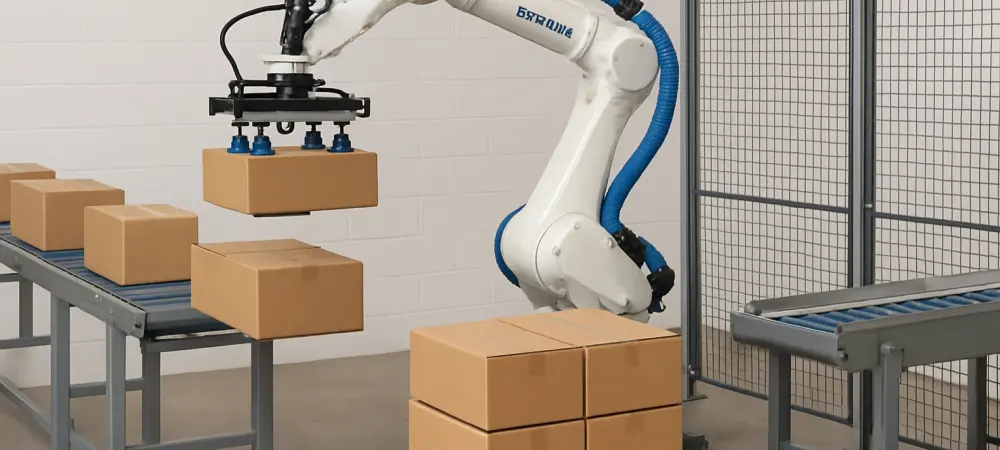
Palletizing remains a critical focus for Yaskawa Motoman, reflecting the packaging industry’s ongoing need for versatile and efficient handling of goods. Through a collaboration with Mujin, the company unveiled a robotic system capable of both palletizing and depalletizing boxes of varying sizes. Utilizing advanced 3D imaging and motion planning, this technology eliminates the need for manual waypoint programming, allowing the robot to adapt to different configurations autonomously. This innovation is particularly valuable in environments where product diversity and frequent changeovers are common, as it minimizes downtime and boosts throughput. By automating such labor-intensive tasks with precision, Yaskawa Motoman addresses a pressing need for scalability and flexibility, ensuring that operations can keep pace with fluctuating demands without sacrificing accuracy or speed in the process.
In addition to palletizing, Yaskawa Motoman has made strides in mixed-package sorting through a partnership with Plus One Robotics. This solution enables robots to identify optimal pick points from randomly oriented shapes, showcasing remarkable adaptability to unpredictable packaging scenarios. Such capability is essential for warehouses and distribution centers dealing with assorted items that lack uniformity in size or orientation. The technology reduces reliance on manual sorting, cutting down on errors and labor costs while enhancing overall efficiency. Beyond the immediate operational benefits, this development reflects a broader trend toward intelligent systems that can handle variability with minimal human intervention. Yaskawa Motoman’s commitment to solving these complex challenges demonstrates a forward-thinking approach that aligns with the evolving needs of the packaging sector, paving the way for more streamlined and resilient supply chains.
Integrating Hardware and Software for Seamless Operations
Yaskawa Motoman’s portfolio extends beyond AI and partnerships to include a robust range of robotic hardware tailored for packaging applications. The HC cobot series, designed for medium-volume palletizing, offers a balance of precision and safety for collaborative environments, while the GP series of industrial robots excels in larger-scale tasks such as inspection and heavy-duty palletizing. These hardware solutions are built to withstand the rigors of high-demand settings, ensuring reliability even under continuous operation. By offering a spectrum of robotic options, Yaskawa Motoman caters to a wide array of operational scales and requirements, providing companies with the tools needed to automate effectively, whether they are handling niche products or mass production lines. This diversity in hardware underscores their holistic approach to addressing the multifaceted challenges within the packaging industry.
Complementing this hardware is an array of software tools designed to maximize efficiency, such as PalletSolver, which facilitates offline creation of pallet patterns for both single and mixed stock-keeping units (SKUs). This software significantly reduces downtime during transitions between product or packaging formats, a common bottleneck in automated systems. By enabling pre-planning and quick adjustments, PalletSolver enhances operational throughput, allowing businesses to respond swiftly to market changes without sacrificing productivity. This integration of physical and digital solutions highlights Yaskawa Motoman’s dedication to creating cohesive systems that work in tandem to optimize performance. The result is a seamless workflow where hardware and software synergize to deliver safer, faster, and more adaptable automation, meeting the critical needs of modern packaging operations with unparalleled precision.
Shaping the Future of Intelligent Automation
Reflecting on Yaskawa Motoman’s showcase at the Las Vegas event, it’s evident that their contributions marked a pivotal moment for packaging automation. Their blend of AI-driven robotics, innovative palletizing solutions, and integrated hardware-software ecosystems demonstrated a clear vision for tackling real-world industry challenges. Each advancement, from autonomous decision-making to user-friendly programming, was crafted to enhance efficiency while reducing manual dependency, addressing key pain points in production environments. These efforts not only elevated operational standards but also set a benchmark for what intelligent systems could achieve in dynamic settings, inspiring confidence in automation’s potential to transform the sector.
Looking ahead, the path forward involves embracing these technologies to build more responsive and scalable packaging operations. Companies should consider adopting adaptable systems that prioritize both power and accessibility, ensuring they can handle variability without extensive overhauls. Exploring partnerships and investing in training for intuitive tools can further ease the transition to smarter automation. Yaskawa Motoman’s innovations offer a blueprint for navigating the complexities of modern production, suggesting that the future lies in solutions that balance cutting-edge intelligence with practical application. By focusing on such strategies, the industry can move toward a more efficient and sustainable model, ready to meet evolving demands with agility and foresight.