

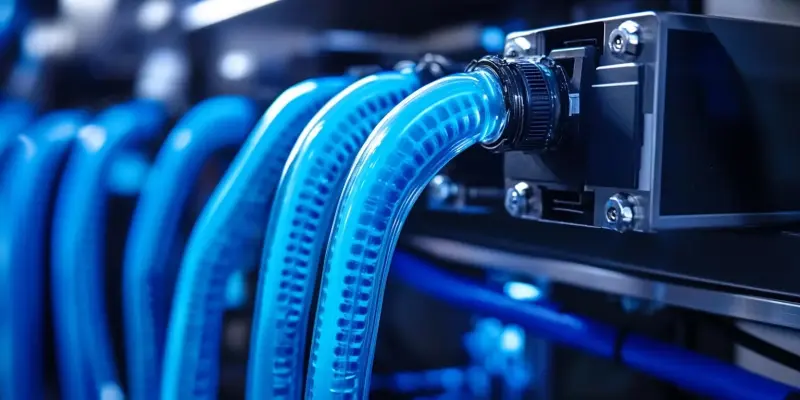
As digital transformation accelerates and artificial intelligence (AI) applications grow more sophisticated, the demand for greater computational power and efficient data processing has surged. This transformation has driven the need for data centers to evolve in significant ways, particularly in terms of cooling systems. Wesco, a key player in the data center industry, is leading the charge in this area by developing liquid cooling solutions that can effectively manage the heat generated by high-performance GPUs and CPUs. Traditional air-cooling methods no longer suffice in modern data centers, making liquid cooling techniques indispensable in maintaining operational efficiency and performance.
The shift towards AI-driven workloads has necessitated changes in data center infrastructure, including the incorporation of taller and larger cabinets to house the advanced equipment. Additionally, the heat produced by such high-demand GPUs and CPUs requires more sophisticated cooling solutions. Wesco’s innovative liquid cooling systems are designed specifically for individual applications, taking into account various environmental factors such as fluctuations in temperatures and existing cooling mechanisms. Opting for liquid cooling not only addresses the heat management challenge but also enhances the overall performance of data centers.
The Need for Liquid Cooling in Modern Data Centers
Alan Farrimond, the vice president at Wesco Data Center Solutions, emphasizes that the transition to liquid cooling involves comprehensive changes across the entire design of data centers. This includes not just the cooling systems, but also impacts cabinets, infrastructure, cabling, load management, and even flooring. The power consumption and cooling demands of modern data centers have significantly escalated, with traditional CPU-based servers drawing around 200 watts (W) of power compared to GPU-based servers that consume upwards of 700 W. This rise in power consumption presents substantial engineering challenges when scaled across numerous servers and cabinets, making air cooling an impractical solution.
Andrew Jimenez, Wesco’s senior director for technical sales, underscores that this transition to liquid cooling requires innovative approaches. Techniques such as direct-to-chip cooling, rear door heat exchangers, and full-immersion cooling are now essential to manage the intense power and heat demands of modern data centers. Unlike traditional data centers that relied on basic air cooling, contemporary data centers driven by AI and Internet 3.0 require power plans ranging from 50 to 100 kilowatts per cabinet. Such high demand fundamentally transforms the engineering and design ethos of data centers, necessitating revolutionary advancements in cooling technology.
Overcoming Deployment Challenges
The transition to liquid cooling isn’t without its challenges. Alan Farrimond and Andrew Jimenez highlight that deploying these systems is a complex process, requiring expertise in mechanical, electrical, and plumbing engineering. Partnering with firms experienced in implementing liquid cooling systems within data centers is crucial to navigate these complexities effectively. Successful deployment often involves collaboration with multiple manufacturers adhering to the same design specifications and ensuring globally consistent service delivery to meet worldwide demand. These collaborative efforts are essential to overcoming the deployment hurdles and achieving smooth integration of liquid cooling solutions.
To enhance data center productivity and efficiency, Wesco has developed entroCIM, a smart facility platform that aggregates data from various sources, including IT, OT systems, sensors, and third-party applications. EntroCIM provides a comprehensive view of data center functionality, enabling operators to improve performance and prevent failures through predictive maintenance and optimization. By tracking smart metering, access control, building management, and other critical parameters, entroCIM plays a pivotal role in maintaining productivity and achieving sustainability goals. This platform underscores the importance of integrated software solutions in optimizing data center operations.
Sustainability and Efficiency in Data Centers
Sustainability has emerged as a paramount concern in the modern data center landscape. With the advent of new liquid cooling systems and evolving data center designs, traditional metrics like power usage effectiveness (PUE) are now complemented by newer measures such as water usage. EntroCIM is instrumental in monitoring data center performance against set sustainability key performance indicators (KPIs). This enables operators to identify and address inefficiencies, ensuring that data centers operate sustainably. The platform employs AI and machine learning to autonomously optimize operations, transcending mere data collection to facilitate informed decision-making.
The discussion also delves into the role of AI in maintaining operational efficiency and addressing skill shortages within data centers. Farrimond explains how entroCIM assists with planning and provisioning essential skills across data centers globally, thereby managing high-demand periods effectively. As a significant percentage of data centers struggle with headcount tasks, using AI for operational optimization is pivotal. However, AI is not expected to completely replace human involvement, especially for physical tasks that require manual intervention. This balanced approach ensures operational efficiency while mitigating the impact of skill shortages.
Wesco’s Role in the Future of Data Centers
In conclusion, Wesco has positioned itself at the forefront of revolutionizing data centers through the sophisticated engineering and deployment of liquid cooling systems, strategic global partnerships, and advanced software solutions like entroCIM. These efforts collectively ensure that data centers can efficiently meet the evolving demands of AI-driven workloads while maintaining productivity and sustainability. Wesco’s proactive approach to addressing the challenges and opportunities in the data center industry underscores the importance of continuously innovating to keep pace with technological advancements. The company’s leadership and expertise in this space will undoubtedly shape the future of data centers, ensuring that they remain efficient, sustainable, and capable of supporting the ever-increasing computational demands of the digital world.