

By breaking down complex forms into manageable sequential steps, developers are lowering barriers to entry for users operating in imperfect physical conditions. This transformation is part of a broader industry-wide pivot toward extreme intentionality, where every pixel must justify its presence on the screen. For years, the prevailing philosophy in software development was one of accumulation, where success was measured by the sheer volume of features available to the consumer. However, the current landscape of 2026 reveals that users no longer equate density with value. Instead, they seek efficiency and clarity, pushing designers to adopt a subtractive mindset. By stripping away non-essential visual elements and focusing on the core utility of an application, developers can reduce the cognitive load that often leads to user fatigue. This shift is particularly evident in the way modern interfaces prioritize primary actions through standardized navigation bars, ensuring essential tools are always within thumb’s reach.
Adapting to Diverse Hardware: The Flexible Interface
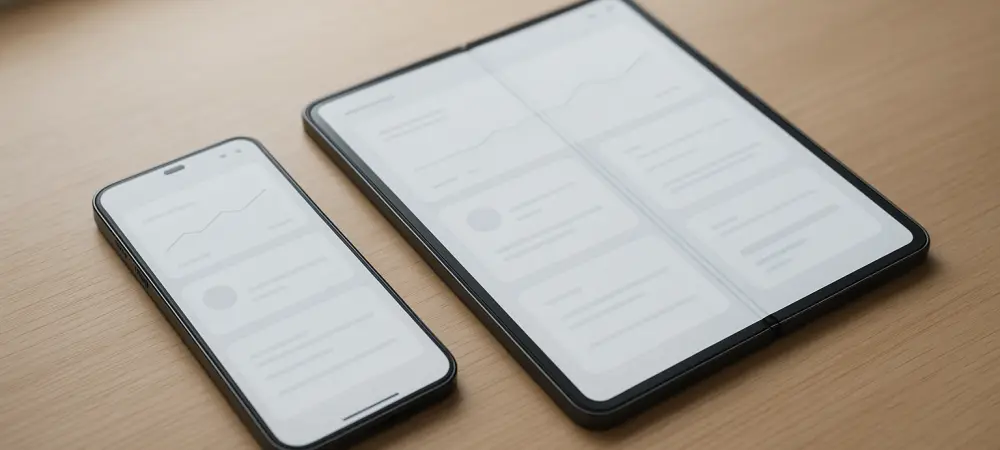
The contemporary era of mobile design has moved far beyond the constraints of the standard smartphone rectangular screen. Modern users frequently oscillate between various form factors, including compact handhelds, expansive tablets, and the increasingly popular category of foldable devices. This hardware diversity requires interfaces to be exceptionally elastic, moving away from rigid pixel-perfect layouts toward fluid, responsive systems. When an application transitions from a folded state to an unfolded tablet view, the internal architecture must recognize the new canvas size and redistribute elements without disrupting the flow of the interaction. This involves creating multi-pane layouts where a single-column list of emails can instantly become a split-view window showing both the inbox and the message content. Achieving this level of adaptability ensures that the user never feels limited by their choice of device, as the software intelligently scales its utility to match the available physical space.
Furthermore, maintaining the “user state” across these hardware transitions has become a critical benchmark for high-quality design. If a consumer is halfway through filling out a form on their phone and then switches to a tablet, the application should ideally preserve their progress and position with zero latency. This requires a sophisticated back-end synchronization that treats the user’s session as a continuous journey rather than a series of isolated events. Design teams are now focusing on “contextual awareness,” where the interface adjusts its density and interaction model based on how the device is being held or oriented. For instance, a foldable screen might offer a more cramped, one-handed keyboard in its compact mode but expand into a full desktop-style input method when opened. By prioritizing this type of hardware-software synergy, developers are building a more cohesive ecosystem where the transition between different physical tools becomes essentially invisible to the end user.
Prioritizing Universal Design: Accessibility as a Standard
Accessibility has transitioned from a niche compliance checkbox to the primary engine driving mainstream mobile innovation. Principles that were originally intended to assist users with permanent disabilities—such as high-contrast text ratios and oversized touch targets—are now recognized as essential for the general population. Mobile devices are frequently operated in sub-optimal environments, such as under the glare of direct sunlight or in high-stress situations where a person only has one hand free. By adopting a simplified visual hierarchy and significantly increasing the font size and spacing, designers are making applications easier for everyone to navigate regardless of their current environment. This universal approach to design reduces the likelihood of accidental clicks and frustration, leading to higher retention rates. It is no longer enough for an app to be functional; it must be intuitively accessible to a sixty-year-old in a grocery store as much as it is to a tech-savvy teenager.
Beyond the purely visual aspects, modern UX redesigns are focusing on the semantic structure of information to accommodate varied cognitive needs. Developers are increasingly utilizing shorter, more digestible blocks of text and clear, descriptive labels that leave no room for ambiguity. This strategy of “progressive disclosure” allows users to access advanced settings only when they are needed, keeping the initial interface clean and approachable. By adhering to these global design standards, software creators are ensuring that their products can be used by the widest possible demographic without requiring a steep learning curve. This inclusive methodology also extends to language and cultural localization, where icons and color palettes are chosen based on their universal meanings to avoid confusion in international markets. Ultimately, the focus on accessibility has democratized technology, making complex digital tools feel as natural and straightforward as physical objects for every type of user.
Integrating Transparent AI: Efficiency Through Intelligence
Artificial Intelligence has moved from a speculative concept to a permanent, subtle fixture within the mobile user interface. However, the current trend is not toward AI for its own sake, but toward “transparent assistance” that helps users accomplish tasks faster without being invasive. Features such as predictive text, smart search suggestions, and automated organization are now expected by default, yet they must be implemented with a light touch. Effective integration requires that the user remains in control at all times, meaning they must be able to understand why an automated action was taken and how to reverse it if necessary. For example, a modern calendar app might suggest an appointment time based on previous habits, but it must present this as a suggestion rather than a final decision. This level of transparency builds trust between the user and the software, ensuring that the technology feels like a helpful assistant rather than an unpredictable and overwhelming force.
In tandem with intelligent features, the industry has come to recognize that technical performance is a fundamental pillar of user experience that cannot be separated from visual design. An application that features stunning animations but suffers from high latency or jittery scrolling will always be perceived as a failure by the modern consumer. Reliability is now treated as a core design requirement, focusing on how an app handles network interruptions, how quickly it resumes from a background state, and how effectively it preserves data during unexpected crashes. Designers are working closer than ever with engineers to optimize “perceived performance,” using techniques like skeleton loaders and optimistic UI updates to make the software feel faster than the underlying hardware might suggest. By prioritizing these under-the-hood mechanics, the interface remains fluid and responsive, reinforcing a sense of effortless interaction that is critical for maintaining long-term user engagement and brand loyalty.
Building a Future-Proof Strategy: Lessons for Developers
The transition toward a more empathetic and technically sound mobile environment proved that user experience was never just about surface-level aesthetics. Industry leaders recognized that the most successful applications were those that respected the user’s time and mental capacity by providing invisible but robust support systems. To achieve this, development teams implemented a strategy of rigorous simplification, removing secondary features that did not contribute to the primary mission of the software. They also established a workflow where accessibility audits were performed at the very beginning of the design phase, ensuring that high contrast and touch-target sizing were baked into the product’s DNA. This proactive approach helped companies avoid costly redesigns and ensured that their products remained competitive in a market that increasingly valued inclusivity. Furthermore, the move toward transparent AI required that users were always provided with a clear manual override.
In the final analysis, the evolution of mobile design was defined by a shift from being “device-centric” to being “human-centric.” The lessons learned from this period suggested that the next logical step for any organization involved deeper cross-platform integration and an even greater emphasis on foundational performance. To remain relevant, designers were tasked with creating systems that were not only beautiful but also resilient and adaptable to the unpredictable ways people interact with technology. This meant investing in modular design systems that could be easily updated as new hardware emerged, as well as maintaining a strict focus on reducing friction at every touchpoint. By viewing every design choice through the lens of human psychology and physical limitations, developers established a blueprint for digital interactions that felt natural and intuitive. This journey through refinement showed that the best technology is that which serves the user so well that its complexity is never actually noticed.