

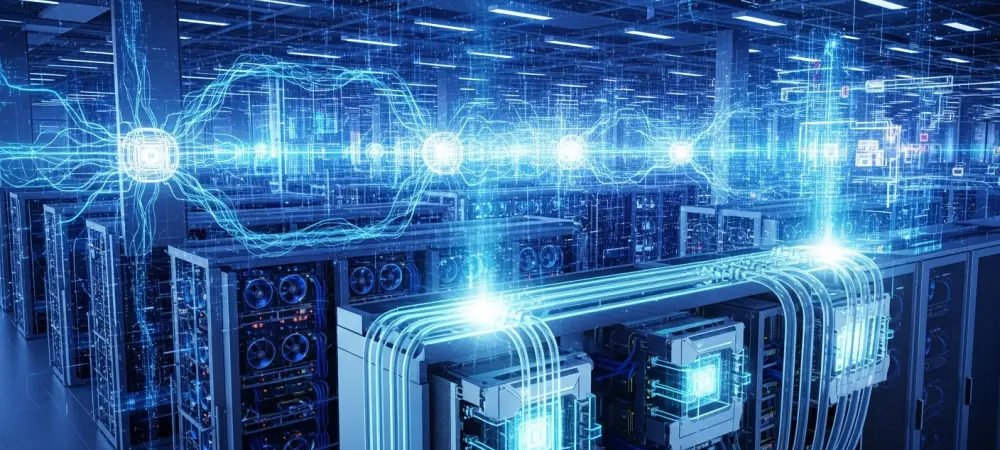
The profound transformation currently sweeping through the data center industry is not merely a series of incremental upgrades but a fundamental shift in how digital infrastructure is conceptualized and executed. For decades, the primary mission of these facilities was to maximize storage capacity and ensure that central processing units could handle a predictable stream of virtual machine requests. However, the rise of generative AI has shifted the engineering focus from storage-centric designs toward compute-heavy architectures where every component is optimized for massive parallel processing. This transition represents a critical best practice for any enterprise looking to remain competitive, as the infrastructure requirements for training and running large language models differ significantly from traditional enterprise applications. Modern facilities must now account for extreme power densities, specialized networking fabrics, and cooling solutions that move beyond simple air circulation.
As organizations integrate these advanced technologies, the strategy for deploying digital infrastructure must evolve to prioritize the efficient movement and processing of data rather than its mere preservation. This shift necessitates a holistic approach to the stack, encompassing everything from the physical rack configuration to the high-level deployment models used for real-time inference. Moving toward this new reality requires a deep understanding of how specific AI workloads, such as retrieval-augmented generation and large-scale model training, impact the physical and logical layers of the data center. By adopting a set of modernized best practices, businesses can ensure that their facilities are not just warehouses for servers but dynamic engines of value creation capable of supporting the next generation of cognitive computing.
Why Modernizing Data Center Infrastructure Is Essential
Following established infrastructure best practices is no longer an optional strategy for forward-thinking firms; it has become a strict requirement for operational survival as we move through 2026 and toward the end of the decade. The sheer intensity of generative AI workloads puts unprecedented stress on legacy systems, often leading to hardware failures or severe performance bottlenecks if the environment is not properly calibrated. Modernizing the data center allows an organization to create a resilient foundation that can absorb the volatile demands of AI inference and training without compromising the stability of existing corporate applications. This resilience is the bedrock of digital transformation, providing the agility needed to pivot as new AI models and hardware iterations enter the market with increasing frequency.
Operational efficiency serves as a primary driver for this modernization effort, particularly when considering the staggering cost of high-end graphics processing units and specialized AI accelerators. When a data center is optimized for high-density compute, it prevents thermal throttling, which occurs when chips automatically slow down to prevent heat damage. By maintaining an ideal operating environment, enterprises can maximize the return on investment for their hardware, ensuring that every cycle of a million-dollar GPU cluster is utilized effectively. Without these modern optimizations, expensive hardware remains chronically underutilized, effectively wasting capital that could have been redirected toward further innovation or scaling initiatives.
Scalability and resilience also play a pivotal role in the decision to overhaul existing digital infrastructure, as the surge in AI workloads often happens in unpredictable bursts. Proper architectural planning ensures that facilities can handle these spikes without triggering frequent outages or creating performance lag that degrades the user experience. A modern design incorporates modularity, allowing for the rapid addition of compute nodes or the reconfiguration of power distribution units to meet changing demands. This foresight protects the organization from the “demand shock” that has characterized the recent growth of the AI sector, providing a buffer that allows for steady, planned expansion rather than frantic, reactive patching of old systems.
Cost management remains a constant pressure point for technology leaders, and strategic infrastructure choices provide one of the most effective ways to mitigate the massive energy and cooling expenses associated with generative AI. Traditional air-cooling methods are increasingly seen as a financial liability because of their high energy consumption and relative inefficiency at high densities. By transitioning to more advanced cooling technologies and modular designs, companies can significantly reduce their power usage effectiveness ratio, leading to lower utility bills and a smaller environmental footprint. These choices are not just about sustainability; they are about maintaining a competitive cost structure in an era where power availability is becoming a scarce and expensive resource.
Best Practices for Reshaping AI Data Center Infrastructure
Adapting digital infrastructure to meet the unique demands of generative AI requires a departure from “business as usual” toward a more specialized and aggressive engineering posture. The following practices provide a roadmap for organizations seeking to align their physical facilities with the computational needs of modern models, focusing on the areas where the impact of AI is most disruptive.
Implementing High-Density Liquid Cooling Systems
As rack densities climb toward 100kW per cabinet, traditional air cooling is rapidly becoming obsolete because the physical properties of air simply cannot move heat fast enough to keep up with modern accelerators. The implementation of high-density liquid cooling involves transitioning to Direct-to-Chip cooling or immersion cooling to manage the extreme thermal output of the latest hardware. Direct-to-Chip systems utilize a network of small tubes to deliver coolant directly to a cold plate sitting on top of the processor, while immersion cooling involves submerging the entire server in a non-conductive dielectric fluid. Both methods offer far superior heat transfer capabilities compared to air, allowing for tighter server packing and higher performance without the risk of hardware degradation.
Beyond the raw thermal benefits, liquid cooling systems offer a significant improvement in overall facility efficiency by reducing the energy required for fans and large-scale air conditioning units. This transition allows for a more compact data center footprint, as liquid-cooled racks can be placed closer together without creating the “hot spots” that plague traditional air-cooled rows. Furthermore, the heat captured by liquid cooling systems is often at a higher temperature, making it easier to repurpose for facility heating or other industrial processes. This creates a circular energy economy within the data center, turning a waste product into a valuable resource and further improving the sustainability profile of the entire operation.
Case Study: Managing 100kW Racks With Immersion Cooling
A prominent hyperscale provider recently faced a challenge where their legacy air-cooled facility could no longer support the next generation of AI training clusters, which required 100kW per rack. To solve this, they implemented a comprehensive immersion cooling system that bypassed the need for massive fans and complex airflow management. The result was a 30 percent reduction in total energy consumption compared to their traditional air-cooled units, even while supporting significantly higher compute densities. This move allowed the provider to extend the life of their existing building while drastically increasing its total processing capacity, proving that liquid cooling is a viable path for retrofitting older sites.
Transitioning From Storage-Centric to GPU-Fabric Networking
The internal communication patterns of a data center are being rewritten as enterprises shift their focus from standard Ethernet storage connectivity to low-latency, high-bandwidth interconnects. Traditional networking was designed to move files between a storage array and a server, but AI workloads require massive amounts of data to move between hundreds of different processing units simultaneously. This has led to the adoption of GPU-fabric networking, which utilizes specialized protocols and high-speed switches to create a seamless pool of compute power. By minimizing the “hop” count between nodes and utilizing technologies like Remote Direct Memory Access, organizations can ensure that their GPUs are fed data at the speed of light, preventing costly idle time during training runs.
In this new networking paradigm, the focus shifts toward maintaining a perfectly balanced data pipeline where no single link becomes a bottleneck for the rest of the cluster. This requires a rethink of the cabling and switching architecture, moving toward “spine-and-leaf” designs that provide predictable latency across the entire fabric. Moreover, the integration of optical networking components directly into the server rack is becoming more common, as these parts generate less heat and provide more bandwidth than traditional copper cables over longer distances. This evolution in networking is essential for supporting the large-scale parallel processing that defines modern AI, where a delay in one part of the network can stall the progress of an entire multi-billion-parameter model.
Real-World Example: Optimizing Data Pipelines for Real-Time Inference
A global financial services firm recently redesigned its network fabric to address a significant bottleneck between its memory arrays and its GPU clusters during high-speed market analysis. By implementing a low-latency interconnect system specifically tuned for GPU communication, the firm significantly reduced the idle time of its processing units during large-scale model training and real-time inference. This optimization allowed them to process complex financial models 40 percent faster than their previous configuration, highlighting how networking is just as critical as raw compute power in the AI era. The firm discovered that the “networked” nature of their processors was the true key to unlocking higher levels of predictive accuracy.
Prioritizing Retrieval-Augmented Generation for Efficiency
Rather than attempting to train massive models from scratch—a task that remains prohibitively expensive for all but the largest tech giants—organizations should prioritize architectures built around retrieval-augmented generation. This approach involves building data pipelines that allow a pre-trained AI to “look up” private, specialized information from an external database during the inference process. By doing so, the company can utilize smaller, more efficient models that do not require massive, high-cost training infrastructure. This best practice significantly lowers the barrier to entry for high-performance AI, as the primary requirement becomes the efficiency of the data retrieval system rather than the raw number of GPUs available for model training.
Focusing on these architectures also provides a much-needed layer of data security and governance, as the model itself does not need to “memorize” sensitive corporate information. Instead, the information remains in secure, searchable databases where access can be tightly controlled and audited. This separation of the “thinking” component of the AI from the “knowledge” component makes the overall system more flexible, as the database can be updated in real-time without needing to retrain the underlying model. Consequently, the infrastructure requirements shift toward high-speed storage and efficient search algorithms, allowing enterprises to achieve state-of-the-art results using a fraction of the power and space required for traditional model development.
Case Study: Reducing Capital Expenditure Through RAG Deployment
A global logistics company sought to implement an internal AI to manage its complex documentation and supply chain queries without incurring the massive costs of a dedicated training center. By utilizing a retrieval-augmented generation approach, the company was able to run its operations out of mid-range colocation facilities rather than building a multi-billion-dollar site from the ground up. The RAG architecture allowed them to use smaller, off-the-shelf models that queried their proprietary logistics database, providing highly accurate answers at a tenth of the expected operational cost. This strategic choice allowed the company to scale its AI initiatives across multiple regions while keeping its capital expenditure under tight control.
Adopting a Hybrid and Modular Infrastructure Portfolio
To combat the risk of rapid hardware obsolescence, businesses should adopt a mix of on-premise “AI pods,” cloud-based training bursts, and edge computing sites. This hybrid approach allows an organization to keep its most sensitive data on-site while utilizing the massive, on-demand scale of public cloud providers for intensive training cycles that would otherwise overwhelm local resources. Modular infrastructure, such as pre-configured containers or “pods” that include their own power and cooling, allows for rapid deployment in existing facilities without the need for a total building overhaul. This flexibility is vital in a market where the leading-edge hardware of today can be superseded by a more efficient version in less than eighteen months.
Furthermore, the integration of edge computing into this portfolio allows for initial data processing to occur closer to the source, reducing the amount of “noise” that needs to be sent back to the central data center. In an industrial or retail setting, this might involve running small inference models on the factory floor or at the branch office to provide immediate feedback to users. These “data springs” act as the first line of processing, filtering and aggregating information before it is passed to the core AI clusters for deeper analysis. This distributed model creates a more resilient and responsive ecosystem, ensuring that the organization can maintain operations even if connectivity to the central hub is temporarily interrupted.
Example: The Networked Constellation Approach in Manufacturing
An industrial manufacturer recently deployed a hybrid model known as a “networked constellation” to manage its global fleet of smart factories. In this setup, initial data processing and anomaly detection occur at edge sites directly on the factory floor, providing millisecond-level response times for critical safety systems. Heavy model optimization and long-term trend analysis are then offloaded to a specialized cloud provider, while sensitive proprietary designs are kept within a high-security on-premise AI pod. This tiered approach has ensured that the manufacturer can scale its AI capabilities cost-effectively across dozens of locations while maintaining the highest levels of data sovereignty and system uptime.
Strategic Outlook and Conclusion
The transition toward generative AI infrastructure has represented a fundamental shift from the old metric of “how much we can store” to the modern requirement of “how efficiently we can process.” While the technical requirements—such as extreme power density and the move toward liquid cooling—presented daunting challenges initially, they eventually offered a path to unprecedented compute capability and operational insight. Organizations that successfully navigated this period of rapid change were those that recognized early on that the data center could no longer function as a passive utility. Instead, it became an active and integral part of the business strategy, requiring continuous investment in networking fabrics and modular deployment models to stay ahead of the computational curve.
Looking back at the recent developments in the sector, it is clear that a hybrid approach emerged as the most resilient strategy for managing the high costs and rapid depreciation of specialized AI hardware. By combining retrofitted on-premise sites with retrieval-augmented generation architectures, companies were able to protect their proprietary data while still leveraging the latest advancements in large-scale models. This balanced strategy allowed decision-makers to evaluate local power availability and total cost of ownership more effectively, avoiding the pitfalls of over-committing to massive capital expenditures that might have become obsolete before reaching their full potential. The market eventually rewarded those who viewed their digital infrastructure as a dynamic, evolving engine of value.
Ultimately, the successful implementation of these best practices ensured that the modern data center could function as a specialized hub for cognitive tasks, rather than just a storage facility for digital archives. The industry learned that efficiency in the AI era is not just about saving power, but about maximizing the “intelligence per watt” that a facility can produce. As we move forward, the focus has shifted toward building even more integrated systems where the boundary between hardware and software continues to blur. The lessons learned during this reshaping of the infrastructure landscape provided a clear roadmap for the future, proving that the foundation of any successful AI initiative is a well-planned, high-density, and flexible physical environment that can adapt to the next wave of innovation.