

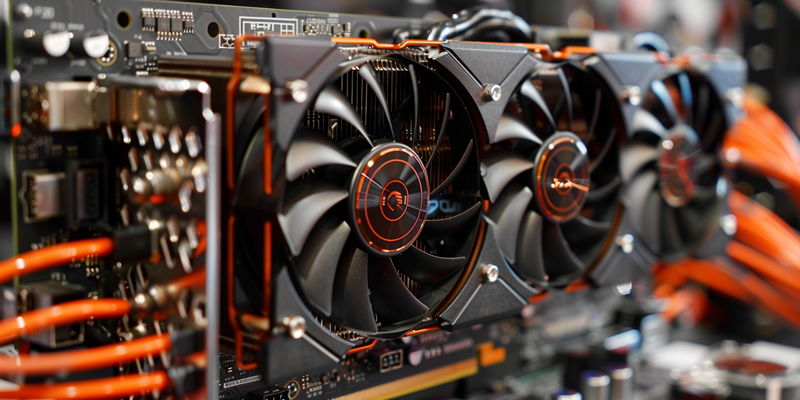
The advancements in artificial intelligence (AI) and machine learning (ML) have necessitated a new tier of workstation capabilities. AMD’s Radeon PRO W7900 Dual Slot GPU emerges as a response to these growing demands, promising a compact yet powerful solution that augments the professional graphics card portfolio. As workstations pivot toward accommodating sophisticated AI computations, let’s explore how the Radeon PRO W7900 is set to transform the professional landscape.
Leveraging Compact Power for Enhanced Workload Management
Professionals in AI and creative industries often confront a dual challenge: the need for robust computational power and the limitations imposed by physical space. AMD acknowledges this dilemma with the introduction of the Radeon PRO W7900, a dual-slot GPU adept at sliding into standard workstation enclosures while offering substantial scalability for demanding tasks. Its well-thought-out design empowers users to bolster their computational resources without expanding their spatial footprint, which is especially beneficial for those who manage multiple AI models or engage in heavy graphical workloads. The integration of up to four such units in a single system, a notable improvement over its predecessor, affirms AMD’s commitment to facilitating high-performance computing in confined workspaces.
A New Benchmark in Memory and Performance
At the core of the Radeon PRO W7900 lies a fusion of sizeable memory capacity and stellar compute performance. Equipped with 48 GB of GDDR6 memory, the GPU employs ECC technology to preserve data fidelity, making it an ideal match for handling extensive AI datasets and large language models. The impressive compute performance is encapsulated by the Navi 31 GPU, associated with 96 Compute Units and 6144 cores. The combined potency of these components enables the Radeon PRO W7900 to not only meet but set new industry benchmarks for memory and performance, positioning it as a preferable tool to propel AI research and development forward.
Striking a Balance between Efficiency and Capabilities
AMD doesn’t sacrifice efficiency for raw power. Despite its robust performance capabilities, the Radeon PRO W7900 operates within a 295W thermal design power (TDP), presenting an energy-efficient solution for power-conscious organizations. Balancing high energy demands with sustainable operations has become increasingly crucial in the industry, and the Radeon PRO W7900 skillfully addresses this by offering the best of both worlds – superior performance housed within an energy-conscious framework. This nuanced approach to design demonstrates AMD’s understanding that the future of AI workstations lies not only in their raw power but also in their ability to run cooler and longer, paving the way for more sustainable and enduring technological ecosystems.
Achieving Cost-Effectiveness in AI Processing
Cost efficiency is a key determinant of success in the GPU market, and the Radeon PRO W7900 stands out for its favorable performance-to-cost ratio. When evaluated against NVIDIA’s Ada 6000 GPUs, AMD’s offering shines, providing up to 52% better performance per dollar in specific benchmarks. The economic appeal of the Radeon PRO W7900 is magnified in the AI-specific domain, where its significant memory buffer contributes to a 38% better value in performance. Such cost-effective prospects make the Radeon PRO W7900 a prime choice for businesses and professionals seeking to extract maximum value from their investments without settling for anything less than top-tier performance.
Software Synergy: Enhancing AI Frameworks and Workflows
No GPU can excel in isolation; the surrounding software ecosystem is essential in maximizing a GPU’s potential. The Radeon PRO W7900 is complemented by AMD’s forthcoming ROCm 6.1.2 suite, designed to optimize AI framework integration and streamline multi-GPU support. Such software synergy not only enhances the technical strengths of the GPU but also simplifies the complexity of AI workflows for professionals. The user experience is further smoothed out with the suite’s beta support for Windows Subsystem for Linux (WSL-2), cementing AMD’s Radeon PRO W7900 as a well-rounded package for anyone operating within an AI-driven environment.
Positioning for the Future of AI Workstations
The rapid progress in artificial intelligence (AI) and machine learning (ML) has brought about the need for more robust workstations. In response, AMD has introduced the Radeon PRO W7900 Dual Slot GPU. This new addition to their professional graphics card lineup is compact, yet it packs a significant punch, making it well-suited for the increasingly complex AI tasks that modern workstations are expected to handle. The Radeon PRO W7900 is not just another component – it’s a game-changer poised to reshape the professional environment by enabling workstations to manage more advanced AI and ML applications with ease. As we journey into an era where AI and ML are becoming omnipresent in professional settings, the advent of GPUs like the Radeon PRO W7900 underscores the tech industry’s commitment to meeting these computational challenges head-on, signaling a new chapter in the evolution of professional graphics capabilities.