

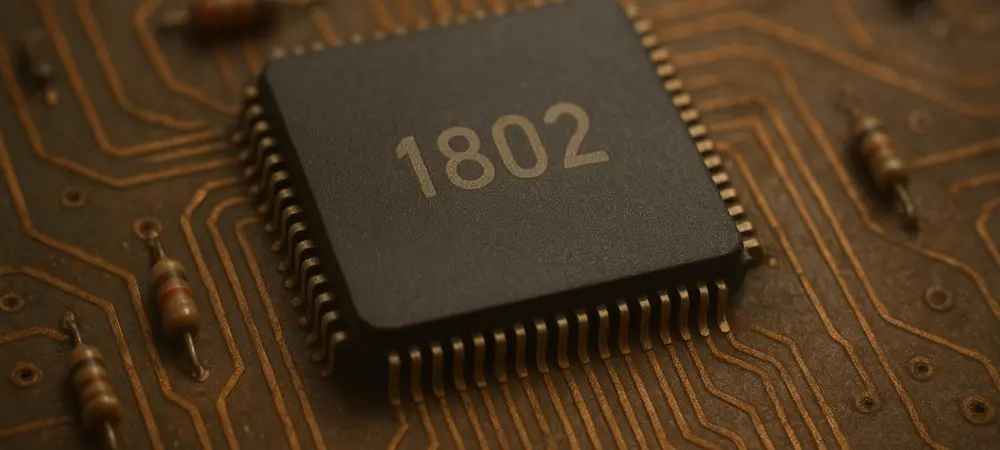
The CDP1802 microprocessor remains in production nearly fifty years after its release, serving as a durable testament to the robust CMOS design principles established at RCA labs. While the commercial history of the digital age is often dominated by the narratives of California-based semiconductor giants, the COSMAC (Complementary Silicon Metal-Oxide Semiconductor) architecture represents a profound alternative path that originated in Princeton, New Jersey. This architectural milestone, spearheaded by the singular vision of Joseph Weisbecker, redefined the parameters of efficiency, reliability, and accessibility in the early days of microcomputing. Unlike many of its 1970s-era contemporaries that relied on high-power NMOS logic, Weisbecker’s design prioritized low power consumption and high noise immunity, traits that would eventually allow the 1802 to power deep-space missions and critical industrial infrastructure long after more famous chips had faded into history. By synthesizing his expertise in logic design with a creative approach to problem-solving, Weisbecker bridged the gap between the room-sized mainframes of the 1950s and the ubiquitous embedded systems that define our modern technological landscape in 2026.
The Era of Massive Mainframes
Transitioning: From Vacuum Tubes to Transistors
In the mid-1950s, the computing landscape was characterized by extreme physical scale and staggering power requirements, exemplified by RCA’s Bizmac project. Joseph Weisbecker, joining the company after his graduation from Drexel University in 1956, found himself working on a machine that occupied 20,000 square feet and utilized 30,000 vacuum tubes. The Bizmac was a monumental feat of engineering for its time, but to an architect with an eye for efficiency, it represented a technological dead end—a “dinosaur” that generated immense heat and required a small power plant to operate. Weisbecker recognized that the future of the industry depended not on scaling these massive systems upward, but on shrinking the fundamental switches that performed the logic operations. Even as the industry transitioned to transistors with systems like the RCA 501 and the Spectra 70, the prevailing corporate philosophy remained focused on high-performance mainframes that were inaccessible to individual users and small-scale applications.
This period of mainframe dominance instilled in Weisbecker a strong desire to challenge the status quo by exploring the decentralization of computing power. He observed that the sheer complexity and cost of these machines limited their utility to large corporations and government agencies, leaving a vast void where small-scale, versatile computing should exist. His intuition suggested that the physical miniaturization of electronic components would eventually reach a point where a computer could fit on a desktop or even inside other machines, but corporate inertia at RCA often relegated him to peripheral design tasks. Despite these constraints, he spent his professional hours analyzing core architectural principles, looking for ways to streamline data paths and instruction sets. This intellectual groundwork was essential, as it allowed him to conceptualize a microprocessor architecture that was built from the ground up to be lean, logical, and inherently more efficient than the scaled-down mainframes others were attempting to build.
Negotiating: The Path to Intellectual Freedom
A critical turning point in the development of the COSMAC architecture occurred when Weisbecker briefly left RCA in 1963 to join a startup, only to return three years later with a unique set of demands. Having already proven his value through several lucrative patents, he was in a position of strength when negotiating his new employment contract. He secured a rare agreement that allowed him to retain the intellectual property rights for any inventions related to “toys and games,” while RCA would own any of his developments specifically categorized as computers. This distinction was not merely a hobbyist’s whim; it was a strategic move that allowed him to explore complex logical structures through the medium of mechanical puzzles and electronic games. By distancing his creative experiments from the rigid oversight of the mainframe division, he created a private laboratory where he could test architectural concepts that would later form the bedrock of the 1802’s design.
The “toys and games” clause proved to be the catalyst for some of his most profound insights into simplified logic and user interaction. Weisbecker used these recreational projects, such as the “Think-A-Dot” mechanical game, to master the application of flip-flops and Boolean algebra in a way that was both tangible and highly efficient. These games were effectively miniature logic processors, and they allowed him to refine his ideas about how a machine should handle data and instructions without the overhead of massive corporate budgets or project managers. This personal creative outlet provided the freedom to fail and iterate quickly, leading to a design philosophy that emphasized “elegance through simplicity.” When he eventually turned his attention back to designing a formal computer, he brought with him a repertoire of clever logic shortcuts and a deep understanding of how to maximize the utility of a limited number of transistors, a skill that would become the hallmark of the COSMAC architecture.
Prototyping a Vision in the Basement
Building: The Future from Spare Parts
By 1968, the disconnect between Weisbecker’s vision and RCA’s corporate strategy led him to take the extraordinary step of building his own computer in his residential basement. Frustrated by the lack of internal support for a small-scale computer project, he decided to prove the feasibility of a microprocessor-like architecture using off-the-shelf components. This was an era before the microprocessor even existed as a commercial product, meaning Weisbecker had to source individual Transistor-Transistor Logic (TTL) chips, switches, and lights to construct an 8-bit control panel. Accompanied by his daughters, he spent many weekends visiting local Radio Shack stores across New Jersey, scouring the shelves for the necessary parts to realize his design. These trips were more than simple errands; they were a grassroots effort to gather the materials for a revolution in computing that the major players in the industry had not yet foreseen.
The basement project, known internally as the “System 00,” was a physical manifestation of the COSMAC architecture long before it was etched onto a silicon wafer. By building the machine himself, Weisbecker was able to troubleshoot the logical flow and the instruction set in real-time, ensuring that every cycle was used to its maximum potential. He often engaged in lengthy technical discussions with the Radio Shack employees—many of whom were former technicians from RCA or other local electronics firms—sharing his goal of creating an 8-bit machine that anyone could build and program. These interactions highlighted a growing community of enthusiasts who were eager for the kind of accessible computing Weisbecker was developing. The success of this basement prototype served as the undeniable proof-of-concept that eventually forced RCA to take notice, proving that a single individual could design a sophisticated computer architecture using a fraction of the resources typical of a large engineering team.
Innovation: The Strategic Move to CMOS
The most significant technical decision Weisbecker made during the transition from his basement prototype to a commercial product was the insistence on using CMOS technology. At a time when other semiconductor companies were heavily invested in PMOS or NMOS processes for their higher speeds, Weisbecker recognized that CMOS offered unparalleled advantages for the emerging field of embedded systems. CMOS was notoriously difficult to manufacture in the early 1970s, but it provided extremely low power consumption and high resistance to electrical noise, making it ideal for environments where power was limited or interference was high. This visionary choice meant that the COSMAC architecture was not just another chip; it was a uniquely resilient tool designed for longevity rather than raw benchmark performance. This focus on reliability would later make the CDP1802 the gold standard for high-reliability applications in space and industry. This commitment to CMOS also allowed the CDP1802 to operate across a wide range of voltages, a feature that was nearly unheard of in the mid-1970s. While competing chips required highly regulated power supplies, the 1802 could run on simple batteries, further democratizing the use of microprocessors in portable devices and remote sensors. Weisbecker’s design philosophy favored a static logic approach, which meant the processor could be slowed down or even stopped entirely without losing its internal state, a capability that dramatically reduced power consumption during idle periods. By the time the CDP1801 and later the 1802 were announced, they represented a radical departure from the power-hungry designs of the era. This technical foresight ensured that the COSMAC architecture remained relevant as the industry moved toward the low-power requirements of the 21st century, establishing a legacy of efficiency that continues to influence embedded design in 2026.
Individual Agency and Technological Legacy
Challenging: The Corporate Status Quo through Results
The eventual commercialization of the COSMAC architecture stands as a powerful case study in how individual agency can alter the trajectory of a massive corporation like RCA. Joe Weisbecker did not wait for a management directive to begin his work; instead, he used his basement prototype to demonstrate a working 8-bit system that outperformed many of the theoretical designs being discussed in formal boardrooms. When he finally presented his “small computer” to RCA leadership, he wasn’t just showing them a series of diagrams; he was showing them a functioning machine that proved computing power could be decentralized and made affordable. This forced the company to pivot from its exclusive focus on mainframes and invest in the burgeoning microprocessor market, leading to the creation of a specialized division dedicated to CMOS logic and the eventual release of the CDP1800 series.
Furthermore, Weisbecker’s ability to bypass traditional roadblocks was a result of his strategic use of personal projects to validate his professional engineering goals. By bridging the gap between his “toys and games” and industrial computer design, he was able to innovate faster than the company’s bureaucratic processes would typically allow. This model of innovation—where an engineer takes the initiative to build a prototype independently—foreshadowed the hobbyist and startup culture that would later define the personal computer revolution. The COSMAC project proved that the most significant technological leaps do not always come from massive R&D budgets, but from individuals who possess both the technical skill to build a system and the courage to challenge the prevailing wisdom of their peers. His work at RCA ultimately opened the door for a new era of microelectronics that prioritized the user over the machine.
Establishing: The Standard for High-Reliability Systems
The enduring legacy of Joe Weisbecker’s COSMAC architecture is perhaps most visible in its dominance within the aerospace and critical infrastructure sectors. Because the 1802 was designed with the inherent stability of CMOS technology and a simple, robust instruction set, it was uniquely suited for radiation hardening. This led to its adoption in legendary space missions, including the Galileo probe to Jupiter and the Magellan mission to Venus, as well as various Earth-orbiting satellites. In these environments, the chip’s low power draw and resistance to data corruption were far more valuable than the higher clock speeds offered by contemporary processors from Intel or Motorola. Even as we operate in 2026, the principles of radiation tolerance and power efficiency established by the COSMAC team remain foundational to how we design hardware for the harsh conditions of orbit and beyond.
Beyond the stars, the COSMAC architecture carved out a permanent niche in the world of embedded systems where “set it and forget it” reliability is paramount. The CDP1802 was used in everything from automotive engine controllers to industrial scales and medical equipment, where its ability to function in electrically noisy environments ensured long-term operational success. Weisbecker’s focus on a “small computer” that was smart and versatile rather than merely fast created a blueprint for the modern microcontroller. This emphasis on specialized utility allowed the 1802 to remain in production for decades, serving as a reminder that technological progress is not always about the newest or fastest product, but about finding the most effective solution for a specific problem. The architecture’s survival into the current era serves as a testament to the value of durable engineering in an increasingly disposable world.
Legacy: The Blueprint for Modern Microcomputing
Joseph Weisbecker’s career path from a basement hobbyist to a legendary computer architect provided a fundamental blueprint for the future of microcomputing. By synthesizing his diverse interests in magic, puzzles, and electronics, he developed a unique approach to logic that favored clarity and user engagement. He consistently maintained that complex engineering concepts should be accessible to the general public, leading him to design logic games that taught the underlying principles of the COSMAC architecture to hobbyists and students alike. This philosophy of democratization was instrumental in fostering the early community of home computer enthusiasts, who would go on to build the software and hardware ecosystems we rely on today. His work proved that the “thinking machine” was not a mysterious black box, but a tool that could be understood and manipulated by anyone with a curious mind.
As we look toward the future of embedded computing, the lessons of the COSMAC revolution remain more relevant than ever. The focus on energy efficiency, the strategic use of simple but powerful logic, and the courage to identify and move past technological “dinosaurs” are the very qualities required to navigate the complexities of 21st-century engineering. Practitioners should consider the value of building prototypes that prioritize reliability and specific utility over general-purpose performance, as this is where the most enduring innovations are often found. The history of the CDP1802 suggests that for those looking to create lasting impact, the most effective strategy is to master the fundamentals of logic and apply them with the same creative spirit that Joe Weisbecker brought to his New Jersey basement. By focusing on simple, elegant solutions to complex problems, engineers can continue to push the boundaries of what small, smart machines can achieve.