

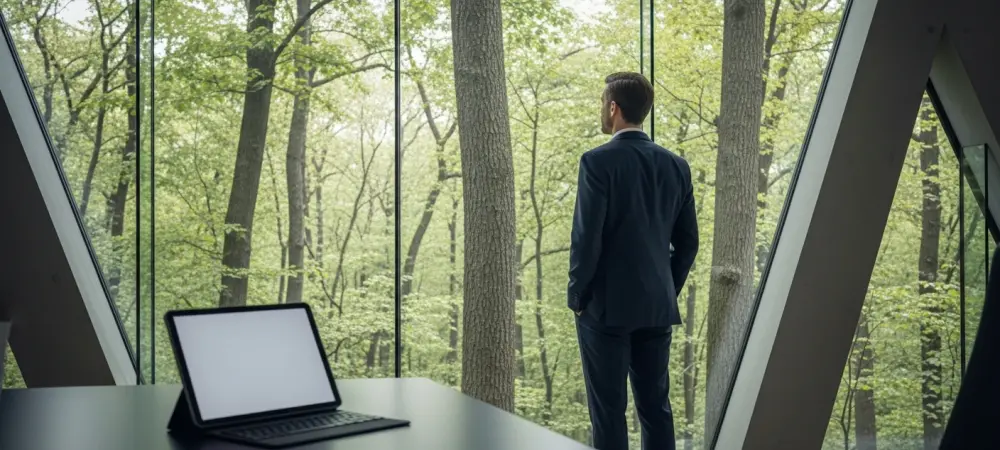
The relentless flicker of a high-definition screen often serves as the primary gateway to existence for the modern individual who spends more time navigating digital interfaces than breathing the crisp air of the unmediated world. In a landscape defined by hyper-connectivity, the average person currently dedicates upwards of 70 hours a week to staring into “the glass”—a term encompassing the smartphones, tablets, and laptops that act as ubiquitous intermediaries for every human interaction. While these sleek surfaces offer a window into an infinite reservoir of data and communication, they simultaneously construct a formidable barrier against the visceral, embodied experience of being truly alive. This shift has created a profound disconnect where convenience is prioritized over vitality, leading many to evaluate their personal sense of “aliveness” at a meager two or three on a ten-point scale.
This pervasive numbness serves as a silent byproduct of a world where human beings have increasingly become spectators rather than active participants in their own lives. When every need is met through a tap on a screen and every curiosity is satisfied by an algorithm, the raw friction of physical existence begins to dissipate. The loss of this friction results in a sanitized version of reality that lacks the depth and texture necessary for a robust sense of self. Consequently, the modern condition is often characterized by a strange paradox: the more connected individuals become to the digital network, the more detached they feel from their own physical presence and the immediate environment.
The Paradox of the Glass Barrier
The transition toward a fully mediated existence is not merely an individual choice but a systemic evolution driven by digital insulation. By the current midpoint of this decade, the virtualization of life through advanced platforms and high-fidelity simulations has begun to replace the “grittiness” of real-world interaction. This retreat from the physical realm is clearly visible in the changing habits of the younger population. For example, manual vehicles now account for less than 4% of car registrations in the United States, reflecting a broader trend where the mechanical and the manual are viewed as unnecessary burdens. Younger generations are increasingly hesitant to obtain driver’s licenses, preferring the insulated safety of ride-sharing apps or digital transit solutions over the responsibility of operating a machine. By removing the inherent friction from daily tasks, society is inadvertently fostering a culture of avoidance that stunts personal development. The lack of tactile engagement with the world lessens the opportunity for individuals to test their limits and develop practical competence. This digital insulation creates a “cushioned” life that, while comfortable, lacks the transformative power of challenge. When the primary mode of engagement is through a screen, the body and mind are deprived of the complex sensory inputs required to maintain a state of high vitality. This leads to a persistent reliance on artificial systems to navigate the complexities of life, further deepening the divide between the human spirit and the physical world.
From Physical Reality to Digital Simulation
The metaphor of facing a charging lion in the African bush provides a stark and necessary contrast to the curated safety of digital landscapes. In the wild, when a 250-pound predator charges at a speed of fifty miles per hour, the innate biological response is to flee in a state of panic. However, survival in such an extreme scenario requires the exact opposite: standing perfectly still and holding one’s ground. This “primordial rawness” demands a state of total presence and an instantaneous entry into a flow state, both of which are almost entirely absent from the modern, automated routine. Such encounters strip away the layers of digital mediation and force an immediate, visceral engagement with reality. Standing one’s ground in the face of such a threat reveals a psychological truth that transcends the savanncourage is not the absence of fear, but the willingness to engage with it directly. This level of presence is what executive coach David Gerber identifies as the ultimate antidote to the numbness of modern life. By intentionally reintroducing friction and significant challenges into a daily routine, an individual can break out of the “quantized” safety of automation. Reclaiming a sense of visceral reality requires a conscious rejection of the path of least resistance, favoring instead the difficult, the unpredictable, and the physically demanding.
Standing Your Ground: Lessons from the African Bush
The pursuit of a frictionless life, heavily powered by Artificial Intelligence that generates correspondence and manages complex schedules, often results in a state of “personal and professional drift.” This drift is characterized by a loss of agency and a lack of direction, as the individual becomes a passive recipient of automated suggestions. Psychologist Dr. Rhonda Boyd has noted that the decline in real-world engagement is closely linked to rising levels of anxiety and a pervasive fear of independence. When the external world is perceived as too difficult to navigate without digital assistance, the internal capacity for resilience begins to atrophy, leaving the person vulnerable to paralysis when faced with minor inconveniences.
This modern paralysis is eerily mirrored in the literary works of the past, such as T.S. Eliot’s “The Love Song of J. Alfred Prufrock.” The protagonist’s chronic fear of visceral engagement leads to a life defined by missed opportunities and deep regret, a sentiment that resonates with the screen-fatigued individual of today. In the age of AI, the “eternal Footman” is the glowing screen that observes our lack of engagement with a subtle snicker, reminding us that by offloading cognitive and physical struggles to machines, we risk losing the essential traits that define the human experience. The comfort of the simulation acts as a velvet trap, offering safety at the cost of the soul’s expansion.
The Psychological Cost of Perpetual Comfort
To transition away from a life lived on “cruise control,” individuals must prioritize the development of what is known as the “courage muscle.” This concept involves making a conscious effort to step out of the established comfort zone through deliberate shifts in behavior and decision-making. Individuals can begin this process by identifying specific areas where they have offloaded too much agency to automated systems. By intentionally reclaiming these tasks—whether they involve complex problem-solving or manual navigation—a healthy level of friction is reintroduced. This friction serves as the resistance necessary to build psychological and physical strength, ensuring that the individual remains an active agent in their own narrative. Reclaiming vitality also requires the courage to face the “lions” of difficult conversations, physical exertion, and intellectual uncertainty. Treating courage as a skill that requires daily exercise ensures that when the “bush” of life presents an inevitable obstacle, the individual possesses the inner strength to stand firm. Instead of retreating further into the safety of an algorithmically curated existence, the goal is to increase the level of presence in every moment. This active engagement with the world restores the “1-to-10 intensity” of life, moving the individual from a state of passive observation to one of vibrant, active participation in the physical world.
Strategies for Living with 1-to-10 Intensity
The path toward reclaiming human vitality was established through a series of intentional choices that prioritized the physical over the digital. Individuals sought out experiences that demanded total presence, effectively exercising the “courage muscle” until it became a reliable source of strength. This transition required a fundamental shift in how one interacted with technology, moving from a position of dependency to one of mindful utility. By choosing manual experiences and embracing the inherent risks of real-world interaction, society began to move away from the sterilized comfort of automated living. The “eternal Footman” of the screen was silenced by the roar of authentic human engagement and the reclamation of personal agency. Practical steps were taken to dismantle the glass barrier, such as setting rigorous boundaries on screen time and seeking out physical challenges that required immediate focus. These actions cultivated a state of primordial rawness that allowed people to feel truly alive once more. The anxiety of independence was replaced by the confidence of competence, as individuals learned that they could navigate the complexities of life without constant digital mediation. Ultimately, the focus shifted from optimizing for convenience to optimizing for intensity, ensuring that the human spirit remained resilient and vibrant. The journey back to vitality was defined by the courage to stand one’s ground against the encroaching silence of a life lived on autopilot.