

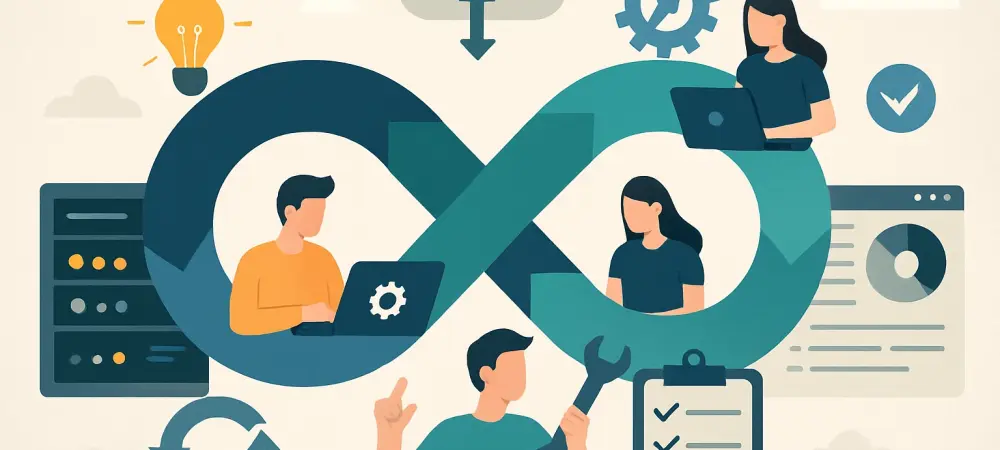
What happens when the promise of seamless teamwork in software development collides with the reality of clashing priorities and endless blame games? In an era where rapid software delivery is non-negotiable, DevOps was meant to unite development and operations teams, yet many organizations still struggle with fractured collaboration. A staggering 72% of IT leaders report persistent silos despite adopting DevOps practices, according to a recent industry survey. This gap raises a provocative question: could artificial intelligence be the missing piece to finally harmonize these critical teams?
Why DevOps Struggles to Unite Teams and How AI Might Help
The vision of DevOps has always been to create a shared purpose between developers, who push for innovation at breakneck speed, and operations staff, who safeguard system stability. However, this ideal often unravels under the weight of differing goals, leading to tension rather than teamwork. Miscommunication frequently results in delayed releases or system outages, with each side pointing fingers instead of solving problems together.
Cultural barriers are not the only hurdle; practical challenges like manual processes and inconsistent environments exacerbate the divide. As software systems grow more complex, the need for alignment becomes even more pressing. AI emerges as a potential solution by offering tools that can bridge these gaps through automation and insight, promising to transform discord into a unified effort.
The Core Disconnect in DevOps Culture and Practice
At its heart, DevOps aimed to dismantle the walls between teams by fostering empathy and joint accountability. Yet, in many cases, the focus has shifted to implementing tools like CI/CD pipelines without addressing the human element. This over-reliance on technology creates an illusion of progress while trust remains elusive, as developers and operators often work in isolation despite shared platforms.
Beyond tools, the clash of mindsets—speed versus reliability—fuels ongoing friction. A study by a prominent tech research group revealed that 65% of DevOps initiatives fail to improve team dynamics due to unresolved cultural conflicts. This persistent standoff highlights the urgency of finding new approaches to align priorities in a landscape where delays can cost millions.
AI as a Catalyst for Change in DevOps Workflows
Artificial intelligence steps in as a transformative force, not just by automating repetitive tasks but by redefining how teams interact. AI-driven platforms provide real-time dashboards that offer visibility into every stage of the software lifecycle, ensuring that both developers and operators see the same picture. This transparency helps eliminate misunderstandings that often lead to conflict.
Moreover, machine learning algorithms can predict system failures before they occur, allowing operations teams to move from constant crisis management to strategic planning. Tools that automate infrastructure setup through code further reduce manual errors, creating consistent environments that minimize disputes. Platforms like System Initiative exemplify this shift, using AI to enable collaborative spaces where knowledge is shared rather than hoarded. The impact of such technology is measurable. Organizations adopting AI for DevOps report a 40% reduction in deployment failures, according to recent data from a global IT consultancy. By smoothing out operational bottlenecks, AI paves the way for a partnership where innovation and stability coexist, proving that tech can reinforce human connection.
Insights from the Trenches on AI’s Role in Team Dynamics
Professionals on the front lines are beginning to see AI as more than a buzzword in the DevOps space. A survey conducted by a leading tech research firm found that 68% of IT executives view AI-driven automation as essential for achieving true collaboration within the next few years. This growing confidence reflects a shift in how technology is perceived—not as a replacement for people, but as an enabler of synergy.
A seasoned DevOps engineer shared a telling perspective: “Before predictive analytics, every outage was a blame fest. Now, with AI flagging risks early, both sides tackle issues as a unit.” Such firsthand accounts underscore the potential for AI to rebuild accountability. Case studies of companies using AI for monitoring and deployment further validate this trend, showing faster resolution times and improved morale across departments.
These voices from the field paint a picture of cautious optimism. While challenges remain, the consensus points toward AI as a tool that can mend fractured relationships by providing a common ground for decision-making. This shift in perception is crucial for organizations aiming to keep pace with relentless market demands.
Actionable Strategies to Embed AI in DevOps for Unity
For those ready to leverage AI in reshaping DevOps, several practical steps can set the foundation for stronger collaboration. Begin by integrating AI-powered monitoring tools that analyze system logs and forecast potential disruptions. Such solutions ensure that developers and operators operate from a unified set of insights, reducing the risk of misaligned efforts.
Another key move is to standardize processes with automation, particularly through infrastructure-as-code practices. This approach eliminates configuration discrepancies that often spark disputes, creating a reliable baseline for both teams. Additionally, joint training on AI tools can cultivate a collective mindset, emphasizing shared objectives over individual departmental goals.
Experimenting with innovative frameworks like Zero DevOps offers a bold path forward, where traditional roles blend into integrated units supported by automation. This model seeks to erase silos entirely, fostering an environment of mutual ownership. By adopting these strategies, organizations can harness technology to amplify teamwork, ensuring that AI serves as a bridge rather than a barrier.
Reflecting on a Path Forward for DevOps with AI
Looking back, the journey of DevOps revealed a stark contrast between its ambitious vision and the reality of fragmented teams. The persistent cultural and operational divides had hindered progress, leaving many initiatives stuck in a cycle of inefficiency. Yet, the emergence of AI had begun to shift this narrative, offering tools that not only streamlined workflows but also rebuilt trust through shared visibility.
The lessons from this evolution pointed toward actionable next steps. Organizations needed to prioritize investments in predictive analytics and standardized automation to prevent recurring conflicts. Equally important was the commitment to training programs that united teams under a common understanding of AI’s potential. By focusing on these areas, the DevOps community could continue to redefine collaboration, ensuring that technology and human effort worked hand in hand for superior software outcomes.