

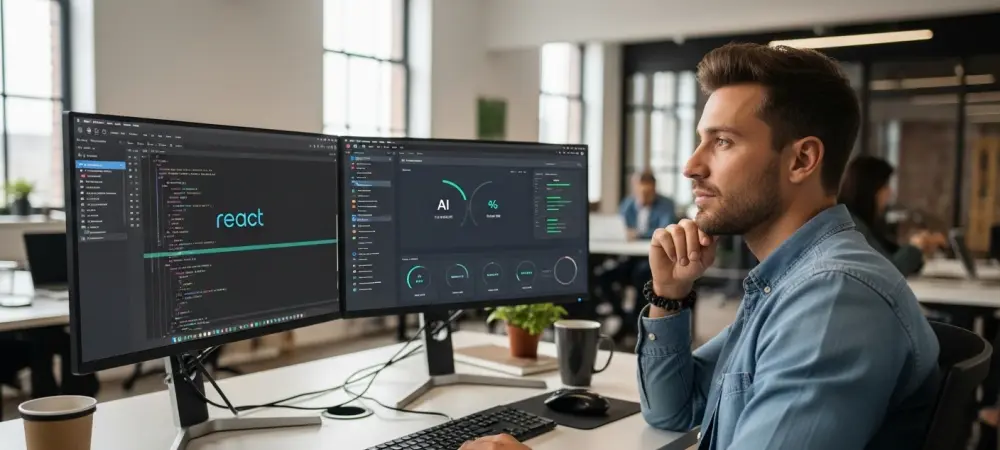
The traditional boundaries of software engineering are rapidly evaporating as the concept of vibe coding redefines what it means to build complex digital products in a landscape dominated by autonomous agents. This paradigm shift suggests that the historical barriers to entry in technical fields are dissolving, allowing individuals without formal computer science backgrounds to construct sophisticated prototypes while veteran engineers manage fleets of AI models to achieve outcomes that previously required an entire department. In this environment, the primary driver of success is no longer the ability to manually write every line of logic, but rather the capacity to direct a strategic ratio of effort: one percent human intuition paired with ninety-nine percent machine execution. The developer has evolved into a director or an orchestrator, responsible for identifying market gaps and guiding artificial intelligence toward a functional, high-quality solution that meets the demands of a modern audience. As the industry moves further into 2026, the focus is shifting away from syntax mastery toward the higher-level skill of articulating complex visions and organizing models to execute them with precision and scale.
The Evolution of Execution: From Manual Writing to Agent Orchestration
Software development has crossed a critical threshold where artificial intelligence has transitioned from a simple tool for code completion to an autonomous engine capable of professional-grade task execution. With the proliferation of advanced large language models and specialized development environments, AI can now undertake large-scale practical tasks that were previously far too complex for automated systems to manage. This marks a fundamental departure from the era of manual code authorship, moving instead toward a sophisticated orchestration of intelligent agents that can handle everything from architectural design to front-end implementation. For the modern builder, the day-to-day workflow no longer involves fighting with compiler errors for hours; instead, it centers on the high-level management of multiple AI workers that process instructions in parallel. This transition does not render the engineer obsolete but rather shifts their primary utility toward strategic oversight and the definition of architectural goals that the AI then carries out with mechanical efficiency.
Despite the immense power of these automated systems, a robust technical foundation remains a significant competitive advantage for those operating in an agent-heavy environment. Experienced engineers utilize their deep-seated knowledge to judge the quality of AI-generated code, identify subtle bugs that might escape a novice, and implement rigorous standards for system stability and concurrency. In this new era, the most critical skill set involves mastering the nuances of AI communication—the ability to express complex, multifaceted demands in a way that models can interpret without ambiguity. Success is determined by how well a human can organize a group of models to execute a specific vision while maintaining a coherent structure across the entire codebase. This requires a level of logic and systems thinking that transcends simple coding, turning the developer into a bridge between abstract human needs and the literal, data-driven execution of the machine.
Market-Driven Development: Solving Human Problems Instead of Technical Ones
A persistent challenge within the traditional programming community has been the tendency for developers to build tools specifically for other technical users, a habit that often restricts the commercial potential of their creations. Because software engineers are natural problem-solvers, they frequently gravitate toward creating scripts, plugins, or developer tools that address niche technical hurdles they encounter in their own work. However, the market for such products is often quite small because other developers frequently prefer to build their own custom solutions rather than paying for a third-party service. This cycle often leads to a surplus of technical utilities that lack a broad user base, regardless of how well-engineered they may be. To achieve significant impact, builders must look beyond the confines of the development environment and identify pain points that affect the general population in their daily lives.
In contrast, those who focus on solving everyday problems are far more likely to create products with mass-market appeal and sustainable business models. Genuine demand often emerges from an earnest attempt to simplify personal inconveniences in areas such as travel logistics, home cooking, or workplace productivity. Identifying a authentic pain point, such as a specialized tool that automates complex video production tasks for non-experts, can validate a product idea much faster than traditional market research ever could. By leveraging multi-agent workflows to handle the heavy lifting of development, an individual can focus their energy on observing human behavior and identifying where technology can provide the most relief. This shift toward life-centric insights allows for the creation of software that serves a purpose for the average consumer, transforming a technical project into a viable commercial product that solves real-world issues.
The Rapid Validation Model: Balancing Speed and Production Stability
The modern development framework favors a progressive, two-phased model over the rigid, top-down design processes of the past. The first phase centers on the creation of a one-week Minimum Viable Product, often referred to as a 59-point version, where the primary objective is validation rather than perfection. During this initial week, the goal is to produce a functional prototype that is just stable enough to prove the core concept and elicit immediate feedback from potential users. Speed is prioritized above all else, including long-term architectural purity or perfect code documentation, as the builder seeks to determine if the product actually resonates with the intended audience. By using fast feedback loops and AI-driven debugging, the developer can iterate rapidly, treating the accumulation of technical debt as an acceptable trade-off for the invaluable data gained through early user interaction.
Once a specific demand has been verified through the initial prototype, the developer transitions into a one-month stability phase to transform the experimental tool into a production-grade application. This secondary stage involves adding essential features for high concurrency, implementing rigorous automated testing suites, and refining the user interface to ensure a professional experience. The shift in focus allows the builder to address the technical debt accrued during the first week while building a foundation that can support a growing user base. By the end of this thirty-day cycle, the project matures from a rough concept into a stable, commercial-ready application that is prepared for public launch. This phased approach minimizes the risk of wasting months on a product that no one wants, ensuring that deep engineering effort is only applied to ideas that have already demonstrated clear market potential.
Strategic Stack Selection: Leveraging AI Knowledge for Faster Delivery
For independent builders and small teams, the return on investment for learning a dynamic new framework for every new project is often quite low. The most efficient strategy in the current era is to stick to a familiar and widely used technology stack that AI models understand and handle with exceptional accuracy. Utilizing popular and well-documented frameworks like React for front-end development and Python for back-end logic ensures that the AI can provide more reliable code with fewer errors during the generation process. When a developer uses a mainstream stack, the underlying models have a massive corpus of training data to draw from, which significantly reduces the likelihood of hallucinations or logical inconsistencies. This allows the human orchestrator to focus on the unique business logic of their application rather than troubleshooting the quirks of an obscure or experimental programming language. Instead of building every component from the ground up, efficient developers prioritize the adaptation of existing open-source architectures found on platforms like GitHub. By using AI to search for, analyze, and integrate proven solutions, builders can leverage the collective intelligence of the global engineering community to solve common problems. This approach allows them to focus their limited time on the unique features that differentiate their product while maintaining a maintainable and stable foundation. The goal is to create a synergy between the human’s strategic direction, the AI’s vast knowledge of existing code, and the stability of established frameworks. This combination results in a development velocity that was unthinkable just a few years ago, enabling a single person to manage complex deployments that would have previously required a team of specialized engineers.
Architecture for Intelligence: Managing Context in Multi-Agent Workflows
As AI models become increasingly specialized, the most efficient development workflows involve using multiple agents simultaneously to handle different aspects of a single project. The developer’s role is to assign specific tasks to the most appropriate agent, effectively creating a virtual team of specialists that works around the clock to move the project forward. However, the primary bottleneck in this multi-agent environment is not the raw intelligence of the individual models, but rather the flow of information across the system. This information, often referred to as context, is the lifeblood of the development process, and its mismanagement can lead to project-wide failures or inconsistent logic.
When a task moves from one agent to another, the secondary agent must have a perfect understanding of the project’s history, its current state, and its ultimate goals. Without proper management, agents can become overwhelmed by irrelevant data or fail to prioritize the most important rules, a phenomenon known as context rot. To combat these issues, builders utilize centralized documentation and shared memory systems to synchronize state across different AI sessions. By documenting architectural decisions, recurring logic, and specific goals in a persistent format, they ensure that every agent in the workflow remains aligned with the overall vision. This process of skill precipitation allows future agents to call upon specific logic or patterns without having to reinvent the solution from scratch, creating a compounding effect where the system becomes more efficient the longer the project continues.
The Organizational Paradigm: Operating as a Comprehensive Solo Team
The rise of multi-agent workflows is creating a new organizational paradigm where a single individual can operate with the efficiency and output of a full-scale development department. New unified workstations are emerging to streamline this workflow, allowing a solo builder to manage the entire lifecycle of development, cloud operations, and product promotion from a single integrated interface. In this structure, the individual acts as the CEO, CTO, and lead designer simultaneously, using AI to fill the roles of junior developers, QA testers, and DevOps engineers. This level of autonomy grants the builder unprecedented control over the final product while drastically lowering the overhead costs of software creation.
This shift does not make deep technical expertise obsolete, but it does fundamentally change the requirements for achieving success in the software industry. The dividing line between winners and losers is moving toward the ability to gain demand insight and the competence to communicate that insight to a machine. The ability to write code is becoming a universal basic capability, meaning that the true value of a developer is now found in their unique human perspective and the strategy they use to guide the intelligence at their fingertips. As more people gain access to these powerful tools, the market will increasingly reward those who can identify meaningful problems and orchestrate the right agents to solve them. The solo-team model represents the ultimate democratization of technology, where the constraints of headcount and capital are replaced by the limits of an individual’s imagination and their ability to manage complex information flows.
Sustainable Implementation: Transitioning Into an Orchestration-Centric Workflow
The transition toward multi-agent workflows necessitated a complete reimagining of how software projects were structured and executed. Success in this new environment required a departure from the rigid, long-term planning cycles that defined the previous decade, favoring instead a highly adaptable and modular approach. Builders who thrived were those who focused on creating clear, persistent documentation that served as a single source of truth for their AI agents, ensuring that the project’s core logic remained consistent even as models were swapped or updated. By treating every interaction with an agent as a strategic assignment rather than a simple request, developers were able to maintain a high level of quality control over their codebases. This disciplined approach to orchestration allowed individuals to scale their operations without the traditional risks of technical sprawl or communication breakdowns between human team members.
Ultimately, the move to an AI-driven development cycle proved that the most powerful tool a developer possessed was no longer their keyboard, but their ability to orchestrate the vast intelligence available to them. Individuals who prioritized speed, managed context with meticulous care, and focused on real-world utility successfully moved from initial ideas to live, paying products in remarkably short timeframes. This evolution established a new standard where the human provided the creative soul and strategic direction, while the AI provided the tireless labor and technical execution. The era of the solo-team builder arrived, proving that with the right orchestration strategy, the potential for innovation was no longer limited by the size of one’s staff, but by the clarity of one’s vision.