

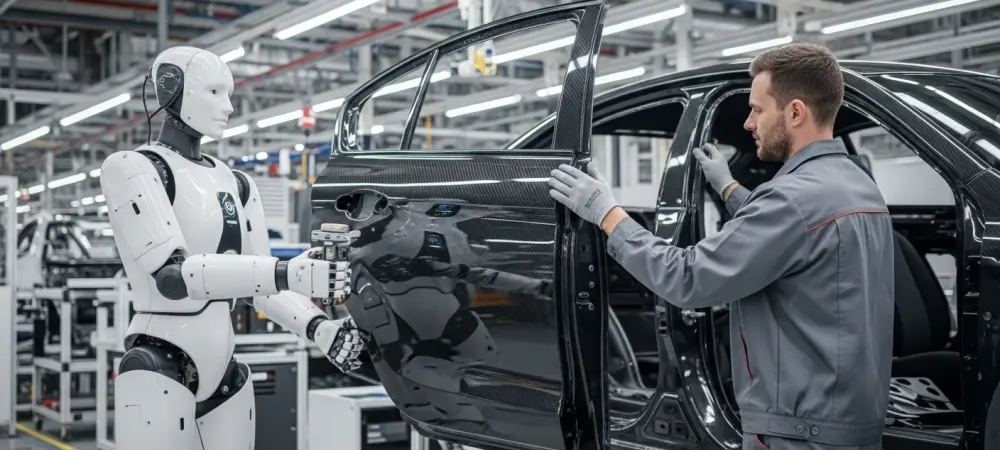
The industrial landscape is undergoing a radical transformation as the traditional image of a factory—defined by massive, fixed robotic arms shielded behind yellow safety cages—begins to fade into history. Today, the most advanced automotive assembly lines are witnessing the arrival of bipedal and wheeled humanoid machines that navigate open floors with the same fluidity as their human colleagues. These sophisticated entities represent a departure from rigid automation, signaling the rise of physical artificial intelligence capable of performing complex, multi-stage assemblies in environments once deemed too unpredictable for non-human workers.
This shift is not merely an aesthetic upgrade but a strategic response to the increasing complexity of vehicle production. Modern cars, particularly electric models, require a level of dexterity and spatial awareness that standard industrial robots simply cannot provide. As the global labor market faces a shortage of workers willing to endure physically taxing roles, automakers are turning to humanoids to bridge the gap. These machines offer the unique advantage of being able to operate within existing factory layouts designed for people, eliminating the need for expensive and time-consuming structural overhauls.
The End of the Robotic Arm Era
For decades, the automotive industry relied on stationary robots to perform high-speed welding and painting. However, these machines are essentially blind and immobile, limited to the repetitive tasks programmed into their logic. The new generation of humanoid assistants breaks these chains by utilizing advanced sensors and machine learning to understand their surroundings. This allows them to move between different workstations, adapting to changes in the production flow rather than waiting for components to come to them in a fixed position.
Furthermore, the transition toward human-centric robotics reflects a move toward versatile manufacturing. Instead of having a single-purpose machine for every task, a humanoid can be programmed to install a dashboard in the morning and sort battery cells in the afternoon. This flexibility is essential for a market that demands rapid customization and shorter production cycles. By integrating these mobile units, manufacturers are creating a more resilient supply chain that can pivot to new designs without replacing the entire hardware fleet.
Why the Automotive Industry Is Betting on Humanoids
Automakers are currently grappling with the intricate demands of high-voltage battery assembly and the installation of delicate interior electronics. These tasks require a “soft touch” and high precision that bulky, hydraulic arms often lack. Humanoid robots, equipped with multi-fingered grippers and force-feedback sensors, can handle fragile components without causing damage. This capability is vital for ensuring the long-term reliability of electric vehicles, where a single misplaced connector can lead to significant safety risks or performance failures.
Beyond technical precision, the economic argument for humanoids is becoming undeniable. The cost of human labor for high-stamina, ergonomic-heavy tasks continues to rise, while the cost of AI-driven hardware is steadily decreasing. By deploying robots that can work ten-hour shifts without fatigue, companies can maintain a consistent production tempo while reducing the frequency of workplace injuries. This transition allows the automotive sector to remain competitive in a global market where efficiency and speed-to-market are the primary drivers of success.
From Pilot Programs to High-Volume Production Lines
The journey from experimental prototypes to active participants in car production has been remarkably swift. In Germany, BMW has successfully integrated the “Aeon” robot at its Leipzig facility, marking a major milestone in European manufacturing. This robot, which features a mobile wheeled base and a human-like torso, is currently responsible for assembling high-voltage batteries. This move followed extensive trials in the United States, where similar machines proved they could handle the rigors of a full-scale production environment while assisting in the creation of tens of thousands of vehicles.
Meanwhile, in Asia, Xiaomi has pushed the boundaries of autonomous assembly at its Beijing plant. Their proprietary robots have demonstrated a 90% success rate in high-precision assignments, such as fastening floor nuts and managing protective films on the SU7 Ultra line. Xiaomi’s strategy is aggressive, focusing on a massive rollout over the next five years to achieve a state of “intelligent manufacturing.” This approach treats the factory floor as a living ecosystem where AI is deeply embedded in every physical movement, rather than being an external tool.
Industry Perspectives on the Human-Machine Symbiosis
Engineers and factory managers view this technological leap as a partnership rather than a replacement strategy. The consensus within the industry is that robots are most effective when they take over the “dull, dirty, and dangerous” jobs that lead to high turnover among human staff. By delegating these repetitive or hazardous duties to synthetic assistants, the human workforce can be elevated to roles involving quality oversight, creative problem-solving, and complex technical maintenance. This synergy ensures that the human element remains central to the final touch of a luxury vehicle.
Moreover, this symbiotic relationship is fostering a new era of workplace safety. Robots equipped with advanced collision-detection systems can work side-by-side with people without the need for physical barriers. This allows for a collaborative environment where a human worker might handle the final inspection while a humanoid robot holds a heavy door or aligns a battery pack. This fluid interaction is redefining the modern factory as a space where biological intelligence and artificial precision complement each other to achieve higher standards of quality.
A Framework for Integrating Humanoids in Modern Factories
Successfully incorporating humanoid technology requires a phased strategy that begins with identifying the most significant ergonomic pain points. Manufacturers should look for tasks where human error is high due to fatigue, such as under-chassis fastening or the placement of heavy battery modules. By prioritizing these areas, companies can achieve an immediate return on investment and demonstrate the practical value of AI to their stakeholders. Starting with smaller, high-impact tasks allows for the fine-tuning of the software before scaling up to broader applications. The next step involves moving away from stationary cells in favor of mobile, multi-functional platforms. Leveraging the mobility of bipedal or wheeled robots allows a factory to be more dynamic; machines can be relocated to different parts of the assembly line as bottlenecks emerge. Finally, establishing clear metrics for success—such as “first-pass yield” and autonomous up-time—is crucial for refining the AI’s performance. By following this structured path, the automotive industry set the stage for a future where the line between human effort and robotic assistance is both seamless and highly productive.