

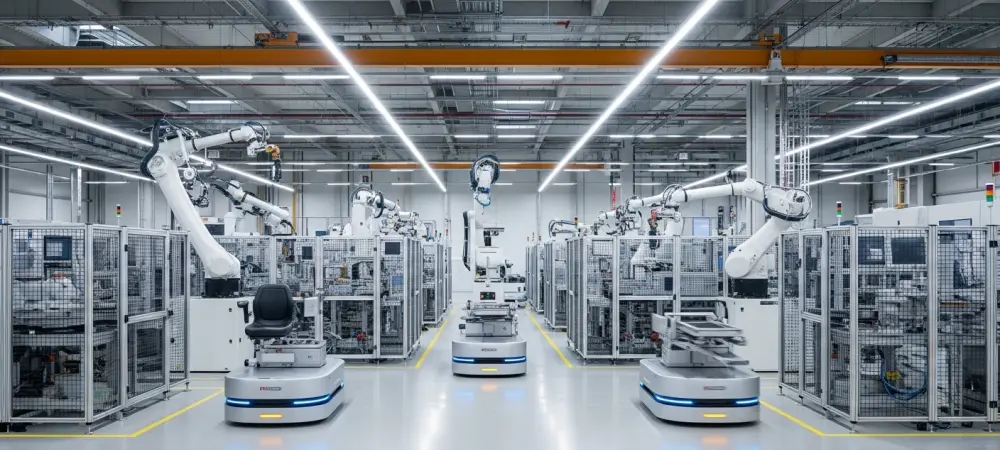
Industrial machinery no longer waits for a human to diagnose a failing bearing or recalibrate a drifting sensor because the systems themselves have developed the capacity to anticipate and rectify these issues before they manifest as downtime. This shift away from rigid, pre-programmed scripts represents a fundamental evolution in how the industrial world operates. Organizations are now seeing equipment downtime slashed by 27% through the implementation of systems that think, learn, and act with a level of independence once reserved for science fiction. This transition marks the definitive end of siloed operations and the arrival of a unified, intelligent ecosystem where software acts as an anticipatory partner rather than a passive tool.
The industrial landscape has moved beyond the era of fragile automation, where a single unexpected variable could bring an entire production line to a halt. In its place, a sophisticated network of autonomous intelligence has emerged, capable of managing complexity at scale. This new reality is not merely about doing things faster; it is about the fundamental redesign of workflows to ensure that every piece of data contributes to a self-improving cycle. As these systems continue to mature, the distinction between manual oversight and automated execution continues to blur, creating a seamless stream of productivity.
The Shift from Scripted Tasks to Autonomous Intelligence
The reliance on rigid, pre-programmed bots has faded into the past as organizations embrace systems that possess the cognitive flexibility to handle real-world variability. In the current industrial environment, automation is no longer synonymous with a fixed set of instructions that must be manually updated whenever a process changes. Instead, the focus has shifted toward intelligence that can adapt to fluctuating market demands and supply chain disruptions in real time. This change allows for a more resilient operational posture, where the software itself identifies bottlenecks and suggests optimizations without requiring a team of engineers to rewrite code.
By integrating advanced neural networks and deep learning protocols, modern facilities have achieved a level of synchronization that was previously unattainable. The move toward autonomous intelligence means that the software does not just follow a path; it understands the objective and finds the most efficient route to achieve it. This has resulted in a significant reduction in waste and an increase in throughput, as systems are now capable of making micro-adjustments to machinery settings that a human operator might overlook. The end result is an industrial ecosystem that is inherently more stable and responsive to the needs of a global economy.
Why the 2026 Paradigm Shift Is Non-Negotiable
The convergence of Operational Technology (OT) and Information Technology (IT) has transitioned from a strategic objective to an absolute requirement for survival in the modern marketplace. Industrial sectors are currently navigating a high-pressure environment characterized by persistent labor shortages and an unprecedented level of technical complexity. To remain viable, companies have been forced to abandon local, isolated optimizations in favor of a cohesive feedback loop that synchronizes end-to-end business and manufacturing workflows. This level of integration provides the extreme agility needed to pivot operations in response to sudden shifts in global trade or consumer behavior.
Furthermore, the demand for total visibility across the enterprise has made legacy, disconnected systems a liability. In an age where every second of inefficiency translates into a competitive disadvantage, the ability to view real-time data from the factory floor alongside financial metrics is indispensable. This holistic approach ensures that every operational decision is backed by comprehensive data, reducing the risk of costly errors. As a result, the move toward a unified digital infrastructure is no longer seen as a luxury but as the foundational layer upon which all modern industrial success is built.
The Four Pillars of the Intelligent Industrial Ecosystem
Modern automation is founded upon the principle of hyper-automation, a concept that merges AI, machine learning, and robotic process automation into a singular, high-functioning platform. This integration allows for global visibility across an entire enterprise, breaking down the barriers that once separated different departments. At the center of this movement is “Agentic AI,” which consists of autonomous agents capable of managing complex industrial tasks without constant human intervention. These agents handle everything from real-time predictive analytics to dynamic alarm management, ensuring that the system remains within optimal parameters at all times.
The transition toward an “AI-first” philosophy has also redefined the goals of digital transformation. Rather than simply automating existing manual tasks, organizations are now building infrastructure that is inherently self-healing and capable of autonomous maintenance. This includes the ability for systems to identify security vulnerabilities and apply patches or restart failing services without human prompts. Complementing this is the democratization of development through low-code tools, which allows employees across various departments to contribute to the automation roadmap. Finally, the use of digital twins provides a virtual environment where leaders simulate “what-if” scenarios to ensure that sustainability and profit targets are met simultaneously.
Expert Insights into the Renaissance of Process Automation
The fundamental change in operational philosophy is supported by extensive research and the observations of industry leaders. Gartner has highlighted that a vast majority of new digital initiatives are now driven by low-code and no-code platforms, effectively shifting the power of innovation from specialized IT departments to the broader workforce. This democratization means that professionals in HR, finance, and operations are now active participants in the digital evolution of their companies. By leveraging cloud-native tools and unified operations centers, firms have successfully reduced their Mean Time to Repair (MTTR) and realized total cost savings between 10% and 30%.
These expert projections indicate a clear trend where the most successful organizations are those that treat AI as a strategic decision-maker. Data from various implementations shows that when AI is allowed to manage routine complexities, human talent is freed to focus on higher-level strategy and creative problem-solving. This shift has led to a renaissance in how work is defined, with a greater emphasis on the collaboration between human intuition and machine precision. The evidence suggests that the integration of these technologies is the primary driver behind the current surge in industrial productivity and operational resilience.
Strategic Framework for Implementing 2026-Ready Automation
The transition toward this self-optimizing system required a shift in how data flowed across the enterprise. Leaders who dismantled the traditional silos between departments allowed for a holistic flow of information that aligned technical operations with business objectives. Companies successfully deployed low-code platforms to bridge the talent gap, which empowered the workforce to build their own solutions. The implementation of predictive process intelligence and digital twins moved maintenance from a reactive chore to a model of proactive resilience. This strategic framework ensured that by the time the current standard was established, organizations operated within a system that balanced operational excellence with energy efficiency.
The integration of these advanced tools also fostered a culture of continuous improvement that permeated every level of the organization. Managers utilized the insights gained from real-time analytics to make more informed decisions regarding resource allocation and production scheduling. By prioritizing the synchronization of IT and OT, firms created a robust foundation that supported long-term growth and environmental stewardship. The successful adoption of this framework demonstrated that the key to modern competitiveness lay in the ability to harmonize human expertise with autonomous technology. This comprehensive approach effectively transformed the industrial landscape into a more agile, sustainable, and profitable environment.