

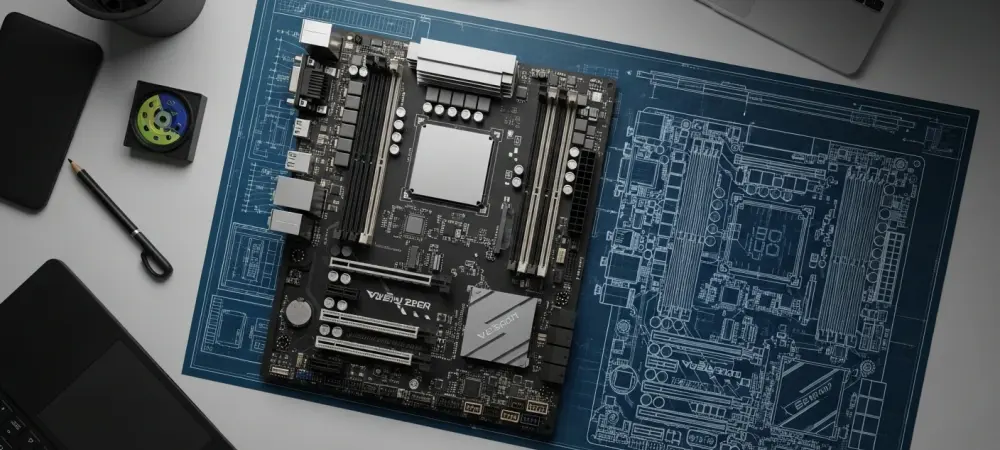
A Modern Take on a Classic Era
While many enthusiasts lovingly restore vintage hardware, one Polish hobbyist named Piotr “maniek86” Grzesik embarked on a far more ambitious journey: to design and build a 486-style motherboard entirely from scratch. This endeavor stands as a remarkable achievement within the burgeoning retro computing community, representing a powerful synthesis of deep-seated nostalgia and contemporary engineering prowess that bridges decades of technological evolution. Grzesik’s project transcends simple restoration by deconstructing the fundamental principles of a bygone computing era and rebuilding them with modern tools. It is an act of preservation through recreation, offering a tangible connection to the foundational architecture that powered the personal computing revolution. For a community dedicated to keeping technological history alive, this work serves as both an inspiration and a practical demonstration of what is possible when passion meets technical skill.
The M8SBC-486: More Than Just a Replica
The resulting creation, dubbed the M8SBC-486, was conceived not as a perfect commercial clone but as a homebrew experimental platform. Its primary purpose was to serve as a hands-on educational tool, allowing Grzesik to deeply explore and learn from the intricacies of legacy x86 architecture. This goal shaped every design decision, prioritizing function and discovery over flawless compatibility.
By defining the project as an experimental venture, Grzesik freed himself from the constraints of creating a mass-market replica. Instead, the M8SBC-486 became a personal testament to the spirit of early PC builders, where innovation often stemmed from curiosity and a willingness to push boundaries. This approach makes the motherboard a unique piece of hardware that tells a story of learning and creative problem-solving.
Inside the Build: Key Features and Milestones
The project’s success is measured by its impressive fusion of custom-designed hardware and its ability to run iconic legacy software, bringing the digital world of the early 1990s to life on a modern circuit board.
The “Hamster 1” FPGA Core
At the heart of the M8SBC-486 is not a salvaged Intel processor but a custom chipset codenamed “Hamster 1,” ingeniously implemented on a Xilinx Spartan-II FPGA. This field-programmable gate array is the central nervous system of the board, responsible for emulating the complex logic of a 486-class processor and its supporting components. Operating with a 24 MHz front-side bus, the FPGA core can achieve a clock speed of up to 48 MHz in a DX2 configuration, placing its performance squarely within the 486 era. This clever use of a modern programmable chip to replicate vintage silicon is a hallmark of the project, demonstrating a sophisticated approach to retro engineering.
Core System Specifications
The motherboard is outfitted with 4MB of SRAM, providing sufficient memory for the operating systems and applications of the time. This choice reflects a balance between period authenticity and practical usability, ensuring the system has the resources needed to perform meaningful tasks. Further enhancing its functionality are two 16-bit ISA slots, a critical feature for expansion in the 486 era. These slots open the door for adding peripherals like video cards and network adapters, transforming the M8SBC-486 from a standalone board into the foundation of a configurable and expandable retro computer.
Software and Gaming Success
A key milestone for the project was its successful boot of several classic operating systems, including MS-DOS 6.22, FreeDOS, and a custom-tailored Linux kernel. This software compatibility validates the hardware design and proves the M8SBC-486 is a genuinely functional computing platform.
The ultimate benchmark for any retro build, however, is its gaming capability. The M8SBC-486 passed this test with flying colors, running iconic titles like FastDoom, Wolfenstein 3D, and Prince of Persia. Its ability to also handle demoscene productions from the era further cements its status as a successful and capable homage to 90s computing.
The Charm of Imperfection: Navigating Design Limitations
What makes the M8SBC-486 particularly compelling is its experimental nature, which Grzesik openly embraces. The board’s limitations are not failures but rather defining characteristics that reflect its primary goal as a learning platform. Key design omissions, such as the absence of a secondary programmable interrupt controller (PIC) and DMA support, were conscious choices that simplified the complex build process.
These trade-offs, however, have practical consequences. The lack of essential legacy components renders the board incompatible with classic ISA sound cards, a notable omission for a gaming-capable machine. Furthermore, while the system can run Windows 3.1 in an unstable state, it is unable to complete the installation of Windows 95, highlighting the immense challenge of achieving full compatibility with more complex operating systems.
Current Status and Community Contribution
Having achieved his initial goals of running Linux and Doom, Grzesik considers the project a successful proof of concept. He has expressed satisfaction with the M8SBC-486’s performance as an educational tool and an experimental platform, underscoring that it was never intended to be a finished, polished product.
Instead of pursuing further refinements himself, Grzesik has positioned his work as an open foundation for the wider retro computing community. By sharing his designs and experiences, he encourages other enthusiasts to build upon his efforts, potentially leading to more robust and feature-complete homebrew systems in the future.
Reflection and Broader Impacts
The M8SBC-486 is more than just a functional piece of hardware; it is a source of inspiration and a valuable contribution to the collective knowledge of the hobbyist community, helping to preserve critical aspects of technological history.
Reflection on the Achievement
Grzesik’s project stands as a remarkable feat of reverse engineering and digital design. Its strength lies in its successful implementation of a complex CPU architecture on an FPGA, making it an invaluable educational resource. While its practical limitations prevent it from being a perfect replacement for original hardware, its value as an engineering accomplishment is undeniable.
Broader Impact on Retro Computing
Projects like the M8SBC-486 are vital for the health of the retro computing scene. They inspire innovation by showing what can be accomplished with modern tools and a deep understanding of historical systems. Moreover, they empower a new generation of hardware enthusiasts to move beyond collecting and repairing, encouraging them to create and contribute to the ongoing story of personal computing.
A Blueprint for the Future of Retro Hardware
The M8SBC-486 project ultimately succeeded in its mission to explore and demystify the 486 architecture. Its significance lies not in its ability to perfectly replicate the past, but in its role as an experimental platform that makes complex, legacy technology accessible to modern hobbyists. Through ambitious homebrew creations like this, the spirit of early PC engineering was kept alive, ensuring that its foundational lessons remain available for future generations to discover and build upon.