

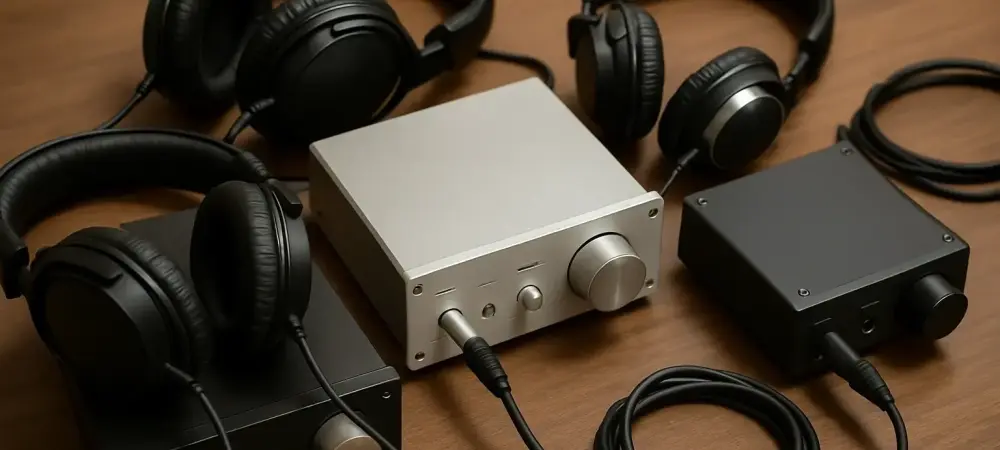
In the realm of personal audio technology, advancements continue to transform how music is experienced. An intriguing development is the rise of headphone amplifiers, designed to elevate audio quality for the discerning listener. Companies like Campfire Audio and Pro-Ject have recently introduced innovative products aimed at enhancing sound clarity and performance for wired headphones and earbuds. These amplifiers, catering to both portable and desktop settings, not only improve audio fidelity but also redefine technological expectations in personal listening devices.
In-depth Analysis of Features and Performance
The Campfire Audio Relay stands out as a portable digital-to-analog converter (DAC) and amplifier, made for USB-C devices such as smartphones and laptops. Engineered with an AKM 4493 SEQ DAC chip, it provides an analog sound profile that resonates well with high-resolution PCM and DSD playback. Noteworthy is its ability to modify gain and switch filter modes, with balanced 4.4mm and 3.5mm outputs, allowing for customization. Although priced at $299/£229, its performance is characterized by exceptional sound quality, positioning it as a premium yet accessible device for audiophiles seeking rich auditory experiences on-the-go.
On the other hand, Pro-Ject’s Head Box E offers a distinctive desktop alternative with its compact design and affordable price point of approximately $120/£89. Unlike integrated chipsets, it utilizes discrete components to deliver 665 milliwatts of power into 32 ohms, ensuring superior audio output to conventional stereo amp stages. The dual headphone outputs—6.3mm and 3.5mm—enable simultaneous listening sessions, while the RCA connections allow integration with hi-fi systems. Despite its simplicity, the Head Box E underscores a commitment to delivering high-quality sound without burdening the listener’s budget, making it an appealing choice for home audio setups.
Conclusion and Verdict
By 2025, headphone amplifiers have substantially improved personal audio experiences, with Campfire Audio and Pro-Ject setting significant benchmarks. The Campfire Audio Relay catered to a market seeking portable yet robust sound amplification, while the Pro-Ject Head Box E emphasized affordability and home audio solutions. These products expanded the quality capabilities for wired headphone users, ensuring that high-fidelity sound became a common standard instead of a luxury. Future iterations are likely to continue this trajectory, focusing on integrating even more advanced features and enhancing accessibility across diverse user demographics.