

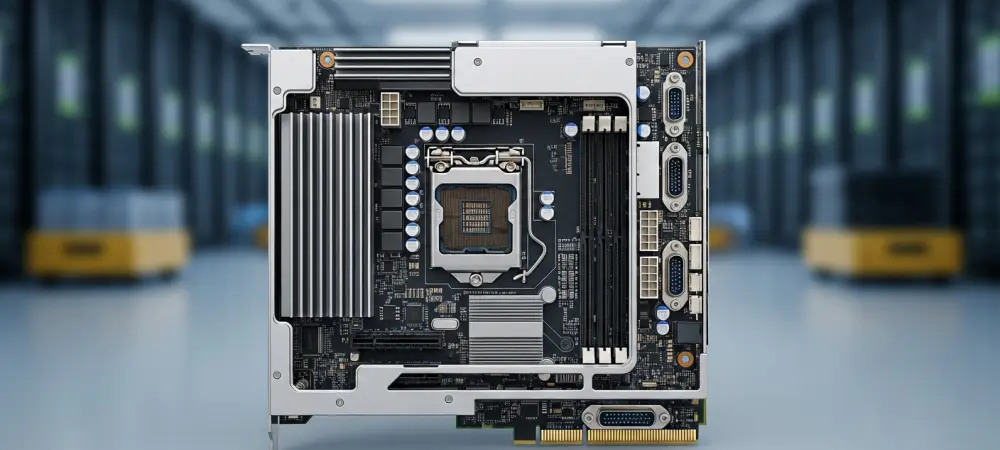
The digital nervous system of the modern smart factory is no longer found in centralized data centers but resides within the ruggedized circuitry of industrial motherboards that power everything from robotic arms to precision medical scanners. This fundamental shift marks a transition for these specialized circuit boards, elevating them from niche hardware components to essential pillars of the global industrial economy. As high-tech environments become more complex, the demand for localized processing power has skyrocketed, creating a landscape where reliability and data integrity are the highest priorities for engineers. The ongoing digitization of manufacturing and infrastructure is driving a massive wave of hardware upgrades, as legacy systems prove insufficient for the high-speed requirements of modern automated networks. Companies are increasingly moving away from simple computation and toward platforms capable of complex, real-time data analysis directly at the source of collection. This evolution is not merely about raw speed; it is about providing the physical infrastructure necessary to support a world where autonomous systems must make split-second decisions without relying on distant cloud servers. Consequently, the industrial motherboard has become a critical strategic asset for any organization seeking to maintain a competitive edge in a rapidly evolving technological environment.
Economic Trajectory: Projected Growth and Hardware Reliability
Market analysts have identified a consistent upward trend for the industrial motherboard sector, projecting a steady compound annual growth rate of nearly six percent through 2035. This sustained expansion is rooted in the indispensable nature of these components across a wide variety of essential industries, including healthcare, defense, and energy management. By the middle of the next decade, the market is expected to reach a valuation that far exceeds current levels, driven by the replacement of aging infrastructure and the birth of entirely new automated sectors. Unlike the consumer electronics market, which often experiences volatile cycles based on fashion or minor feature updates, the industrial segment thrives on the necessity of operational continuity. The growth is particularly visible in emerging economies where new smart factories are being built from the ground up, as well as in established markets where existing facilities are undergoing comprehensive digital overhauls to keep pace with global efficiency standards. The primary differentiator for this market remains the extraordinary durability and longevity required of the hardware, which must often function for over a decade in harsh conditions. Industrial motherboards are engineered to withstand persistent mechanical vibrations, significant electromagnetic interference, and extreme thermal fluctuations that would cause a standard consumer PC to fail within days. This requirement for long-term stability creates a unique economic dynamic where customers value availability and consistent performance over low initial purchase prices. Because these boards are integrated into multi-million dollar pieces of equipment like MRI machines or automated assembly lines, the cost of failure is prohibitively high. This necessitates a supply chain that can guarantee the availability of identical replacement parts for many years, a service that provides a stable and predictable revenue stream for manufacturers. This focus on reliability ensures that the market remains resilient even during broader economic shifts, as the maintenance of critical infrastructure cannot be deferred indefinitely.
Technological Catalysts: The Rise of Industry 4.0 and Edge Intelligence
The rapid adoption of Industry 4.0 principles serves as a primary engine for the expansion of the industrial computing market, as modern production facilities require unprecedented levels of local processing power. To manage the complexities of digital twins, where a virtual model is synchronized with physical machinery, the underlying hardware must handle massive data streams with minimal latency. This trend has moved computational tasks from the cloud back to the factory floor, where industrial motherboards serve as the primary processing hubs for autonomous mobile robots and high-speed sensor networks. This shift represents a fundamental change in how industrial data is managed, moving from a model of simple logging to one of active, real-time control that requires sophisticated onboard logic and high-performance central processing units. As communication protocols like Time-Sensitive Networking become standard, the need for boards with specialized networking controllers and high-bandwidth interfaces continues to grow. Edge Artificial Intelligence has emerged as another transformative force, allowing for complex decision-making processes to occur exactly where data is gathered. By integrating AI acceleration directly onto the motherboard through specialized graphics processing units or dedicated neural processing units, companies can perform tasks like visual quality control and predictive maintenance without the delays associated with remote servers. This localized approach significantly enhances security by keeping sensitive operational data within the local network, a factor that is increasingly important for government and defense contractors. The demand for boards equipped with high-performance expansion slots and robust power delivery systems has risen accordingly, as these features are necessary to support the high-wattage components required for modern machine learning applications. This technological convergence is forcing manufacturers to innovate rapidly, creating a new class of “intelligent” motherboards that are far more capable than their predecessors from just a few years ago. The expansion of the Industrial Internet of Things is also influencing the physical design of hardware, as engineers increasingly demand smaller and more efficient board architectures. In many industrial environments, such as narrow control cabinets or mobile equipment, space is at a premium, leading to the widespread adoption of compact form factors like Mini-ITX and various Computer-on-Module designs. These smaller boards do not sacrifice performance for their size; instead, they utilize high-density integration to provide a full suite of industrial-grade features in a fraction of the space. This trend toward miniaturization has allowed for the deployment of powerful computing nodes in locations that were previously inaccessible, such as remote pipeline monitoring stations or underwater sensors. As more organizations look to distribute intelligence throughout their entire operations, the shipment volume for these specialized, space-constrained boards is expected to represent an increasingly large portion of the overall market.
Design Innovations: Modular Architectures and Advanced Thermal Engineering
A significant shift in product design is currently taking place through the widespread implementation of modular architectures, most notably the System-on-Module approach. By separating the core processing and memory components from the carrier board that handles input and output functions, manufacturers offer their clients a much higher degree of flexibility. This design philosophy allows industrial operators to upgrade their computing power as new processors become available without having to redesign the entire mechanical interface or replace the expensive cabling of a larger machine. Such modularity reduces the long-term total cost of ownership and helps companies stay current with rapidly advancing processor technologies. The growth of this segment reflects a broader market desire for hardware that can adapt to changing requirements over a lifecycle that may span fifteen years, ensuring that the initial investment in industrial equipment remains viable for as long as possible. As the processing power of industrial motherboards increases, managing the heat generated by high-performance silicon has become one of the most significant engineering hurdles in the industry. This is particularly challenging in fanless systems, which are preferred in environments filled with dust, moisture, or chemical vapors that would quickly destroy standard active cooling components. To address this, engineers are developing advanced thermal management solutions that utilize sophisticated heat pipe designs, specialized metal enclosures, and high-efficiency power conversion components to dissipate heat through conduction rather than airflow. There is a growing premium market for boards that can maintain peak performance across an extended temperature range, from sub-zero environments to the intense heat found near industrial furnaces. This focus on thermal resilience is a key competitive advantage for high-end manufacturers, as it allows their hardware to be deployed in the most punishing environments on the planet where failure is not an option.
Supply Chain Realities: Regional Concentration and Logistics Risks
The production of industrial-grade computing hardware remains heavily concentrated in East Asian hubs, particularly in Taiwan and mainland China, where a dense ecosystem of suppliers and skilled labor exists. These regions benefit from decades of experience in high-precision electronics manufacturing and an integrated supply chain that allows for the rapid prototyping and assembly of complex circuit boards. However, this geographical concentration presents significant risks for global procurement strategies, as localized disruptions can have cascading effects on industries worldwide. Many organizations are now re-evaluating their reliance on these specific regions, seeking to diversify their supplier base to protect against geopolitical tensions or logistics bottlenecks. Despite this desire for diversification, the sheer efficiency and cost-effectiveness of the East Asian manufacturing model remain difficult to replicate elsewhere, ensuring that these regions will continue to dominate the market for the foreseeable future. Western markets in North America and Europe have expressed a renewed interest in nearshoring or onshoring motherboard production to ensure a more secure and predictable supply of critical components. While several initiatives have been launched to build local fabrication facilities, high labor costs and the absence of a comprehensive local component ecosystem continue to be major obstacles. Most Western manufacturers focus on high-value, low-volume specialized boards where the cost of labor is a smaller percentage of the total price, rather than trying to compete on mass-market industrial hardware. Lead times for specialized silicon and industrial-grade capacitors remain a concern for system integrators, though inventory levels are expected to stabilize as the industry moves closer to 2027. This stabilization will likely result from better coordination between chip manufacturers and board designers, as well as a more cautious approach to just-in-time inventory management in the wake of recent global supply challenges.
Sector Dynamics: Industrial Automation and High-Stakes Environments
Industrial automation continues to be the largest consumer of this hardware, driven by the need for ruggedized controllers that can survive on the factory floor while managing complex robotic workflows. In the energy sector, motherboards are critical for the operation of smart grids and renewable energy management systems, where they must process data from thousands of sensors to maintain grid stability. The transportation industry also represents a significant growth area, particularly as autonomous warehouse vehicles and real-time fleet tracking systems become more prevalent. Because these sectors are often decoupled from each other, the motherboard market remains resilient, as a slowdown in one industry is frequently offset by an expansion in another, such as the current surge in green energy infrastructure.
Specialized fields like healthcare and aerospace represent the high-margin segment of the market, where hardware must meet incredibly strict safety and diagnostic certifications. Medical devices, ranging from stationary diagnostic workstations to portable patient monitoring systems, require boards that offer long-term availability and precise electrical characteristics to ensure patient safety and data accuracy. In the aerospace and defense sector, the requirements are even more extreme, with hardware needing to survive high G-forces, radiation, and intentional interference. Manufacturers who can navigate these complex regulatory landscapes and prove the absolute reliability of their designs can secure long-term contracts that provide a foundation for future research and development investments.
Market Strategies: Lifecycle Support and Competitive Positioning
A defining characteristic of the industrial motherboard market is the strength and necessity of the aftermarket, which supports systems that are far older than typical consumer electronics. Because a factory or power plant might represent an investment that must last for twenty or thirty years, there is a constant need for legacy hardware support and drop-in replacements that are compatible with aging interfaces. Many successful manufacturers have built their business models around this need for continuity, offering “frozen” bills of materials where every individual resistor and capacitor remains identical for years. This service allows customers to avoid the massive expense and risk of recertifying an entire system just because a single component on a motherboard went out of production. By providing these specialized legacy services, hardware providers build deep, long-term relationships with their clients, creating a barrier to entry for lower-cost competitors who lack the infrastructure to support products for over a decade.
The competitive landscape is increasingly divided between companies offering standardized, cost-competitive products and those focusing on highly specialized, ruggedized solutions. Established players with global reach and broad product portfolios continue to lead the market by leveraging their ability to navigate diverse international regulations and environmental standards. To stay ahead, these companies are investing heavily in research and development, focusing on the integration of artificial intelligence and advanced cybersecurity features at the firmware level. While price competition remains a factor in the standard industrial board segment, the demand for boards that can survive in extreme conditions or process complex AI workloads allows for healthy profit margins. As the industry moves forward, the ability to provide a complete ecosystem of hardware, firmware, and long-term support will be the primary factor that determines which companies thrive in a market that has become fundamental to the functioning of the modern world.
The comprehensive analysis of market dynamics across the industrial motherboard sector demonstrated that long-term strategic success relied heavily on balancing technological innovation with rigorous physical reliability. Proactive organizations identified that the shift toward Edge AI necessitated a complete rethink of thermal management and power delivery, leading to the adoption of more resilient, fanless designs. It was found that decision-makers who prioritized modular System-on-Module architectures were better positioned to navigate the rapid cycles of processor advancement without incurring the massive costs of full system replacements. Strategic procurement teams recognized the risks of regional manufacturing concentration and took steps to secure diverse supply chains, ensuring that critical infrastructure projects remained on schedule despite global logistics fluctuations. The industry moved toward a model where hardware was no longer viewed as a disposable commodity but as a foundational asset that required careful lifecycle management and ongoing firmware security updates. These historical shifts in strategy ultimately confirmed that the most successful implementations were those that treated industrial computing as a long-term commitment rather than a short-term acquisition. Moving forward, the focus must remain on deep integration between hardware capabilities and the specific operational requirements of harsh industrial environments.