

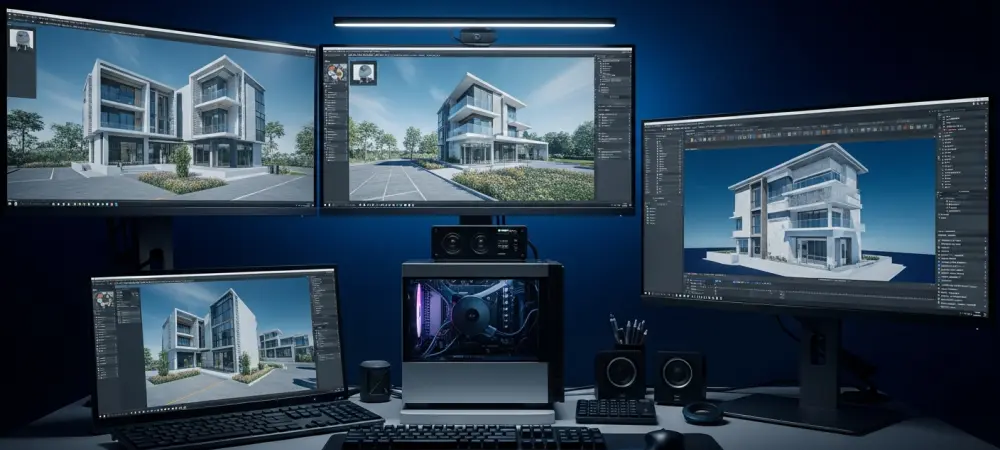
Creative professionals currently face a technological plateau where software capabilities often outpace the hardware available to mid-range workstations, necessitating a shift toward high-performance specialized components. The introduction of the PNY GeForce RTX 5080 OC Slim marks a pivotal moment in this evolution, as it bridges the gap between massive enthusiast-grade hardware and the space-constrained reality of modern studio environments. While high-end GPUs have historically been associated with the gaming sector, the 50-series architecture emphasizes local artificial intelligence processing and complex 3D simulation above all else. This specific model provides a critical bottleneck-breaker for editors handling massive 8K video files or developers training proprietary machine learning models in real-time. By prioritizing architectural efficiency over sheer physical size, this hardware ensures that creative workflows remain uninterrupted by the hardware limitations that once defined previous generations of digital production.
Core Architecture and Computational Power
Blackwell Foundation: Maximizing Computational Density
The Blackwell architecture represents a fundamental redesign of how data flows through a graphics processor, focusing on maximizing throughput for non-linear workloads in professional environments. This PNY model houses 10,752 CUDA cores, providing a massive parallel processing environment that serves as the primary engine for every light-path calculation and pixel shader executed in professional software. Unlike traditional gaming-focused units, these Blackwell cores are optimized for sustained high-intensity cycles, which is necessary when rendering long-form cinematic sequences or executing large-scale physics simulations. The architectural improvements allow for significantly higher instructions per clock compared to previous generations, ensuring that every watt of power is translated into tangible productivity. For professionals working in Unreal Engine or Blender, this density means that viewport interactions remain fluid even when handling billions of polygons or highly complex volumetric lighting effects in a single scene.
Overclocking Performance: Pushing the Boost Ceiling
Beyond the raw core count, the factory overclock included in this specific variant pushes the performance ceiling by setting the boost clock to a reliable 2730MHz. This incremental increase might seem minor on paper, but in the context of a twelve-hour rendering job, the cumulative time savings represent a significant boost to a studio’s overall output and project turnaround. Maintaining these high clock speeds requires a sophisticated power delivery system that avoids the frequency throttling often found in less robust designs. PNY has engineered the board to provide consistent voltage to the silicon, ensuring that the 5080 chipset can maintain its peak performance throughout the duration of a project. This focus on stability is what distinguishes a professional-grade component from a standard consumer card, as it prioritizes reliable performance under stress. The ability to sustain these speeds without crashing is the true value of a factory-tuned BIOS for those who cannot afford downtime during critical production.
Next-Generation Memory: The Role of GDDR7 Integration
Memory performance has often been the Achilles’ heel of high-resolution video production, but the inclusion of 16GB of ultra-fast GDDR7 memory addresses these historical limitations. Operating on a 256-bit bus, the card achieves a staggering memory bandwidth of 960 GB/s, which is a requirement for modern editors who are increasingly working with uncompressed 4K and 8K video assets. This high bandwidth allows for near-instantaneous data transfers between the GPU and the system, eliminating the stuttering and lag that typically occur when scrubbing through complex timelines in Adobe Premiere Pro or DaVinci Resolve. Furthermore, the 16GB capacity provides enough VRAM headroom to handle large texture sets and complex 3D models without overflowing into much slower system memory. This ensures that the card remains responsive even when multiple professional applications are running simultaneously, such as a 3D modeling suite and a high-fidelity video compositor, both competing for the same hardware resources.
Physical Engineering and Connectivity Standards
Compact Design: Small Form Factor Optimization
The “Slim” designation is not merely a marketing label but a strategic engineering choice that utilizes a precise two-slot design to fit into increasingly popular compact workstations. While many flagship cards have bloated to three or four slots in width, the RTX 5080 OC Slim maintains a profile of 300mm in length and 40mm in height, making it an ideal candidate for Small Form Factor (SFF) builds. This physical footprint is particularly beneficial for professionals who use external GPU (eGPU) enclosures or require multiple cards in a single workstation for multi-GPU rendering. However, it is important for system builders to account for the 150mm width of the card, which may pose clearance challenges in ultra-compact cases like the Fractal Terra or certain boutique SFF enclosures. Despite its slender profile, the card does not compromise on build quality, featuring a rigid backplate that prevents PCB sagging and ensures the longevity of the internal hardware components over years of heavy use.
Thermal Management: Cooling the Slim Profile
Cooling a high-performance chipset within a slim chassis requires a sophisticated thermal management system that balances airflow with noise levels in a studio setting. PNY has implemented an understated twin-fan configuration paired with a high-density heatsink that is specifically tuned to keep the Blackwell architecture within optimal temperature ranges during long rendering sessions. The fans are designed with custom blade profiles to move a higher volume of air at lower RPMs, which is a crucial consideration for editors who need a quiet workspace for audio monitoring. The aesthetic of the card reflects its professional intent, moving away from aggressive RGB lighting and jagged edges in favor of a clean, matte black finish. This minimalist approach ensures that the hardware fits seamlessly into a professional studio aesthetic without creating unnecessary visual distractions. The robust thermal design ensures that even during peak utilization, the card remains stable, preventing the thermal throttling that could degrade performance and lead to extended rendering times.
Power Delivery: Efficiency and Modern Protocols
Operating at the cutting edge of graphics technology requires a reliable and significant power source, as the RTX 5080 OC Slim demands a minimum 850W power supply for stable operation. The card utilizes the standardized 16-pin 12VHPWR connector, which simplifies cable management and provides a more efficient delivery of power directly to the GPU’s power stages. This modern connection standard is designed to handle the transient power spikes that are common during intensive computational tasks, such as starting a high-resolution render or training a neural network. It is vital for users to ensure that their power supply is ATX 3.0 compliant to provide the most stable experience and avoid the need for cumbersome adapters. The card’s internal power management system is also highly advanced, featuring real-time monitoring of current and voltage to protect sensitive components from electrical irregularities. This level of engineering provides peace of mind for professionals whose livelihood depends on the continuous operation of their workstations.
Performance Benchmarks and Market Positioning
Professional Workloads: Benchmarking AI and Rendering
In practical application tests involving AI-driven software like Topaz Video AI, the RTX 5080 chipset has shown a remarkable ability to handle frame generation and upscaling tasks with speed. These benchmarks reveal that the architecture is particularly adept at processing the motion estimation and temporal data required to transform standard-definition footage into high-quality 4K video. Compared to previous-generation hardware, the 5080 provides a nearly 40% improvement in processing times for these specific AI tasks, which can save days of production time over a feature-length project. The ability of the GDDR7 memory to rapidly cycle through frames allows the AI models to work at peak efficiency without being limited by data transfer bottlenecks. For studios that specialize in restoration or high-end commercial production, this performance gain represents a significant competitive advantage. This real-world speed is far more valuable than synthetic numbers, as it directly impacts the daily output of creative professionals.
Display Connectivity: Driving High-Resolution Monitors
Future-proofing is a key aspect of any professional hardware investment, and PNY has addressed this through a comprehensive suite of high-bandwidth display outputs on the rear of the card. The hardware features three DisplayPort 2.1b ports and one HDMI 2.1b port, providing the necessary infrastructure to support the next generation of high-resolution professional monitors. These connections allow for extreme output configurations, such as driving an 8K display at 165Hz, which is becoming the standard for high-end color grading and professional video monitoring. By utilizing Display Stream Compression, the RTX 5080 can drive multiple high-resolution displays simultaneously without any loss in visual fidelity or increased latency. This is particularly useful for creators who utilize multi-monitor setups to manage complex timelines, asset browsers, and preview windows across several 4K screens. The inclusion of the latest connectivity standards ensures that the card will remain compatible with display technology for years to come.
Strategic Value: Future Considerations for Studios
The launch of the RTX 5080 OC Slim addressed a critical need for high-performance hardware that respected the spatial constraints of modern workstations and external enclosures. Professionals who integrated this card into their pipelines discovered a renewed capability to handle complex AI training and 3D rendering tasks without the need for massive, heat-generating tower PCs. The shift toward GDDR7 memory and the Blackwell architecture provided the necessary infrastructure for the next generation of creative software, ensuring that local processing remained a viable alternative to cloud-based solutions. Moving forward, studios should prioritize the adoption of ATX 3.0 power standards to fully leverage the stability of this hardware and consider transitioning to DisplayPort 2.1b monitors to capitalize on the card’s high-resolution output. Investing in this technology allowed creative teams to focus on their artistic vision rather than managing hardware limitations, ultimately streamlining the path from initial concept to final delivery.