
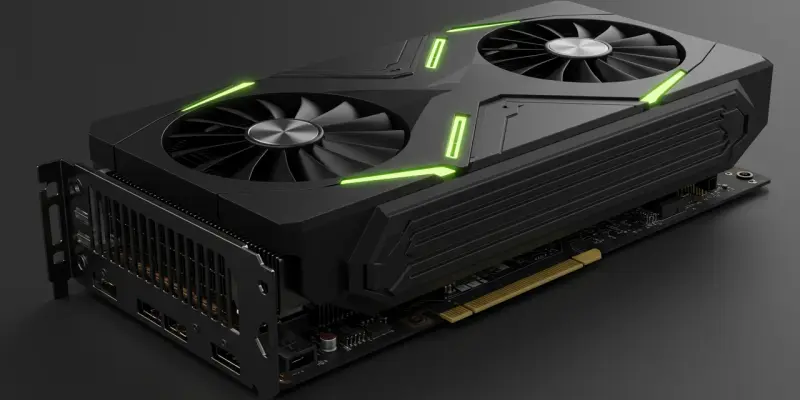
Gigabyte Unveils Thunderbolt 5 AORUS RTX 5090 AI Box

Article Highlights
Off On

Gigabyte’s latest technological revelation has disrupted the gaming landscape with the launch of its groundbreaking AORUS RTX 5090 AI Box, an external GPU that harnesses the power of Thunderbolt 5 for exceptional performance. Introduced at Computex, the AORUS RTX 5090 is a monumental leap for desktop-level gaming enthusiasts. This offering stands out with its pre-installed RTX 5090, a component that boasts unparalleled processing capability with 21,760 CUDA Cores. It leverages a WaterForce AIO cooling system to ensure optimal temperatures and prevent any potential throttling due to heat. The incorporation of Thunderbolt 5 provides an astounding 80 Gbps of bandwidth. This is complemented by advanced connectivity options such as USB4 2.0, USB 3.2 Gen 3 ports, and Power Delivery 3.0 support, which facilitates charging for various devices.

An Unmatched Gaming and AI Performance Experience

Targeting individuals striving for gaming excellence and advanced AI processing, the AORUS RTX 5090 AI Box comes equipped with multiple display outputs. These include three DisplayPorts, a single HDMI 2.1b, and an RJ45 Ethernet port to ensure stable internet connectivity. This powerful setup is designed for users who demand top-tier performance for both gaming and AI tasks. Its performance levels are outstanding, with capabilities that exceed 3000 AI TOPS, thereby outclassing NVIDIA’s AI TOP ATOM DGX Spark Box. Its state-of-the-art specifications justify a retail price between $3,000 and $4,000, marking it as a high-end choice for tech enthusiasts who are particular about their hardware. Gigabyte’s AORUS RTX 5090 sets a new standard by effectively utilizing external GPU technology. It’s an essential tool for those seeking superior gaming performance and advanced AI processing. This innovation is poised to redefine what users expect, setting fresh benchmarks in both gaming and artificial intelligence technology.

Explore more

Effective Email Automation Strategies Drive Business Growth

The digital landscape is currently witnessing a silent revolution where the most successful marketing teams have stopped competing for attention through volume and started winning through surgical precision. While many organizations continue to struggle with the exhausting cycle of manual campaign creation, a sophisticated subset of the market has mastered the art of “set it and forget it” revenue generation.

How Can Modern Email Marketing Drive Exceptional ROI?

Every second, millions of digital messages flood into global inboxes, yet only a tiny fraction of these communications actually manage to convert a passive reader into a loyal, high-value customer. While the average marketer often points to a return of thirty-six dollars for every dollar spent as a benchmark of success, this figure represents a mere starting point for organizations

Modern Tactics Drive High-Performance Email Marketing

The sheer volume of digital correspondence flooding the modern consumer’s primary inbox has reached a point where generic messaging is no longer merely ignored but actively penalized by sophisticated filtering algorithms. As the global email ecosystem navigates a staggering daily volume of nearly 400 billion messages, the traditional “spray and pray” methodology has transformed from a sub-optimal tactic into a

How Will AI-Native 6G Networks Change Global Connectivity?

Global telecommunications are currently undergoing a profound metamorphosis that transcends simple speed upgrades, aiming instead to weave an intelligent fabric directly into the world’s physical reality. While the transition from 4G to 5G was defined by raw speed and reduced latency, the move toward 6G represents a fundamental departure from traditional telecommunications. The industry is moving toward a reality where

How Is AI Redefining the Future of 6G and Telecom Security?

The sheer velocity of data surging through modern global telecommunications has already pushed traditional human-centric management systems toward a breaking point that demands a complete architectural overhaul. While the industry previously celebrated the arrival of high-speed mobile broadband, the current shift represents a fundamental departure from hardware-heavy engineering toward a software-defined, intelligent ecosystem. This evolution marks a pivotal moment where