
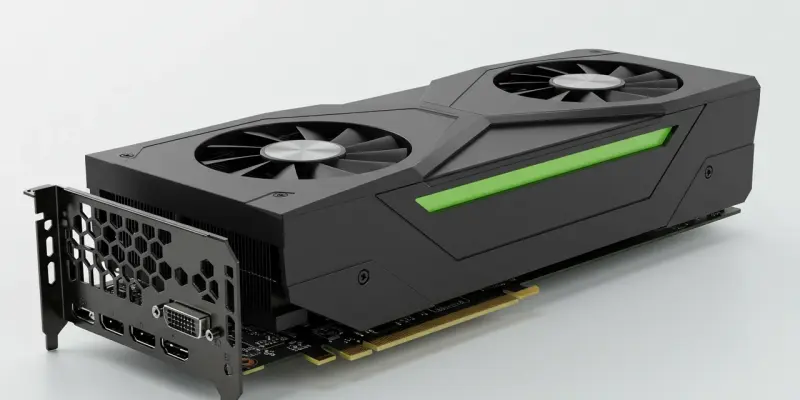
NVIDIA RTX 5060 Listings Reveal Major Price Variability

Article Highlights
Off On

In recent developments, various editions of NVIDIA’s GeForce RTX 5060 graphics card are being listed on major retail platforms like Best Buy even before their official market launch. ASUS and PNY, both aligned with NVIDIA as board partners, have introduced custom iterations of the RTX 5060 that display considerable price discrepancies. Starting at $299, prices soar to a considerable $409 for some models, raising eyebrows and giving rise to questions regarding the cause of such a range. ASUS has introduced three distinct models in its PRIME and TUF series, featuring the TUF Gaming OC edition which stands out with its price tag of $409.99, marking a notable difference from NVIDIA’s original Founders Edition Manufacturer Suggested Retail Price (MSRP) of $299. This comparison highlights the contrast and potential expectations for consumers as they navigate the actual cost landscape. The basic ASUS PRIME model sits at $339, while the PRIME RTX 5060 OC is available for $379.99.

Varying Specifications and Market Dynamics

The evident variation in GPU pricing has highlighted concerns about the potential volatility in retail rates linked to current market trends. Inconsistencies are apparent, including variations in card dimensions and power ratings, with some models exhibiting higher Thermal Design Powers (TDPs) than expected. For instance, PNY’s Dual-Fan version stays at the initial $299 mark, but doubts linger over its price stability post-launch. Price fluctuations indicate that initial Manufacturer’s Suggested Retail Prices (MSRPs) and the actual retail price may vary significantly. As prices remain unpredictable, this acts as a warning for buyers to be cautious and anticipate prices beyond advertised MSRPs due to market dynamics. This issue highlights the broader narrative of erratic GPU pricing, underscoring the unpredictable nature of graphics hardware economics. Moving forward, this situation should prompt consumers to stay informed and actively monitor pricing trends. Awareness of market shifts could protect against unforeseen price surges, aiding in better purchasing decisions.

Explore more

Effective Email Automation Strategies Drive Business Growth

The digital landscape is currently witnessing a silent revolution where the most successful marketing teams have stopped competing for attention through volume and started winning through surgical precision. While many organizations continue to struggle with the exhausting cycle of manual campaign creation, a sophisticated subset of the market has mastered the art of “set it and forget it” revenue generation.

How Can Modern Email Marketing Drive Exceptional ROI?

Every second, millions of digital messages flood into global inboxes, yet only a tiny fraction of these communications actually manage to convert a passive reader into a loyal, high-value customer. While the average marketer often points to a return of thirty-six dollars for every dollar spent as a benchmark of success, this figure represents a mere starting point for organizations

Modern Tactics Drive High-Performance Email Marketing

The sheer volume of digital correspondence flooding the modern consumer’s primary inbox has reached a point where generic messaging is no longer merely ignored but actively penalized by sophisticated filtering algorithms. As the global email ecosystem navigates a staggering daily volume of nearly 400 billion messages, the traditional “spray and pray” methodology has transformed from a sub-optimal tactic into a

How Will AI-Native 6G Networks Change Global Connectivity?

Global telecommunications are currently undergoing a profound metamorphosis that transcends simple speed upgrades, aiming instead to weave an intelligent fabric directly into the world’s physical reality. While the transition from 4G to 5G was defined by raw speed and reduced latency, the move toward 6G represents a fundamental departure from traditional telecommunications. The industry is moving toward a reality where

How Is AI Redefining the Future of 6G and Telecom Security?

The sheer velocity of data surging through modern global telecommunications has already pushed traditional human-centric management systems toward a breaking point that demands a complete architectural overhaul. While the industry previously celebrated the arrival of high-speed mobile broadband, the current shift represents a fundamental departure from hardware-heavy engineering toward a software-defined, intelligent ecosystem. This evolution marks a pivotal moment where