

The intersection of high-performance computing and sophisticated industrial design has reached a pivotal moment as major hardware manufacturers move beyond traditional aesthetics to embrace radical manufacturing techniques. At the Computex 2026 event in Taipei, GIGABYTE celebrated its 40th anniversary by unveiling a product lineup that serves as a bridge between futuristic engineering and organic, lifestyle-focused visuals. This milestone marks a significant departure from the aggressive “gamer” branding that has long defined the sector, opting instead for a refined aesthetic that blends high-end data center technology with consumer electronics. This strategic shift reflects a broader industry movement toward hardware that feels natural in professional and home office environments while maintaining the top-tier performance expected by enthusiasts. The showcase prioritized extreme thermal management and industrial design that adapts to diverse user needs, aiming to cater to a market that increasingly values both raw power and visual elegance in their computing hardware.
Engineering Boundaries: The Evolution of Fabrication
Structural Innovation: The Rise of 3D-Printed Metal
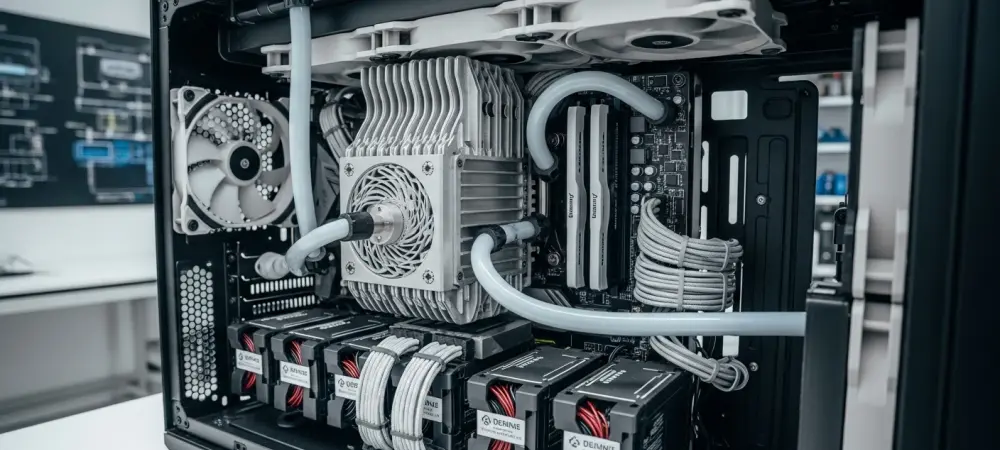
The primary technical highlight of the presentation was the AORUS INFINITY NEXT motherboard, a proof-of-concept project that utilizes 3D metal printing for its core structural and cooling components. This advanced additive manufacturing approach allowed engineers to create an AI Gyroid M.2 heatsink, featuring a complex internal geometry that significantly increases the surface area available for cooling modern high-speed storage devices. Unlike traditional milling or casting, 3D fabrication enables the construction of intricate vapor chambers and airflow paths that would be physically impossible to manufacture otherwise. This specific innovation addresses the growing thermal demands of next-generation PCIe drives, which have historically struggled with heat throttling during sustained workloads. By integrating these organic, mathematically optimized shapes directly into the motherboard architecture, the design demonstrates how future hardware might solve thermal bottlenecks through structural complexity rather than simply increasing the size of traditional metal blocks.
Technical Challenges: Balancing Power and Physical Form
To support the most demanding flagship processors currently available, the AORUS INFINITY NEXT features a massive 64-phase power delivery system capable of handling over 5,000 amps of current. This level of power delivery is typically reserved for enterprise-grade servers and high-performance computing clusters, highlighting the extreme engineering goals behind this specific prototype. However, the radical physical architecture required for such massive cooling components and power stages introduces significant spatial constraints. The volume occupied by the 3D-printed metal cooling structures and extensive vapor chambers leaves no physical space for a traditional discrete graphics card slot on the motherboard. Consequently, the AORUS INFINITY NEXT remains a design exercise rather than a consumer product intended for retail shelves. It serves primarily as a platform for the brand to demonstrate its ability to push the boundaries of extreme engineering and heavy-duty thermal efficiency while exploring new manufacturing frontiers for future hardware.
Aesthetic Harmony: Blending Natural Elements with High Tech
Material Sophistication: The AERO Wood Ecosystem
In a notable contrast to the industrial rigidity of the AORUS series, the AERO Wood line focuses on lifestyle-oriented PC components that utilize natural materials to create a more organic presence. This new ecosystem includes power supplies and graphics card shrouds finished with dark and light wood textures, purposefully moving away from saturated RGB lighting and integrated digital screens. These designs were created to complement high-end home office spaces, suggesting a growing demand among professionals for hardware that offers a minimalist, calming aesthetic rather than a distracting light show. By incorporating wood grain into the external housing of functional components, the manufacturer is challenging the industry standard that high-performance gear must look inherently mechanical. This approach prioritizes a seamless integration into modern interior design, where the computer is treated as a piece of furniture or a decorative element rather than a cluttered collection of plastic and metal parts.
Visual Fluidity: The Advent of Tri-Mode Display Technology
The advancement of display technology was further highlighted by the introduction of the AORUS ELITE FM275K16P, a 27-inch 5K Mini LED monitor featuring a unique “Tri-Mode” functionality for extreme versatility. This technology allowed users to toggle between a high-resolution 5K creative mode for professional editing, a high-performance 4K mode for immersive gaming, and an extreme 330Hz esports mode for competitive play. With over 2,000 local dimming zones and exceptional color accuracy, the display provided a unified solution for users who required top-tier visual performance across a range of different resolutions and refresh rates. This development addressed the common compromise where professionals were often forced to choose between color-accurate high-resolution panels or fast-refresh gaming monitors. By consolidating these capabilities into a single unit, the design showcased a future where a single workstation can adapt to every aspect of a user’s digital life without sacrificing quality or performance in any specific category.
Strategic Outlook: Next Steps for Industrial Hardware
The showcase at Taipei provided a clear roadmap for the next generation of computing, focusing on the convergence of specialized manufacturing and lifestyle integration. Industry experts observed how the transition toward additive manufacturing and natural materials signaled a maturing market that prioritized sustainable, high-efficiency cooling over traditional mass-production techniques. Engineers emphasized that while many of these designs were currently in the prototype stage, the underlying technologies were ready to influence mainstream product lines within the coming cycles. The move toward modular, multi-mode displays and aesthetically neutral hardware components represented a calculated response to the changing demographics of the high-end PC market. Stakeholders were encouraged to consider how these innovations in thermal management and industrial design would eventually lower the barriers between professional workstations and home entertainment systems. This evolution ensured that the performance gains seen in the server sector reached home users in a form factor that was both functional and visually sophisticated.