

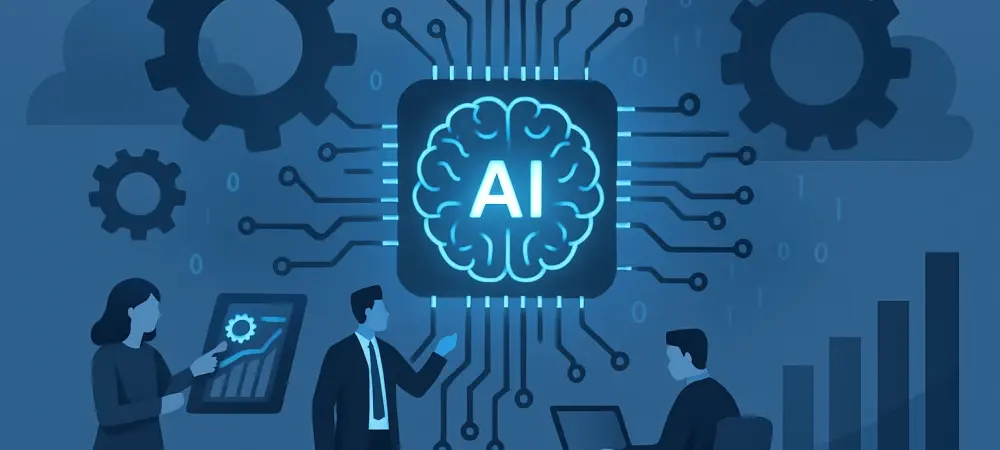
Imagine a world where nearly every enterprise decision, from supply chain optimization to customer service, is driven by artificial intelligence, with 96% of IT leaders already embedding AI into core operations. This staggering statistic paints a vivid picture of how AI has become an indispensable force in the business landscape, reshaping competitive dynamics as of 2025. This review delves into the intricacies of enterprise AI, examining its core components, real-world performance, adoption trends, and the challenges that persist in scaling this transformative technology across industries.
Core Features of Enterprise AI Technologies
Enterprise AI encompasses a suite of advanced technologies designed to enhance business efficiency and innovation. Among the most widely adopted are generative AI, utilized by 60% of organizations for tasks like content creation and ideation, deep learning, embraced by 53% for complex pattern recognition, and predictive AI, deployed by 50% to forecast trends and behaviors. These tools are not mere add-ons but integral to automating processes, reducing costs, and driving strategic decision-making in modern enterprises.
A critical feature underpinning these technologies is data accessibility, often described as the lifeblood of AI initiatives. Yet, only 9% of organizations report having fully accessible data for AI applications, with 38% claiming most of their data is usable. The reliance on hybrid data architectures, blending cloud and on-premises environments, has emerged as a cornerstone for flexible AI deployment, enabling businesses to manage vast datasets across diverse platforms without sacrificing performance or scalability.
Beyond the technologies themselves, security frameworks are a defining feature of enterprise AI. With significant concerns around data leakage affecting 50% of surveyed leaders and unauthorized access worrying 48%, robust governance mechanisms are essential. Solutions such as private AI environments and secure, GPU-accelerated tools behind firewalls are being prioritized to protect sensitive information while maximizing the utility of AI systems.
Performance and Adoption Trends
The performance of enterprise AI is reflected in its rapid adoption, with 96% of IT leaders integrating AI into core business processes as of 2025, a notable leap from previous benchmarks. This acceleration underscores AI’s evolution from a strategic experiment to an operational imperative, fundamentally altering workflows and enhancing competitive positioning. Enterprises are not just adopting AI; they are embedding it into the fabric of daily operations, from customer engagement to internal analytics.
However, performance is not without hurdles, as data integration challenges impede 37% of organizations, while storage and compute limitations each affect 17%. These technical barriers often slow down the scaling of AI projects, preventing full realization of potential benefits. Despite these issues, the ability of AI to deliver actionable insights when paired with accessible data remains a key driver of its widespread uptake across sectors.
Hybrid architectures further bolster performance by offering a balanced approach to data management. This flexibility allows enterprises to tailor AI deployments to specific needs, whether processing data in the cloud for speed or on-premises for control. The trend toward hybrid systems signals a maturing understanding of how to optimize AI’s impact while navigating the complexities of diverse IT environments.
Real-World Impact Across Industries
In practical terms, enterprise AI is transforming industries by enabling unprecedented levels of efficiency and innovation. In healthcare, AI-driven diagnostics are improving patient outcomes through faster and more accurate analyses, while in finance, predictive models are enhancing fraud detection and risk assessment. Retailers leverage generative AI to personalize customer experiences, crafting tailored marketing campaigns that resonate with individual preferences.
Manufacturing sectors are also reaping benefits, with AI optimizing supply chains by predicting demand fluctuations and minimizing waste. These real-world applications highlight AI’s versatility, demonstrating its capacity to address industry-specific challenges while delivering measurable value. The ability to adapt AI tools to unique operational contexts is a testament to their growing maturity as enterprise solutions.
Moreover, AI’s impact extends to workforce dynamics, automating repetitive tasks and freeing employees to focus on creative and strategic endeavors. This shift not only boosts productivity but also redefines job roles, necessitating new skill sets and training programs. The tangible outcomes of AI integration are reshaping how businesses operate and compete in a rapidly evolving global market.
Challenges in Scaling AI Integration
Despite its promise, scaling enterprise AI remains fraught with obstacles that can derail implementation. Data integration issues top the list, with fragmented systems preventing seamless access to critical information needed for AI models to function effectively. This bottleneck often results in delayed projects and suboptimal outcomes, frustrating efforts to achieve comprehensive adoption.
Security concerns add another layer of complexity, as the risk of data breaches during model training looms large. Additionally, reliance on third-party tools, deemed insecure by 43% of respondents, heightens vulnerability to external threats. These challenges underscore the need for stringent controls and customized solutions to safeguard data integrity while pushing AI initiatives forward.
Technical limitations, such as inadequate storage performance and insufficient compute power, further complicate the landscape. Many organizations struggle to support the intensive demands of AI workloads, leading to inefficiencies and increased costs. Addressing these barriers requires not only investment in infrastructure but also a strategic approach to aligning technology with business goals.
Reflecting on Enterprise AI’s Journey
Looking back, the journey of enterprise AI integration by 2025 reveals a landscape of remarkable progress tempered by persistent challenges. The widespread adoption of diverse AI technologies demonstrates their capacity to revolutionize business operations, while hybrid architectures prove instrumental in balancing flexibility and control. Yet, the specter of data accessibility issues and security risks looms large, often stalling full-scale implementation.
For enterprises moving forward, the next steps involve prioritizing robust governance frameworks to mitigate security concerns, alongside investments in infrastructure to overcome technical limitations. Exploring tailored solutions, such as private AI environments, offers a pathway to harness data securely while unlocking deeper insights. Collaboration with technology partners could further accelerate progress, ensuring alignment between AI capabilities and organizational needs.
Ultimately, the evolution of enterprise AI signals a shift toward viewing it as a competitive necessity rather than a luxury. Businesses are encouraged to focus on building resilient data ecosystems and fostering a culture of innovation to stay ahead. By addressing these critical areas, enterprises can transform obstacles into opportunities, paving the way for sustained growth in an AI-driven era.