

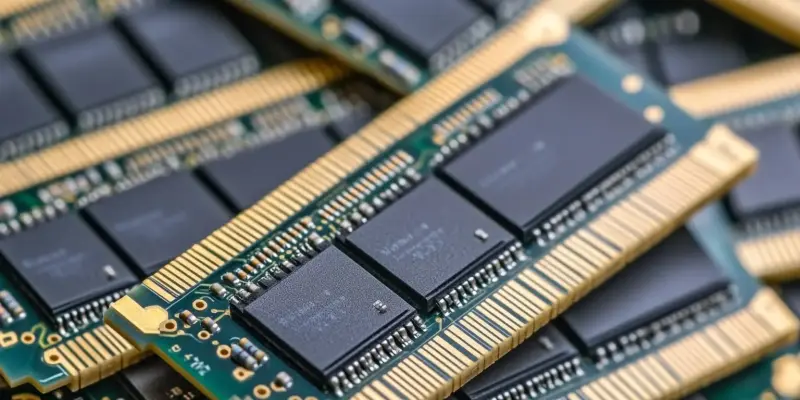
The DRAM industry is navigating the complexities of enhancing data storage capacities by adopting 3D monolithic stacking architectures, marking a shift from incremental innovations towards more revolutionary changes. Traditionally conservative, the sector now faces the challenge of developing these new designs while ensuring they are feasible for mass production in the future.
One of the primary obstacles in 3D DRAM development lies in integrating a sufficiently large capacitor needed for charge storage. Existing single-layer DRAM chips employ vertical capacitors, forming thick layers that complicate the stacking process. To address this, experts are exploring various strategies, such as reducing cell sizes using advanced lithography, running capacitors horizontally, or even eliminating them altogether. The ultimate goal is to implement similar advancements to those achieved with 3D NAND flash memory.
Among the promising approaches is the use of horizontal capacitors. Lam Research has proposed solutions like flipping cells, sliding bit lines, and employing gate-all-around (GAA) transistors to create thinner, stack-friendly layers. Samsung is also innovating with a new cell architecture aimed at area efficiency, transitioning from a 6F2 to a 4F2 cell design with vertical-channel transistors and advanced materials like ferroelectrics.
Capacitor-less DRAM designs are another area under investigation. New technologies such as gate-controlled thyristors and floating-body cells, inspired by floating gate technology in flash memory, present potential alternatives. Neo Semiconductor’s floating-body cell with dual gating, for instance, aims to enhance sensing margin and data retention, offering a glimpse into the future of DRAM architecture.
The article also emphasizes the existing role of High-Bandwidth Memory (HBM) as a form of stacked-die memory. The development of monolithic 3D DRAM could significantly boost HBM architecture, providing increased memory density and energy efficiency—a vital combination for data centers and AI applications.
Despite these advancements, 3D DRAM is still years away from mass production. Experts like Daryl Seitzer from Synopsys and Daniel Soden from Brewer Science highlight that new architectures require considerable development and validation before achieving commercial viability. They acknowledge the significant challenges but stress their importance for attaining greater storage per unit area and reducing production costs.
In summary, the exploration of 3D DRAM stacking is critical for the future of memory technology, promising improvements in efficiency and performance. The industry is methodically addressing the technological hurdles, reviewing various innovative approaches. While the path to commercially viable 3D DRAM remains intricate and lengthy, ongoing efforts show promise for future advancements in data storage solutions.