

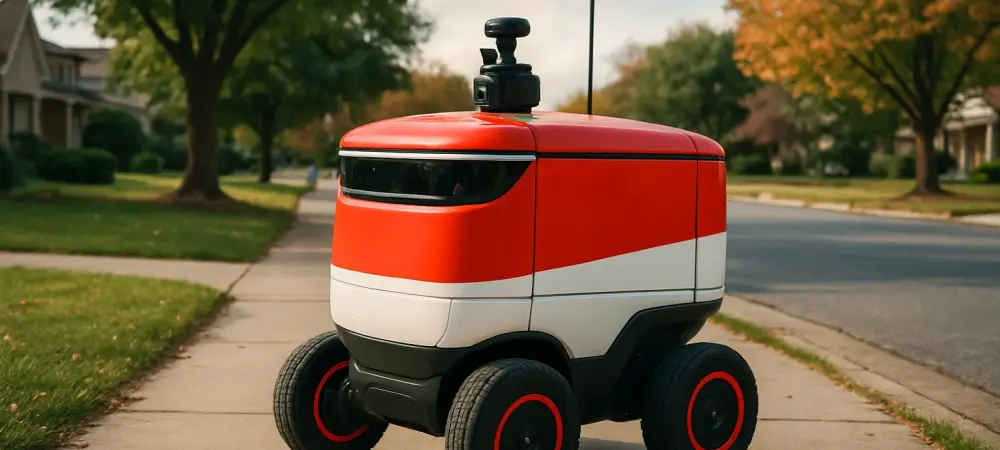
Imagine a bustling city street where a compact robot, no larger than a small cart, zips along the sidewalk, delivering a hot meal to a hungry customer, showcasing the future of urban logistics. This isn’t a scene from a sci-fi movie but a reality unfolding with DoorDash’s latest innovation, Dot, an autonomous sidewalk delivery robot. As automation reshapes the food delivery landscape, opinions vary widely on its potential to transform urban logistics versus the challenges it poses to workers and infrastructure. This roundup gathers insights from industry experts, tech analysts, and gig economy advocates to explore the implications of Dot’s launch, comparing diverse perspectives on efficiency, scalability, and societal impact.
Diving into Dot: What Industry Voices Are Saying
Design and Tech: A Game-Changer or a Gimmick?
Dot, a small electric robot developed by DoorDash Labs, has sparked significant buzz for its innovative design, featuring a top speed of 20 miles per hour, eight cameras, and three lidar sensors for navigation. Many tech analysts praise its compact size, ideal for weaving through crowded urban spaces like sidewalks and bike lanes. They argue that such engineering addresses key logistical hurdles in densely populated areas, potentially slashing delivery times.
However, not all feedback is glowing. Some industry observers question whether the technology can handle unpredictable real-world scenarios, such as erratic pedestrian behavior or sudden obstacles. Concerns linger about reliability during adverse weather, with skeptics suggesting that while the specs are impressive on paper, practical deployment might reveal limitations that could frustrate customers.
A middle ground emerges from urban planning experts who see Dot as a promising step but emphasize the need for robust public safety protocols. They highlight that while the robot’s small footprint minimizes disruption, cities must adapt with clear guidelines to prevent accidents or congestion. This balanced view underscores a broader debate on integrating such tech into everyday environments.
Hybrid Model: Balancing Humans and Machines
DoorDash’s strategy with Dot isn’t about replacing human Dashers but integrating robots into a hybrid delivery platform alongside drones and people, powered by AI to assign orders efficiently. Industry leaders in logistics commend this approach, noting that testing in cities like Phoenix offers a real-world lab to refine the balance. They argue it maximizes efficiency while preserving the flexibility of human workers for complex deliveries.
On the flip side, some tech critics warn of potential over-reliance on automation, pointing out that AI-driven systems might falter under high demand or technical glitches, leaving customers dissatisfied. There’s also apprehension about consumer reception, with fears that a robot delivery could feel impersonal compared to a friendly human interaction at the door.
A contrasting perspective from delivery platform strategists suggests this hybrid model gives DoorDash a competitive edge over rivals who lean heavily on one method. They believe blending human and robotic elements could appeal to a wider customer base, catering to both tech enthusiasts and those who value personal service. This diversity in thought reflects the complexity of scaling such a system.
Industry Trends: Where Does Dot Fit In?
Automation’s Rise: A Sector-Wide Shift
DoorDash isn’t alone in betting on autonomous delivery, as competitors like Uber Eats and Deliveroo also experiment with similar technologies. Many market analysts observe that this trend is less about cutting-edge tech breakthroughs and more about economic scalability, with large platforms leveraging their vast networks to test cost-saving innovations. Sidewalk robots like Dot are often seen as more feasible than drones due to fewer regulatory barriers.
Differing opinions come from policy experts who caution that while sidewalk robots face less red tape, local governments might still impose strict rules as adoption grows. They stress that varying city regulations could slow expansion, especially in regions unprepared for robotic traffic on public pathways. This highlights a gap between ambition and practical rollout.
Another angle comes from economic researchers who argue that automation in delivery isn’t just a tech race but a response to rising labor costs and consumer demand for speed. They suggest that companies adopting robots now could dominate market share by cutting operational expenses over the next few years, from 2025 onward. This economic lens adds depth to understanding the strategic push behind such innovations.
Workforce Implications: Opportunity or Threat?
The impact of robots like Dot on gig economy workers remains a hotly debated topic. Labor advocates express deep concern over potential job displacement, arguing that automation could shrink opportunities for Dashers who rely on delivery gigs for income. They call for safeguards to protect vulnerable workers from being sidelined by machines.
Conversely, technology optimists point out that human skills still surpass robots in areas like customer interaction and navigating complex delivery scenarios. They also note that automation often creates new roles, such as robot maintenance and software oversight, which could offer higher pay despite being fewer in number. This perspective seeks to counterbalance the narrative of job loss with one of transformation.
A third viewpoint from workforce development specialists suggests a need for proactive retraining programs to bridge the gap. They argue that as delivery platforms integrate robots, investing in upskilling workers for tech-adjacent roles could mitigate displacement while fostering innovation. This pragmatic stance emphasizes adaptation over resistance, reflecting a nuanced take on labor dynamics.
Key Takeaways from the Discussion
Looking back, this roundup captured a spectrum of insights on DoorDash’s launch of Dot, revealing both enthusiasm for its compact, efficient design and caution about real-world challenges. Industry voices agreed on the strategic value of a hybrid human-robot model, though they diverged on its scalability and consumer appeal. The broader shift toward automation emerged as a shared observation, driven by economic factors rather than pure tech prowess, while workforce impacts split opinions between threat and opportunity. As a next step, stakeholders in the delivery sector might consider collaborative frameworks to address regulatory and safety concerns, ensuring robots integrate smoothly into urban spaces. For workers, exploring training initiatives in tech support roles could open new career paths. Consumers, meanwhile, can stay informed about how such innovations might reshape their delivery experiences, advocating for a balance between efficiency and personal touch in this evolving landscape.