

The traditional approach of maintaining data centers at frigid temperatures has finally met its end as the industry pivots toward thermal management strategies that prioritize energy efficiency over brute-force cooling. For many years, operators believed that keeping server rooms as cold as possible was the only way to safeguard hardware, yet this “colder is better” philosophy led to unsustainable energy costs and massive carbon footprints that contemporary corporate mandates can no longer tolerate. Today, the rise of artificial intelligence has pushed power densities from the standard 20kW per rack to unprecedented levels exceeding 100kW, forcing a complete overhaul of facility infrastructure and cooling logic. By aligning operations with expanded ASHRAE guidelines, facilities are now running warmer while utilizing precision cooling to protect critical components. This evolution marks a departure from wasteful, generalized airflow toward targeted thermal management that treats heat as a controlled variable rather than an enemy to be suppressed at any cost.
Merging Liquid and Air Systems: The Hybrid Imperative
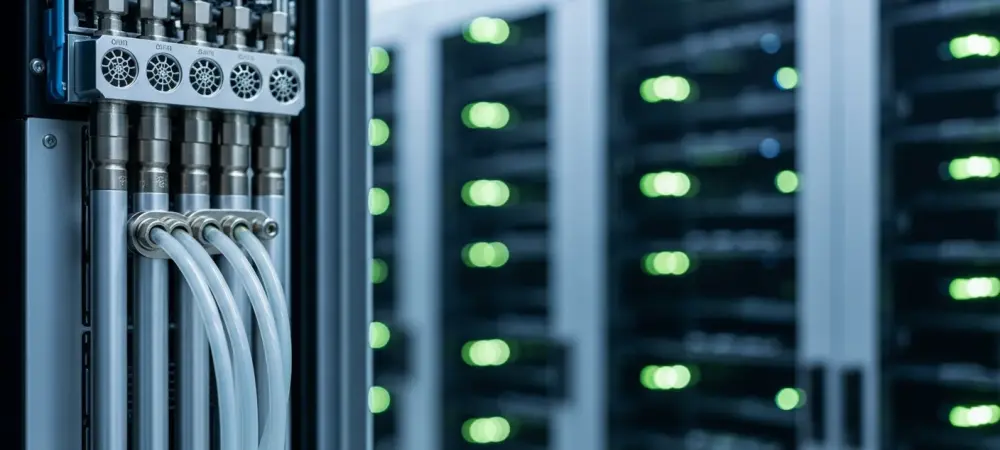
Liquid cooling technologies, such as direct-to-chip and immersive systems, are rapidly becoming standard for high-performance computing clusters, yet they do not exist in a vacuum or render traditional air cooling obsolete. Even the most efficient direct-to-chip cooling loops typically capture only about seventy-five to eighty percent of the total heat generated by high-density AI servers, leaving the remaining thermal load to dissipate into the surrounding air within the chassis. This residual heat, though a minority of the total output, is still significant enough to cause local hotspots if not managed through disciplined airflow strategies. Consequently, modern data center designs are embracing a hybrid architecture where liquid manifolds and high-capacity air handlers work in concert to maintain a stable environment. This dual-pronged approach allows operators to leverage the superior thermal conductivity of liquids for the hungriest processors while relying on air for the surrounding electronics. Strategically separating high-density AI equipment from standard low-density server racks is now a fundamental requirement for maintaining operational efficiency across large-scale facilities. Instead of attempting to upgrade an entire floor to support 100kW racks, operators are creating specialized zones or “pods” where liquid cooling infrastructure is concentrated, while the rest of the white space continues to utilize traditional air-based containment. This spatial discipline prevents the mixing of varied thermal outputs and ensures that expensive liquid cooling resources are utilized only where they provide the greatest return on investment. By isolating high-heat zones, facilities can optimize their power usage effectiveness without undergoing a total structural redesign that would disrupt existing operations. This coexistence of disparate cooling methods represents a mature understanding of data center thermodynamics, acknowledging that a one-size-fits-all solution is no longer viable in an era characterized by wildly diverse compute workloads and power requirements.
Operational Resilience: Balancing Simplicity and Innovation
Maintaining high availability in a high-density environment often requires a return to fundamental physical principles rather than the introduction of increasingly complex mechanical systems. Thermal containment remains the most effective tool in the operator’s arsenal, focusing on the physical separation of hot and cold air streams to eliminate recirculation and bypass airflow. By strictly enforcing hot-aisle or cold-aisle containment, data centers can ensure that every cubic foot of chilled air reaches its intended destination without being wasted on empty floor space. This focus on simplicity reinforces the operational truth that the most reliable system is often the one with the fewest moving parts and the least amount of unnecessary complexity. As power densities climb, the margin for error shrinks, making basic physical barriers more critical than ever. Infrastructure professionals are finding that preventing the waste of existing cooling capacity is far more sustainable and cost-effective than simply installing larger, more power-hungry air conditioning units.
The role of cooling has transitioned from a background facility concern into a core strategic pillar that defines the competitive viability of modern data center business models. A facility’s capacity to support the extreme thermal demands of next-generation AI hardware directly influences its total cost of ownership and its ability to attract high-tier enterprise clients. Investment in cooling infrastructure must now be viewed through a lens of decadal relevance, as systems installed today must be capable of scaling alongside the rapid advancements in chip architecture and power delivery. Moving away from short-term fixes toward flexible, modular cooling designs allows for the seamless integration of future technologies without requiring extensive downtime or capital-intensive renovations. This forward-thinking approach treats the cooling plant as a dynamic asset that can adapt to changing market conditions, ensuring that the data center remains a high-performance environment capable of hosting the world’s most demanding computational tasks with maximum uptime and efficiency.
Validation and Strategy: Precision Modeling for Tomorrow
As thermal margins become increasingly narrow, the use of Computational Fluid Dynamics has evolved from an occasional design check into an indispensable tool for ongoing operational validation. This advanced simulation technology allows data center managers to visualize complex three-dimensional airflow patterns and identify potential thermal risks before they manifest as physical hardware failures. By creating a digital twin of the facility, operators can test various failure scenarios, such as the loss of a cooling unit or a sudden spike in workload, in a risk-free virtual environment. This predictive capability is essential for managing high-density racks where a loss of cooling could lead to critical temperatures within seconds rather than minutes. The data generated by these simulations provides the empirical foundation necessary to fine-tune setpoints and optimize fan speeds, ensuring that the cooling system is never over-provisioned or under-performing. Precision modeling thus serves as the bridge between theoretical design and real-world performance in high-stakes environments. The transition toward hybrid cooling frameworks provided a clear roadmap for operators who sought to balance the aggressive growth of AI with the constraints of power availability and environmental responsibility. It was observed that successful facilities did not simply react to heat challenges but proactively integrated liquid and air systems to create a more resilient infrastructure. Moving forward, the industry prioritized the adoption of granular monitoring and automated thermal controls to ensure that cooling resources were dynamically allocated in real-time. Organizations that invested in comprehensive thermal modeling and modular piping systems found themselves better positioned to handle the next generation of high-wattage silicon. These strategies demonstrated that the path to sustainability required a move away from legacy practices toward a more nuanced, data-driven approach to facility management. By embracing these hybrid solutions and focusing on the physical separation of thermal zones, data centers secured their roles as the essential backbones of the modern digital economy while significantly reducing their overall environmental impact.