

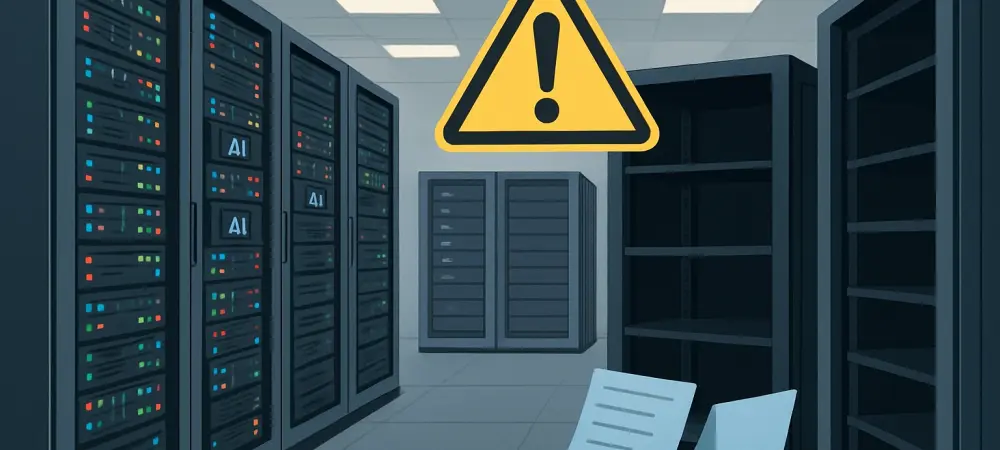
What happens when the digital backbone of modern innovation starts to buckle under pressure? Across industries, businesses are grappling with a critical shortage of data center capacity, driven by the explosive growth of artificial intelligence (AI). This isn’t just a technical hiccup—it’s a seismic shift forcing companies to rethink how they build and sustain their technological future. The race to secure space for AI workloads has become a defining challenge, with implications for competitiveness and growth in a rapidly evolving landscape.
The importance of this issue cannot be overstated. As AI, particularly generative models, becomes integral to operations—from enhancing customer interactions to optimizing supply chains—the demand for robust data center infrastructure has skyrocketed. With capacity shrinking and costs soaring, enterprises are being pushed to adopt long-term strategies, often planning years ahead to avoid being left behind. This story dives into the heart of the crisis, exploring why data centers are critical to AI, the hurdles businesses face, and how leaders are navigating this high-stakes terrain.
The AI Boom: A Data Center Dilemma Unfolding Now
The surge in AI adoption has caught many organizations off guard, creating a scramble for data center space that shows no signs of slowing. Generative AI, with its ability to create content and solve complex problems, requires immense computational power, far beyond what traditional setups can handle. Companies are finding themselves in a bind as they rush to secure infrastructure in a market where availability is increasingly scarce, turning what was once a background concern into a boardroom priority.
This urgency stems from the sheer scale of AI’s integration into business models. Reports indicate that 90% of IT leaders have already deployed generative AI technologies, driven by a sharp rise in executive support—81% of C-suite leaders now champion these initiatives, a significant leap from just a year ago. The result is a perfect storm of demand, pushing data center capacity to its limits and forcing businesses to act with unprecedented speed to avoid operational bottlenecks.
Why Data Centers Are the Backbone of the AI Revolution
At the core of AI’s transformative potential lies an often-overlooked reality: without data centers, the revolution stalls. These facilities provide the raw computing power needed to train and run sophisticated models, especially those powering generative AI applications like chatbots or predictive analytics. As businesses lean into these tools to personalize services or streamline processes, the strain on existing infrastructure becomes palpable, revealing a critical dependency.
The numbers paint a stark picture of this reliance. Industry insights suggest that the computational needs for AI workloads are doubling every few months, far outpacing the growth of data center construction. This mismatch between ambition and reality means that even well-resourced firms are hitting walls, unable to scale their AI initiatives without first securing the necessary space and power. It’s a bottleneck that underscores how physical infrastructure remains the linchpin of digital progress.
Moreover, the implications extend beyond mere capacity. Data centers must also adapt to the unique energy and cooling demands of AI systems, which can consume resources at an alarming rate. This added complexity means that simply building more facilities isn’t enough—strategic design and location choices are becoming just as vital to meeting the needs of this tech-driven era.
Navigating the Crunch: Key Challenges and Emerging Trends
The data center landscape is a battleground of competition and constraint, with businesses facing multiple hurdles. Rental costs in prime U.S. markets like Northern Virginia and Chicago have surged by 15% and 14.7% year-over-year, respectively, according to recent research. This price escalation is squeezing budgets, particularly for enterprises balancing investments between on-premises setups and public cloud solutions, creating tough financial trade-offs.
Beyond costs, availability remains a persistent issue, pushing over half of surveyed companies toward colocation services as a stopgap measure. These partnerships allow firms to lease space in shared facilities, easing the pressure of building from scratch. At the same time, growth is shifting to less saturated hubs like Dallas, Denver, and Atlanta, where land and power are more accessible, signaling a geographic pivot that could redefine the industry’s map over the coming years.
Another trend gaining traction is the move toward small language models—customized AI tools tailored for specific enterprise needs. Unlike the massive models developed by tech giants, these smaller versions demand less infrastructure, offering a potential lifeline for companies struggling with capacity. This shift hints at a future where adaptability, rather than sheer scale, might become the key to navigating the crunch.
Voices from the Field: Insights from IT Leaders and Experts
The data center shortage isn’t just a statistic—it’s a daily reality for those on the front lines of IT decision-making. Ryan Mallory, a prominent industry executive, has highlighted the absence of quick solutions, stating that capacity constraints “require a long-term mindset to address effectively.” His perspective resonates with many leaders who see reactive fixes as insufficient in the face of AI’s relentless growth. Survey data reinforces this sentiment, showing that 80% of organizations are now planning their AI infrastructure needs at least a year in advance, with some extending forecasts to three or even five years. This shift toward proactive strategy marks a departure from past practices, driven by the hard lesson that waiting for space to open up is no longer an option. IT teams are increasingly tasked with predicting future demands, a role that blends technical expertise with crystal-ball foresight.
These voices collectively paint a picture of an industry at a crossroads. The consensus is clear: the old playbook of short-term planning won’t cut it. Instead, there’s a growing recognition that securing a foothold in the AI era means thinking ahead, building partnerships, and anticipating challenges before they become crises—a mindset that’s rapidly becoming the new normal.
Strategic Planning for AI: Actionable Steps for Businesses
With the data center market under strain, businesses must pivot to forward-thinking approaches to safeguard their AI ambitions. A starting point is forecasting capacity needs over a one-to-three-year horizon, a practice already adopted by 62% of IT leaders. This involves assessing current workloads and projecting growth, ensuring that infrastructure keeps pace with innovation rather than lagging behind.
Another practical step is leveraging colocation services to supplement existing setups. By partnering with third-party providers, companies can access additional space and resources without the burden of constructing new facilities—a flexible solution for navigating immediate shortages. This approach also allows for scalability, adapting to fluctuating demands without long-term capital commitments.
Finally, exploring emerging markets and technologies offers a path to cost-effective expansion. Regions like Dallas and Atlanta present opportunities for lower-cost data center development, while adopting small language models can reduce dependency on hyperscale systems. These strategies, grounded in real-time trends, provide a blueprint for turning the data center challenge into a competitive edge, ensuring AI becomes a driver of success rather than a source of strain.
Looking back, the journey through the data center crunch revealed a landscape transformed by necessity and foresight. Businesses adapted by embracing long-term planning, forging strategic partnerships, and seeking out untapped markets to fuel their AI aspirations. The path wasn’t without obstacles—rising costs and scarce resources tested resolve at every turn. Yet, the lessons learned pointed to a clear way forward: anticipate needs before they arise, invest in scalable solutions, and remain agile in the face of technological shifts. As the dust settled, these principles stood as guideposts for any organization aiming to thrive in an AI-driven world, ensuring that infrastructure challenges became stepping stones rather than stumbling blocks.