

The rapid proliferation of Large Language Models and specialized generative AI applications has fundamentally altered the physical landscape of the modern data center, shifting the focus from individual chip performance to the intricate web of connections that bind thousands of processing units together. As high-performance computing becomes the standard for enterprise operations, the internal network has transitioned from a supporting utility into a primary strategic lever that determines whether an organization can effectively train and deploy massive neural networks. This evolution means that the architectural decisions made regarding data movement are now as critical to business success as the selection of the accelerators themselves. Connectivity is no longer a matter of simple plumbing but has become the defining factor for hardware utilization and overall system efficiency. When a single training run for a frontier model can cost tens of millions of dollars, any inefficiency in how data travels between nodes represents a direct hit to the bottom line. Consequently, data center operators are re-evaluating their entire fabric strategy to ensure that the network does not become a permanent ceiling for scalability. By treating connectivity as a core component of the AI stack, companies are finding new ways to optimize their infrastructure, reduce idle time for expensive processors, and accelerate the time-to-market for innovative digital services. This holistic view of the data center allows for a more resilient architecture that can adapt to the ever-increasing demands of machine learning workloads.
Balancing Performance Metrics in AI Networking
Designing a network for the current era of artificial intelligence is an exercise in managing highly complex trade-offs where every microsecond of latency can have a cascading impact on the efficiency of the entire cluster. Architects must prioritize high-speed communication while ensuring that the network fabric remains stable under the immense pressure of synchronized data bursts common in distributed training. Capacity is no longer just about the total bandwidth available but about the ability to move massive datasets across the fabric without creating localized congestion that stalls expensive computing units. Because many AI workloads rely on an “all-reduce” communication pattern, where every processor must wait for every other processor to finish a task, the slowest link in the network effectively dictates the speed of the entire operation. Maintaining low latency and high reliability across thousands of nodes requires a sophisticated understanding of packet prioritization and buffer management to prevent the dropped packets that would otherwise necessitate costly re-transmissions and delay project timelines significantly.
Beyond the raw technical performance of the networking hardware, operators must also weigh the total cost of ownership against the long-term scalability of the facility. Every unit of electricity consumed by the network is a unit that cannot be used to power the accelerators that perform the actual AI computations. This makes power efficiency a primary design constraint rather than a secondary consideration for large-scale deployments. Serviceability and flexibility also play vital roles, as the hardware must be easily accessible for maintenance or upgrades without taking the entire cluster offline. A successful connectivity strategy balances these competing priorities by selecting components that offer the best performance-per-watt while maintaining the flexibility to incorporate future technological advancements. This approach ensures that the capital investment in the data center remains productive over several years, providing a stable foundation for evolving AI models. By focusing on these core metrics, organizations can build a network that is not only fast enough for today’s tasks but also efficient and resilient enough to handle the growing complexity of future workloads.
Defining the Scope: Scale-Up and Scale-Out Architecture
Modern artificial intelligence clusters are built upon a dual-tier networking philosophy that separates the high-speed local communication between chips from the broader distributed fabric that connects the entire data center. Scale-up networks are specifically designed to facilitate the rapid exchange of data within a single server rack or a localized pod of computing nodes. At this level, the goal is to create a seamless pool of memory and processing power that behaves as a single massive supercomputer. Traditionally, copper cabling has been the preferred medium for these short-reach connections because of its low cost and high reliability. However, as the bandwidth requirements for modern accelerators push beyond the 200 Gbps per lane mark, the physical limitations of electrical signaling through copper are becoming a significant hurdle. Engineers are increasingly forced to implement advanced signal conditioning or transition to shorter cable lengths to maintain signal integrity, which in turn limits the physical density of the hardware and increases the complexity of the rack design. In contrast to the localized scale-up fabric, scale-out networks serve as the primary communication highway that links thousands of individual server nodes across the entire data center. This layer is responsible for the massive distribution of training data and the coordination of parameters across a sprawling infrastructure of racks and rows. At this scale, optical connectivity is the only viable solution for maintaining the necessary speeds over the distances required for a large facility. The industry is currently seeing a rapid shift toward 800 Gbps and 1.6 Tbps optical transceivers to meet the insatiable demand for throughput. These high-speed optical links are the backbone of the modern AI data center, allowing operators to build clusters that consist of tens of thousands of GPUs working in parallel. The demand for these components is driven almost entirely by the need to eliminate networking bottlenecks that would otherwise leave expensive computing resources underutilized. As these clusters continue to grow in size, the role of optical networking will only become more central to the overall architecture of the scale-out fabric.
Modular Versus Integrated Optical Solutions
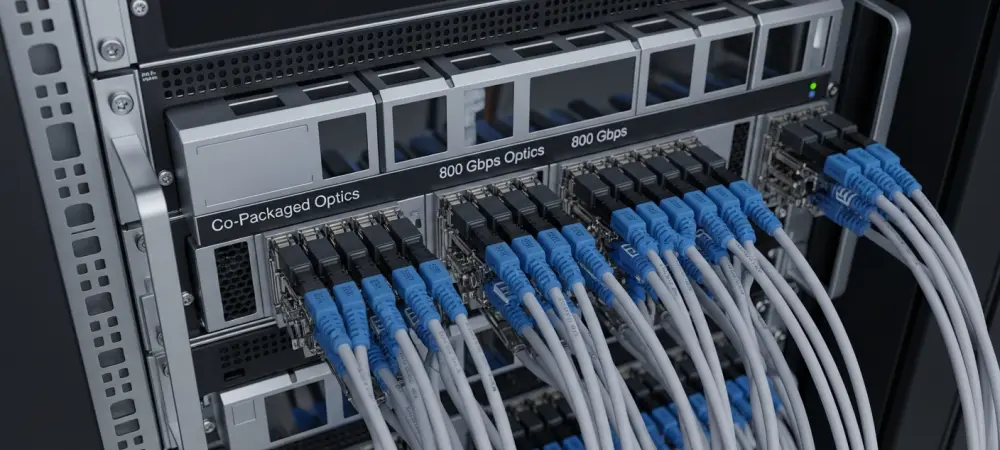
The data center industry is currently navigating a pivotal choice between two distinct architectural paths for optical networking: modular pluggable optics and integrated designs. Pluggable optics remain the dominant standard because they offer unparalleled flexibility and ease of maintenance for operators of all sizes. These modules allow a network switch to be populated with different types of transceivers based on the specific reach and speed requirements of each link. This modularity also helps prevent vendor lock-in, as operators can source transceivers from multiple suppliers to ensure a steady supply chain and competitive pricing. However, as data rates continue to climb, the physical distance between the switch silicon and the optical module becomes a source of significant signal loss. This requires more power-hungry signal processing chips to maintain the integrity of the data, which can lead to increased heat generation and higher operational costs. Despite these challenges, the ability to hot-swap a failed module without replacing an entire switch makes pluggable optics a very attractive choice for organizations that value operational simplicity and flexibility. To overcome the inherent physical limitations of pluggable modules, newer integrated designs like Co-Packaged Optics (CPO) are beginning to emerge as a viable alternative for the most demanding environments. These systems place the optical interfaces directly inside the same package as the switch silicon, drastically reducing the distance the electrical signal must travel. By shortening this path, CPO can significantly lower the overall power consumption of the networking layer and improve the density of the hardware. This allows for a much more compact data center footprint and reduces the cooling requirements for high-speed networking equipment. However, this increased efficiency comes at the cost of modularity and serviceability. Because the optics are integrated into the switch package, a failure in a single optical component could potentially require the replacement of the entire expensive switch unit. This creates a higher level of operational risk and requires a more sophisticated maintenance strategy. For specialized AI operators where power density and raw performance are the top priorities, the benefits of integrated designs often outweigh the drawbacks, leading to a slow but steady shift in the architectural landscape.
Signal Processing Innovations for Higher Throughput
Within the world of optical connectivity, the method used to process signals is becoming a critical differentiator for network efficiency and power consumption. Fully retimed optics, which utilize a Digital Signal Processor (DSP) inside the module to clean and amplify the signal, provide the most robust and reliable performance for long-distance links. This approach ensures that data can be transmitted over hundreds of meters without significant degradation, making it ideal for the sprawling scale-out networks found in modern data centers. However, the inclusion of a DSP adds to the power footprint and latency of each module. As clusters grow to include tens of thousands of these links, the cumulative energy consumption of the signal processing layer can become a major concern. To address this, many operators are looking toward “linear” designs, such as Linear Pluggable Optics (LPO), which remove the DSP from the module and rely on the host switch silicon to manage signal integrity. This configuration can reduce power consumption by up to fifty percent and lower the latency of the connection, providing a more efficient path for data-heavy AI workloads.
Innovation is also occurring at the physical layer with the emergence of Extra-Dense Pluggable Optics (XPO) and other advanced packaging technologies designed to push modular hardware to its limits. These solutions often incorporate liquid cooling directly into the module or use advanced thermal interface materials to handle the extreme heat generated by high-speed data transmission. By improving the thermal management of the module, manufacturers can pack more bandwidth into the same form factor, extending the useful life of traditional pluggable architectures. This allows data center operators to keep using familiar modular systems even as they move toward 1.6 Tbps and beyond. Furthermore, the development of new materials and laser technologies is enabling higher data rates per wavelength, reducing the complexity of the optical components required for each link. These advancements provide a bridge between the current modular standards and the integrated designs of the future, giving organizations the tools they need to fine-tune their networks based on specific power, cost, and performance requirements.
Strategic Alignment and Future Roadmap
A successful connectivity roadmap prioritized the integration of diagnostic tools that provided real-time visibility into the health of the optical fabric. Organizations that achieved the best results did not merely install hardware but instead developed a comprehensive management layer that synchronized networking tasks with workload scheduling. By doing so, they ensured that data was staged and moved precisely when the compute resources were ready, eliminating the micro-stalls that frequently plagued less integrated environments. Future-proofing required a deliberate investment in hybrid designs that allowed for a transition from traditional pluggable optics to more advanced integrated systems as the specific needs of the AI clusters evolved. This proactive approach turned the network into a source of competitive advantage rather than a bottleneck for growth. The decision-making process was informed by deep telemetry data that highlighted where congestion occurred, allowing for targeted upgrades rather than broad, unnecessary overhauls of the infrastructure.
In final considerations, the selection of networking components depended heavily on the long-term sustainability targets of the enterprise. Leaders in the space moved away from a purely performance-driven mindset to one that accounted for the energy footprint of every bit transmitted across the facility. This transition was supported by adopting liquid cooling for high-density interconnects and exploring linear drive architectures that reduced the reliance on power-hungry signal processing chips. By aligning these technical choices with the broader business objectives of agility and cost-efficiency, organizations secured a robust foundation for their AI initiatives. The most effective strategies emphasized modularity where flexibility was required and integrated density where raw performance was the only metric that mattered, creating a balanced and resilient infrastructure. Ultimately, the evolution of data center connectivity demonstrated that the physical network was just as dynamic and critical as the software running upon it, requiring continuous attention and strategic investment to maintain a leading edge in the market.