

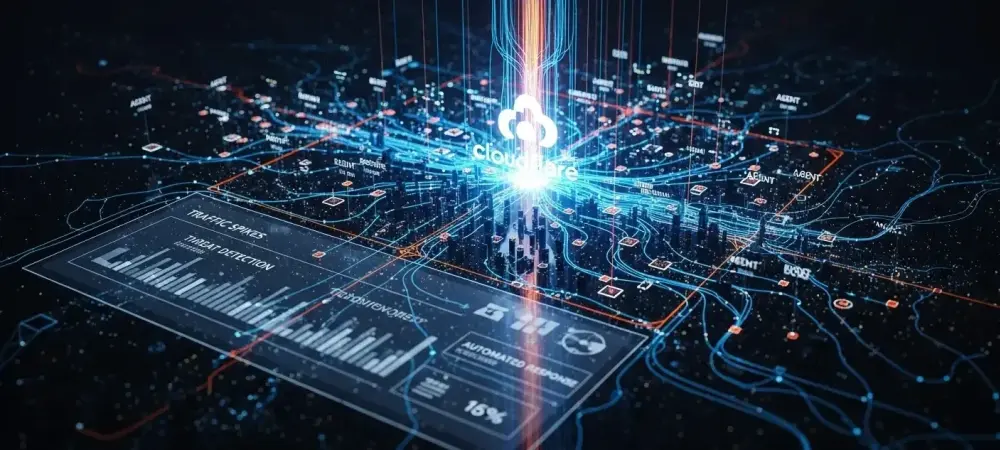
The digital world is currently pivoting from a landscape of passive chatbots toward a complex ecosystem of persistent, autonomous agents capable of independent thought and execution across global networks. This evolution represents a fundamental change in how software is conceptualized, moving away from simple request-response cycles toward long-running, self-directed processes. Cloudflare’s entry into this space, specifically through its Agentic Infrastructure, signals a maturation of the “Agentic Web” where the focus shifts from the intelligence of the model to the reliability and persistence of the environment in which it operates.
Evolution Toward the Agentic Web
The transition from ephemeral AI interactions to persistent software agents marks a departure from the temporary nature of generative AI. In the early stages of this technological wave, AI was largely restricted to isolated chat sessions that vanished once the window closed. Cloudflare’s infrastructure addresses this limitation by treating AI not as a stateless function, but as a continuous entity with its own workspace and memory. This shift is critical for tasks that require hours or even days of autonomous background work, such as managing a supply chain or maintaining a software repository. By building on its established global edge network, Cloudflare has effectively created an “Agent Cloud” that serves as a permanent residence for these autonomous units. The relevance of this infrastructure in the current landscape of serverless computing cannot be overstated. While traditional serverless models were designed for short, predictable tasks, the Agentic Web demands a runtime that can handle unpredictable, long-running logic without incurring the massive overhead costs typically associated with dedicated virtual machines.
Technical Architecture and Core Components
Dynamic Workers for Lightweight Compute
At the heart of this system lies an isolate-based runtime designed specifically for executing AI-generated code. Unlike traditional containers that carry heavy operating system overhead, these Dynamic Workers utilize lightweight sandboxing to isolate processes at the process level. This approach allows for near-instantaneous startup times, which is essential when an agent needs to spin up hundreds of sub-tasks to process data or call external APIs. The security of these sandboxed environments is paramount, as they must safely execute code that is generated on the fly by an AI model.
The economic implications of this compute model are profound. By leveraging a serverless execution style, the infrastructure allows developers to pay only for the exact milliseconds of compute used by the agent. This reduces the entry barrier for complex automation, making it feasible for smaller enterprises to deploy fleets of autonomous workers that would otherwise require a massive capital investment in always-on hardware.
Persistent Workspaces and Artifacts
To support complex, multi-stage builds, the infrastructure incorporates Linux-based Sandboxes. These environments provide the persistent file systems and shell access necessary for agents to perform traditional engineering tasks, such as compiling code or running test suites. Without this persistence, an AI agent would be forced to restart its environment for every step, losing all progress and installed dependencies. These sandboxes ensure that the agent operates within a consistent stateful context.
The Artifacts system complements this by providing a Git-compatible storage layer for version-controlled output. This allows AI agents to produce work that is immediately usable by human developers, maintaining a clear history of changes and forks. By treating AI-generated output as a first-class citizen in the version control ecosystem, Cloudflare ensures that autonomous workflows remain transparent and integrated into existing professional development pipelines.
State Management: The “Think” Framework
One of the most persistent problems in AI orchestration has been the loss of context during long-running tasks. The “Think” framework within the Agents SDK solves this by providing a standardized method for pausing and resuming complex workflows. When an agent reaches a point where it must wait for an external signal or a human approval, the framework saves its current state, including its internal variables and history. This enables the agent to “wake up” days later and continue exactly where it left off, which is a significant jump in reliability for multi-step enterprise tasks.
Emerging Trends in AI Infrastructure
The industry is currently moving away from model-centric development, where the choice of the LLM was the only priority, toward an action-oriented orchestration model. Modern infrastructure now prioritizes the “body” of the AI—its tools, file systems, and connectivity—over the “brain” alone. This shift highlights a growing demand for secure-by-default environments that can mitigate the risks of unverified autonomous code. Furthermore, the ability to swap models with a single line of code allows organizations to maintain infrastructure stability while taking advantage of the latest breakthroughs in model efficiency.
Real-World Applications and Sector Impact
In the realm of software engineering, these agents are already being deployed to handle automated maintenance and security patching. Instead of merely suggesting code changes, an autonomous agent can now fork a repository, run tests in a sandbox, and submit a pull request once it verifies the fix. This level of autonomy moves the needle from “AI-assisted” to “AI-driven” engineering. In enterprise settings, this technology enables complex multi-step workflows that interact with diverse external systems, such as automated procurement or real-time risk assessment across multiple jurisdictions.
Challenges and Adoption Obstacles
Despite the technical progress, managing the state of millions of concurrent autonomous units presents significant scaling hurdles. Orchestrating these entities without creating bottlenecks in global traffic remains a complex engineering feat. Security is another major concern, as the execution of AI-generated code in shared environments could potentially lead to new classes of vulnerabilities if isolation is breached. Additionally, the market faces obstacles like vendor lock-in, where the lack of standardized protocols for agentic communication might force developers into specific ecosystems.
Future Outlook and Strategic Development
The scaling of autonomous AI agents across global edge networks is expected to lead to breakthroughs in how digital services are consumed. The Agentic Web may eventually reshape the global economy by automating many tasks currently requiring human oversight, leading to a more efficient but more complex labor market. Future developments will likely focus on minimizing architectural complexity, allowing developers to deploy sophisticated agents with the same ease that they currently deploy simple web pages.
Summary of Findings and Assessment
The review of Cloudflare’s Agentic Infrastructure revealed a robust transition toward a stateful and persistent web. The analysis indicated that the combination of lightweight isolates and persistent sandboxes addressed the primary limitations of previous AI deployments. It was found that the “Think” framework successfully bridged the gap between stateless AI and autonomous task completion. Ultimately, the technology demonstrated a high level of readiness for enterprise-scale deployment, proving that the infrastructure for the next generation of software was effectively realized through these advancements. Cloudflare established itself as a foundational utility in the persistent AI market, moving beyond a simple content delivery network to a comprehensive runtime for autonomous intelligence.