

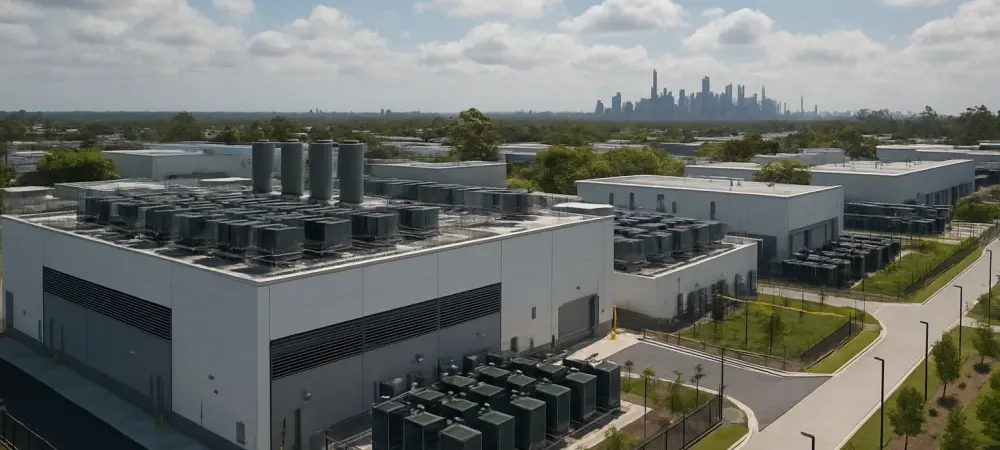
Imagine a world where the digital backbone of entire industries hinges on the capacity and innovation of data infrastructure, a realm where every byte of information fuels artificial intelligence, cloud computing, and beyond. In Melbourne, Australia, this vision is taking shape with Centuria Industrial REIT’s ambitious plan to develop a 40MW data center in the Clayton suburb, marking a significant step in addressing the global appetite for advanced tech infrastructure. As a subsidiary of Centuria Capital Group, this real estate firm is diving headfirst into the surging demand for data storage and processing power, capitalizing on a strategic location adjacent to an existing Telstra-operated facility. Announced as part of the company’s recent financial updates, this project marks a significant step in addressing the global appetite for advanced tech infrastructure. With construction slated to begin after the decommissioning of current facilities around mid-2027, the initiative promises to redefine the region’s role in the digital economy, blending real estate expertise with cutting-edge technology to meet future needs.
Strategic Expansion in Clayton
The Clayton site, spanning over 27,000 square meters, is already a hub of technological activity with two existing data centers totaling 12MW, managed under a long-term lease agreement with Telstra. Centuria’s acquisition of this property in a AU$417 million deal several years ago laid the groundwork for innovative growth, and the upcoming 40MW data center represents a bold leap forward. By utilizing underutilized land partially surrendered by Telstra, the project not only maximizes asset potential but also aligns with industry demands for greater capacity driven by AI and data-intensive applications. Development approvals and power allocations are currently in progress, ensuring that the infrastructure will be ready to support a diverse range of tenant customers. This expansion, guided by in-house expertise, underscores a broader vision of integrating real estate with technology, positioning Melbourne as a critical node in Australia’s data landscape and highlighting the meticulous planning behind such transformative endeavors.
Driving Australia’s Digital Ambitions
Reflecting on the broader impact, Centuria’s initiative in Clayton proves to be a pivotal moment in bolstering Australia’s standing in the global tech arena. The partnership with Telstra, a titan in telecommunications, facilitates a seamless transition of land use and reinforces collaborative efforts to optimize space for future needs. This project, alongside Centuria’s other ventures like a Perth data center and involvement with ResetData’s cloud solutions, illustrates a commitment to sustainable growth in data infrastructure. Looking ahead, the focus shifts to actionable steps such as finalizing construction timelines post-2027 and exploring additional opportunities for AI-driven facilities. Industry trends suggest a continuous need for innovation in capacity and efficiency, urging stakeholders to prioritize scalable solutions. The Clayton development, in retrospect, serves as a catalyst for discussions on how real estate investments can further intersect with technological advancements, paving the way for Melbourne to solidify its reputation as a hub for digital progress.