

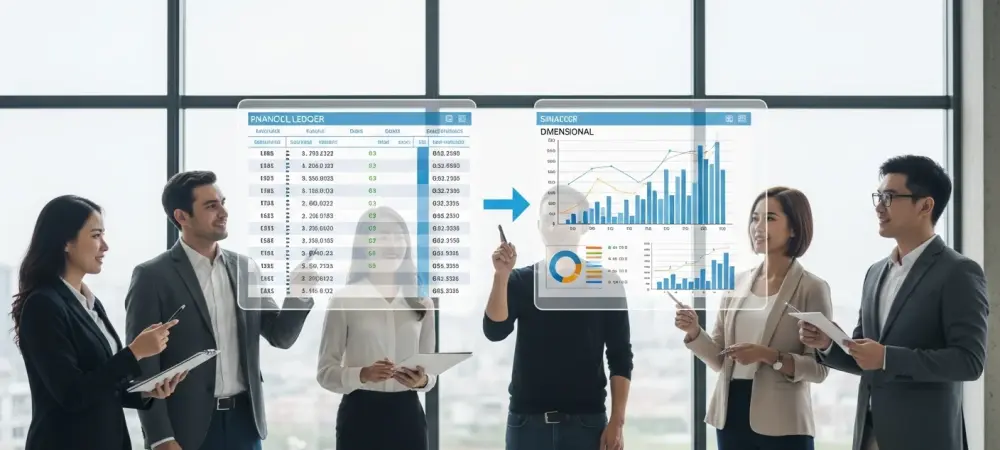
The promise of a modern Enterprise Resource Planning (ERP) system is one of greater efficiency, deeper insights, and enhanced scalability; however, the path to modernization is often riddled with operational landmines that can detonate a company’s financial stability. Migrating from a legacy platform like Dynamics GP to a more sophisticated one, such as Microsoft Dynamics 365 Business Central, frequently triggers a cascade of disruptions that directly impact the most critical financial processes. The primary risks are not merely technical glitches but fundamental business challenges, including significant operational downtime as teams grapple with a new interface, widespread staff confusion when confronted with an unfamiliar dimensional chart of accounts, and a heightened potential for data entry errors. These issues collectively erode user confidence, delay the transition timeline, and can ultimately jeopardize the very return on investment that justified the upgrade in the first place. When the budgeting cycle is thrown into disarray, the entire organization’s ability to plan and execute its strategy is compromised.
Bridging the Gap Between Legacy and Modern Systems
The key to mitigating these substantial risks lies in strategically decoupling the budgeting process from the core ERP system during the transitional period. By implementing a flexible, independent budgeting solution that can integrate with both the old and new systems simultaneously, an organization can create a stable bridge for its finance team. The most critical feature of such a tool is its ability to provide a dual view of the financials, allowing staff to continue working with their familiar legacy account codes while the software seamlessly maps that data to the new system’s dimensional structure in the background. This approach effectively eliminates the abrupt and jarring cutover that causes so much confusion and operational paralysis. Instead of forcing employees to halt their work and undergo intensive training, it enables them to adapt to the new platform gradually. This ensures that essential financial activities, from budget creation to variance analysis, can continue without interruption, thereby maintaining business continuity and preserving the integrity of financial data throughout the migration.
A Blueprint for a Seamless Transition
This strategic approach was successfully validated in a real-world scenario by Cal Farley’s Boys Ranch during its own ERP upgrade to Business Central. The organization faced the common dilemma of modernizing its core financial system without interrupting its meticulously planned budgeting cycle. By leveraging a dedicated budgeting tool, the finance team was able to continue its work within a familiar framework, effectively shielding them from the complexities of the backend system migration. This implementation resulted in a remarkably smooth transition, achieving zero downtime or disruption to their critical financial planning processes. The case demonstrated that an ERP migration did not have to be a chaotic and costly event. With the right intermediary solution in place, the organization proved that it was possible to embrace a modern technological platform while ensuring complete operational continuity and maintaining impeccable financial accuracy. This success offered a powerful lesson: selecting tools that support people through change is just as important as selecting the new technology itself.