

Dominic Jainy is a seasoned IT professional who has spent years bridging the gap between cutting-edge artificial intelligence and unconventional hardware limitations. With extensive experience in machine learning and blockchain, he has become a leading voice for enthusiasts looking to push aging systems far beyond their original design specifications. Today, we discuss the fascinating intersection of DIY engineering and large language models, focusing on how a single M.2 slot can transform a legacy laptop into an AI powerhouse. Our conversation covers the technical hurdles of external GPU integration, the surprising performance of high-end models on repurposed hardware, and the persistent bottlenecks created by the global memory crisis.
How does a person physically and logically bridge a high-end desktop graphics card to an aging laptop that lacks modern expansion ports?
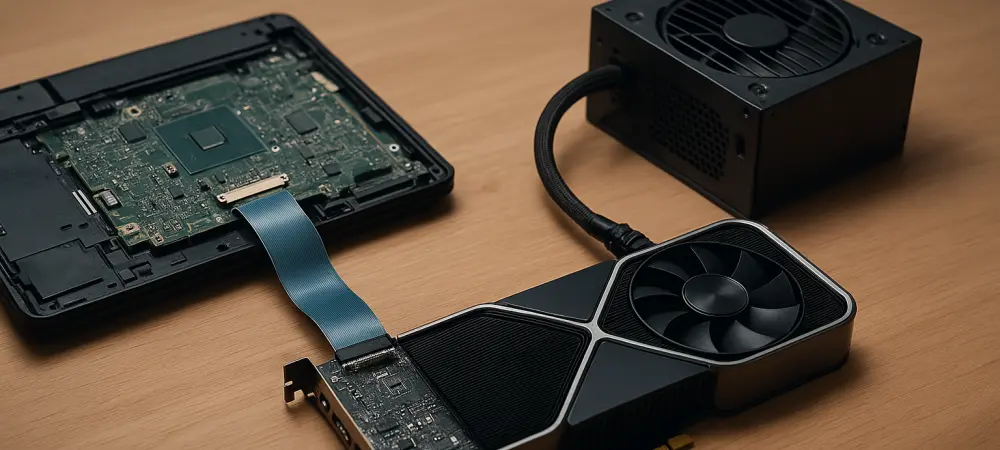
You are looking at a delicate dance of hardware adaptation where you must sacrifice internal storage for raw processing power. By utilizing an ADT-Link PCIe riser adapter, you can bridge the gap between a standard internal M.2 slot and a massive desktop card like the AMD Radeon RX 7900 XT. Because the laptop’s own motherboard cannot possibly provide the juice required for such a beast, you have to wire in a separate 750W PSU to ensure the system doesn’t collapse under the load. Since that solitary M.2 slot is now occupied by the GPU riser, the entire operating system has to be moved to an external drive connected via USB, creating a setup that feels both precarious and incredibly powerful.
What kind of real-world results can an enthusiast expect when offloading heavy AI workloads to this type of unconventional external setup?
When you fire up a demanding model like Qwen3.6 27B, the performance leap is nothing short of breathtaking for a machine of this vintage. Thanks to the 20GB of GDDR6 VRAM provided by the desktop card’s framebuffer, the system can churn through data at impressive speeds of 55 to 60 tokens per second. It is a sensory shock to see a legacy Lenovo notebook, which would typically struggle with basic productivity tasks, suddenly handling sophisticated AI inference with such fluidity. By offloading the model weights and the KV cache entirely to the external GPU, the user successfully bypasses the integrated graphics chip and prevents the VRAM overhead that usually cripples laptop-based AI experiments.
Even with the massive boost in graphical power, what specific hardware limitations still haunt a project like this in the current market?
Despite the incredible graphical throughput, you are still ultimately at the mercy of the laptop’s original architecture, specifically its 16GB of system RAM. When you attempt to push a 100K context window, that system memory vanishes almost instantly, creating a tight bottleneck that limits the overall potential of the AI. The ongoing DRAM crisis has made it nearly impossible to find additional memory at affordable prices, leaving users to live with these frustrating hardware compromises. It is a bitter pill to swallow when you have a high-end card ready to work, but the surrounding legacy components simply cannot keep up with the scale of the data being processed.
What is your forecast for the future of DIY hardware modifications in the local AI space?
I believe we are entering a period where the demand for local AI will drive more users to scavenge and repurpose hardware in ways manufacturers never intended. As models become more efficient and privacy concerns grow, the reliance on massive cloud clusters will dwindle, leading to a surge in specialized rigs that prioritize VRAM capacity over traditional portability. I expect a robust secondary market to emerge for high-VRAM cards specifically for these DIY setups, as users realize that a 20GB or 24GB framebuffer is the true currency of the modern computing landscape. This trend will likely force laptop designers to reconsider internal expansion, perhaps finally bringing back more accessible PCIe lanes for power users who refuse to be sidelined by fixed, soldered specifications.