

Dominic Jainy is a seasoned IT professional whose deep understanding of high-performance hardware and emerging technologies places him at the forefront of the latest digital shifts. With a career dedicated to exploring how advanced computing and specialized hardware can be optimized for both professional and recreational use, he brings a unique perspective to the hardware that powers modern gaming. Today, he shares his insights on the emergence of specialized gaming displays that offer unprecedented flexibility in resolution and speed, examining whether these innovations represent a genuine leap forward for the industry or a niche experiment for the elite few.
The following discussion explores the versatility of triple-mode display technology, the technical trade-offs required to achieve extreme refresh rates, the impact of physical ergonomics on long-term usage, and the market viability of these displays in a competitive global landscape.
Triple-mode monitors now allow users to jump from a native QHD resolution to significantly lower resolutions in exchange for speed; how do you see this evolution changing the landscape for competitive players who need both immersion and performance?
This shift represents a fascinating pivot toward extreme hardware specialization that we haven’t quite seen in the mainstream market before. By starting at a native QHD resolution of 2,560 x 1,440 with a 275Hz refresh rate, these monitors cater to the visual fidelity required for sprawling AAA titles where every texture and light source matters. However, the real story is the flexibility to downshift into specialized modes, essentially giving a gamer three different monitors in one single chassis. Philips is leveraging this to bridge the gap between “immersive” gaming and the raw, twitch-response speed needed for high-stakes esports. It allows a user to maintain a high-end visual setup for their hobbyist hours while having the option to trigger a high-performance environment the moment they enter a competitive lobby.
Dropping down to an HD resolution of 1,280 x 720 seems like a massive sacrifice in visual clarity; what is your perspective on whether an overclocked 540Hz refresh rate truly justifies such a drastic trade-off for a modern gamer?
It is a polarizing choice because 720p is a resolution that has almost entirely vanished from the modern PC gaming vocabulary, but the 540Hz refresh rate it unlocks is undeniably world-class. For a professional esports player, the reduction in input lag and the extreme fluidity of motion can be the difference between a win and a loss, regardless of how “grainy” the image might look. Philips is betting that there is a subset of the community willing to ignore the pixelated aesthetics of a 1,280 x 720 screen to gain that millisecond-level advantage over opponents. Of course, they’ve also included a middle-ground Full HD mode at 1,920 x 1,080 with 360Hz, which provides a much more palatable balance for those who find the jump to 720p too jarring. Ultimately, it’s about providing a “revolutionary” solution where the user never feels bottlenecked by their hardware’s refresh cycle.
Beyond the headline-grabbing resolution switching, what specific hardware features or design elements do you believe will most impact the daily experience and physical health of a dedicated user?
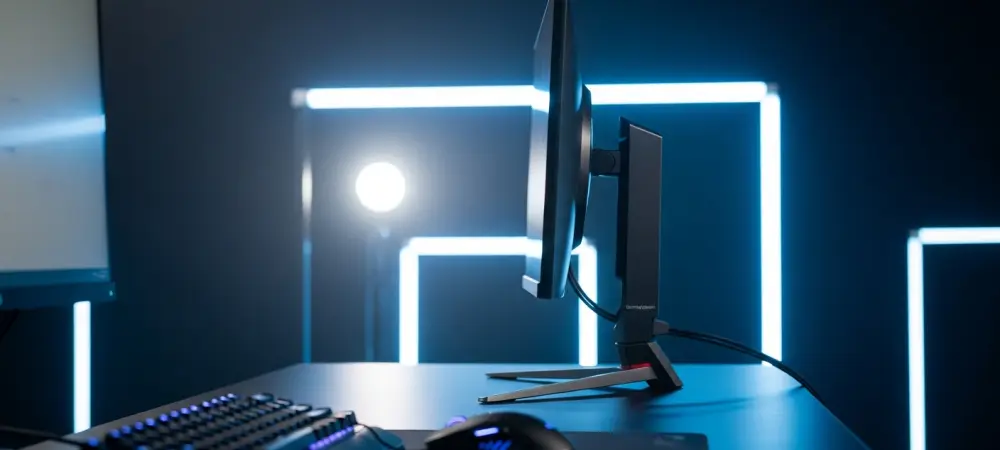
While the speed is what gets people in the door, the physical ergonomics and eye-care features are what actually sustain a long-term gaming career. The Evnia 27M4N5500PT model stands out because of the SmartErgoBase, which allows for precise height, tilt, swivel, and even 90-degree pivot adjustments to ensure the screen is exactly where the neck and eyes need it to be. Furthermore, the use of a Fast IPS panel designed to reduce blue light emissions is critical for anyone spending more than a few hours in front of a screen. By integrating Flicker-Free technology and a dedicated LowBlue Mode, the hardware actively works to prevent the digital eye strain that often accompanies high-intensity sessions. It is the combination of these comfort features with AI-powered lighting and ShadowBoost that creates a comprehensive “premium” experience rather than just a fast one.
With a peak brightness of 350 nits and a current focus on the Asia-Pacific region, how do you evaluate the competitive standing of these monitors in the global high-end market?
The 350-nit peak brightness is a bit of a curious choice for a monitor being marketed as a “premium” gaming device, as it doesn’t quite hit the heights needed for a truly transformative HDR experience. In an era where many flagship displays are pushing well beyond that, these monitors might struggle to convince the “visual-first” crowd who prioritize HDR contrast and deep blacks. However, the inclusion of modern connectivity like HDMI 2.1 and DisplayPort 1.4 ensures that they are ready for the latest GPUs and consoles, keeping them relevant in a technical sense. By launching first in the Asia-Pacific region, Philips is likely targeting the densest population of competitive PC gamers who value the 540Hz ceiling more than they value cinematic peak brightness. It will be interesting to see if the demand for raw speed outweighs the desire for HDR luminance once reviews start circulating.
What is your forecast for the future of multi-resolution display technology?
I believe we are entering an era where “one size fits all” monitors will become a relic of the past, replaced by hardware that adapts its identity based on the software being run. As panel technology continues to mature, I expect we will see these triple-mode capabilities become standard in high-end displays, eventually moving toward even higher native resolutions like 4K that can downscale to 1080p for 600Hz+ performance. Manufacturers will likely refine the “instant” switching through on-screen displays to be even more seamless, perhaps even automating the resolution change when a specific game is launched. We are moving toward a future where the monitor is no longer a static window, but a dynamic tool that optimizes itself for the specific demands of the moment, whether that is high-fidelity art or lightning-fast competition.