

Dominic Jainy is a seasoned IT professional with deep-rooted expertise in artificial intelligence and the evolving landscape of mobile hardware. Having spent years analyzing the convergence of machine learning and consumer electronics, he offers a unique perspective on how high-performance computing is redefining the boundaries of mobile photography. As the industry shifts toward professional-grade cinema tools in a pocket-sized form factor, Jainy’s insights help decode the technical milestones that allow a smartphone to compete with traditional broadcast equipment.
The vivo X300 Ultra marks the first time an “Ultra” model has moved into the international market. What strategic shifts allowed for this global expansion now, and what specific challenges does the brand face when competing with established flagships in the Western videography space?
The decision to bring the X300 Ultra to the global stage at MWC 2026 reflects a newfound confidence in their imaging pipeline that has been years in the making. By mastering still photography first, the brand has built a foundation of trust that allows them to now pivot toward high-end “end-to-end” video production for an international audience. The primary challenge lies in breaking the brand loyalty users have for established Western players who have dominated the professional video niche for a decade. To win, they must prove that their software ecosystem is just as reliable as their hardware when it comes to the demands of professional creators.
This device offers 4K 120fps recording in 10-bit Log and Dolby Vision across all rear cameras. How does this technical parity between lenses change the workflow for mobile filmmakers, and what are the hardware requirements for processing such high-bitrate data without overheating?
Technical parity across all lenses is a total game-changer because it eliminates the visual “jump” creators often experience when switching from a wide-angle to a telephoto lens. Since every camera on the back can handle 4K 120fps in 10-bit Log, a filmmaker can maintain a consistent color grade and motion blur across an entire sequence without compromise. Managing this level of data throughput is incredibly taxing, requiring a sophisticated cooling system to prevent thermal throttling during long shoots. The 10-bit Log format specifically preserves a massive amount of dynamic range, which gives the processor millions of additional color data points to crunch in real-time.
The transition from mastering still photography to focusing on “end-to-end” cinema production includes features like 3D LUTs and a Video Color Palette. How do these tools bridge the gap for creators who usually rely on desktop post-production, and what is the learning curve for a standard user?
These tools essentially move the heavy lifting of a desktop color grading suite directly into the palm of your hand. The Video Color Palette provides granular control over tone, saturation, and contrast, allowing for the kind of stylistic “look” that used to require hours of work in specialized software. For a standard user, the learning curve is surprisingly manageable because the interface provides immediate visual feedback as you adjust the sliders. By applying 3D LUTs during the recording phase, creators can see exactly how the final cinematic product will look before they even hit the stop button.
Video stabilization now features full-range 3° OIS alongside a Quad-Mic Audio Recording Master system. In what real-world environments will these improvements be most noticeable, and how does the audio system distinguish between primary subjects and ambient background noise during complex shoots?
The 3° OIS is most noticeable in high-action environments, such as filming while walking quickly or capturing subjects from a moving vehicle, where standard stabilization usually fails. This physical hardware compensation ensures that the footage remains fluid and “floaty” rather than jittery and digital. On the auditory side, the Quad-Mic Audio Recording Master acts like a directional spotlight for sound, using multiple inputs to triangulate the subject’s voice. It intelligently suppresses ambient distractions like wind or distant traffic, ensuring the emotional weight of the dialogue isn’t lost in the background noise.
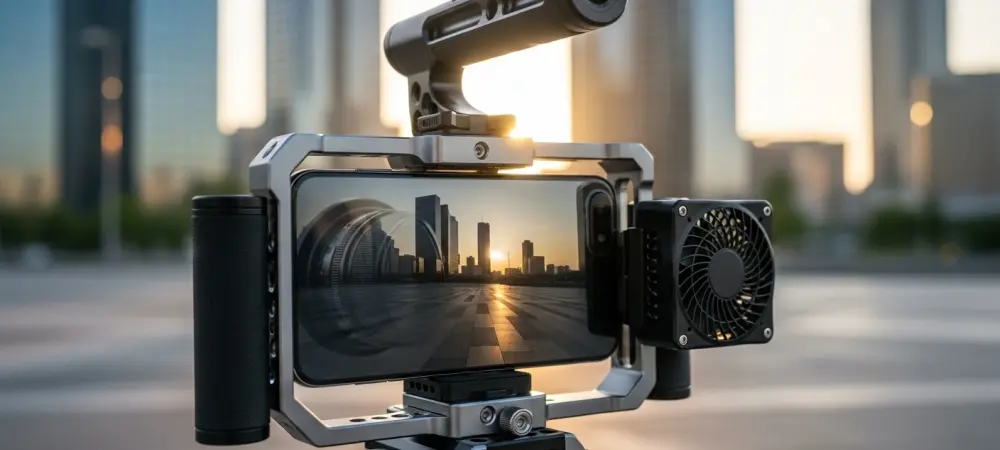
New accessories like camera cages, external lens frames, and cooling fans are being introduced for this model. How do these physical add-ons transform the ergonomics of a smartphone into a professional rig, and which specific accessory is most critical for sustained 4K 120fps production?
These accessories bridge the ergonomic gap between a thin, slippery smartphone and a heavy, tactile cinema camera. A camera cage allows for the mounting of external monitors and grips, providing the stability and “hand-feel” necessary for precision framing. However, for anyone serious about sustained production, the cooling fan is arguably the most critical component. Recording 4K at 120fps generates an immense amount of internal heat, and an external cooling solution is what permits the device to record for extended periods without the system shutting down for safety.
The Pro Video Mode interface is designed to mimic professional-grade videography equipment. Could you walk through the step-by-step process of setting up a cinematic shot using these manual controls, and how does the real-time LUT preview assist in maintaining visual consistency?
Setting up a shot begins with entering Pro Video Mode to lock in your shutter speed at double your frame rate to achieve natural motion blur. From there, you would use the manual focus peaking to ensure your subject is sharp, followed by selecting the 10-bit Log profile to maximize the data captured in the shadows and highlights. The real-time 3D LUT preview is vital here because Log footage looks very flat and gray on its own; the LUT overlays the final intended color grade so you can judge lighting and exposure accurately. This ensures that every clip you film throughout the day will match perfectly when you bring them together in the final edit.
What is your forecast for the vivo X300 Ultra?
I believe the X300 Ultra will serve as a wake-up call to the industry, proving that mobile videography has finally reached a professional “end-to-end” maturity. With the introduction of features like the 3° OIS and 4K 120fps across all sensors, we are seeing the hardware limitations of smartphones virtually disappear. My forecast is that this device will push competitors to stop treating secondary lenses as “backup” cameras and start providing the same high-bitrate capabilities across the entire rear array. As global availability expands, this model will likely become a favorite among independent filmmakers who need a cinema-grade kit that fits in a pocket.