

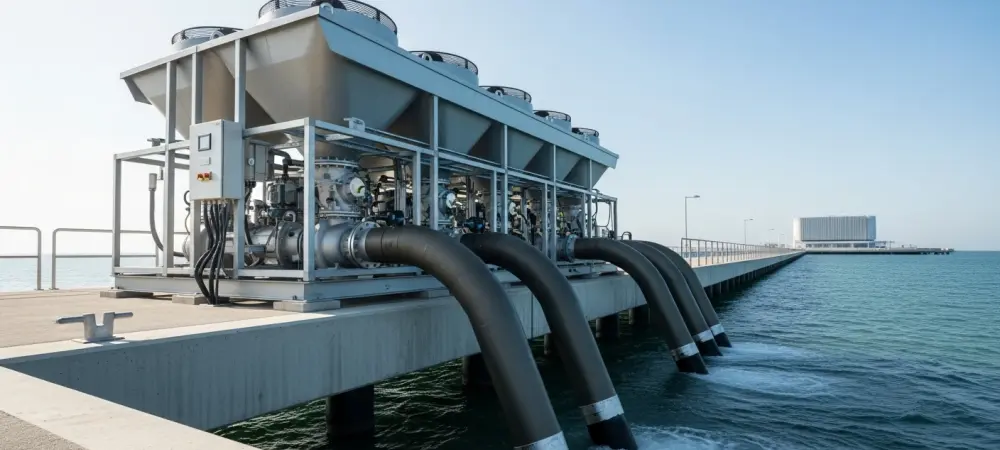
The massive industrial buildings that house the digital heart of our modern world are currently consuming freshwater at a rate that far outpaces the natural replenishment of local aquifers. As artificial intelligence and high-density computing become the standard for every global operation, the heat generated by these silicon engines has reached a breaking point, forcing engineers to reconsider the most abundant resource on our planet. While the tech industry has historically viewed the ocean as a corrosive threat, the urgent need for sustainable scaling is transforming the coastline from a scenic backdrop into a critical piece of infrastructure.
This exploration into maritime cooling addresses the growing friction between technological expansion and environmental preservation. By analyzing the shift toward seawater, the following sections examine the technical hurdles of salt management, the strategic innovations currently in play, and the economic pressures that are finally making expensive oceanic solutions look like a bargain. Readers can expect to understand why the status quo is no longer viable and how the industry is preparing to dive into a saltwater future.
Key Questions: Navigating the Saltwater Shift
Why Is Freshwater Usage Becoming a Liability for Data Center Operators?
The traditional model of data center cooling relies heavily on evaporative systems that require massive amounts of clean, potable water to keep server temperatures stable. In these setups, freshwater is sprayed over membranes to dissipate heat, a process that is highly efficient but incredibly wasteful in regions facing drought or water scarcity. As cloud regions expand into increasingly arid climates, the sheer volume of water required to support high-performance AI chips has begun to spark intense friction between tech giants and the communities that share their water tables.
Beyond the ethical concerns of depleting local drinking supplies, there is a mounting regulatory and social risk that companies can no longer ignore. Governments are beginning to tighten restrictions on industrial water permits, and the public “social license to operate” is often revoked when a new data hall is perceived as a threat to a town’s reservoirs. This pressure has moved the water conversation from a minor environmental metric to a core business risk, necessitating a pivot toward alternative cooling mediums that do not compete with human consumption.
What Technical Barriers Prevent Seawater From Being the Default Choice?
The primary reason salt water has not been the industry standard is its aggressive chemical nature, which wreaks havoc on traditional cooling equipment. Most existing infrastructure was designed for the predictable properties of freshwater; when seawater is used in standard evaporative systems, the water vanishes into the air but leaves behind a thick, crystalline residue of salt and minerals. These deposits quickly calcify, clogging expensive machinery and requiring frequent, costly maintenance that can lead to unexpected downtime.
Furthermore, the corrosive property of salt air and water creates a hostile environment for the sensitive metals found in server racks and cooling loops. Saltwater requires specialized materials like titanium or high-grade plastics to prevent rust and degradation, which adds a significant layer of complexity to the initial design phase. Because of these challenges, the industry has historically preferred the easy path of freshwater, even when facilities are located directly on the coast.
How Is the Industry Solving the Problem of Salt Accumulation?
Engineers have developed several clever workarounds to harness the ocean’s cooling power without letting the salt destroy the hardware. One successful method involves Wet Surface Air Cooling (WSAC), where seawater is sprayed over closed pipes containing a separate cooling fluid. While salt still builds up on the exterior of these pipes, the system is designed to be accessible for periodic freshwater rinsing, effectively isolating the corrosive elements while still benefiting from the ocean’s thermal mass.
Another more radical approach involves submerging the entire facility or using direct-to-chip liquid cooling in a closed loop. By sealing the data center environment and using heat exchangers to transfer energy to the seawater through a protective barrier, the salt never touches the delicate electronics or the internal cooling fluid. Microsoft’s underwater experiments demonstrated that these self-contained units can operate for years with minimal interference, proving that the ocean can serve as a massive, natural heat sink if the equipment is properly armored.
Is the Economic Transition Toward Seawater Cooling Becoming More Feasible?
The financial calculus of data center cooling is shifting rapidly as the cost of freshwater rises and the price of specialized maritime hardware begins to stabilize. For years, the low cost of municipal water made it difficult to justify the high capital expenditure required for seawater-ready pumps, pipes, and filtration systems. However, as AI workloads drive heat densities to unprecedented levels, the efficiency of seawater—which stays cooler than ambient air during summer months—is starting to offer a clear operational advantage.
Moreover, the long-term sustainability benefits are now being factored into the return on investment. A facility that can operate without straining a local aquifer is less likely to face legal battles or forced shutdowns during a drought. As more companies invest in advanced filtration technologies, such as desalination nanofibers, the barrier to entry is lowering. The transition is no longer a luxury for the environmentally conscious but a strategic necessity for any operator looking to build a resilient, future-proof network.
Summary: A Strategic Recap of Maritime Innovation
The move toward seawater cooling represents a fundamental shift in how the digital economy interacts with the natural world. By moving away from evaporative freshwater systems and toward closed-loop maritime architectures, the industry is addressing both its heat problem and its social responsibility. Key takeaways include the recognition that salt management is a solved engineering problem rather than a total barrier, and that the financial premiums of seawater infrastructure are increasingly offset by the rising costs of freshwater scarcity. These innovations suggest that coastal regions will soon become the most sustainable hubs for the global AI infrastructure.
Final Thoughts: The Future of Global Infrastructure
The integration of oceanic cooling was a significant milestone in the evolution of sustainable computing. By treating the ocean as a partner rather than an obstacle, the industry successfully decoupled its growth from the depletion of vital land-based resources. This transition highlighted the importance of proactive engineering in the face of environmental limits, ensuring that the digital world could continue to expand without compromising the physical one. Moving forward, the lessons learned from maritime cooling should serve as a blueprint for other resource-heavy industries looking to harmonize their operations with the planet’s natural cycles.