

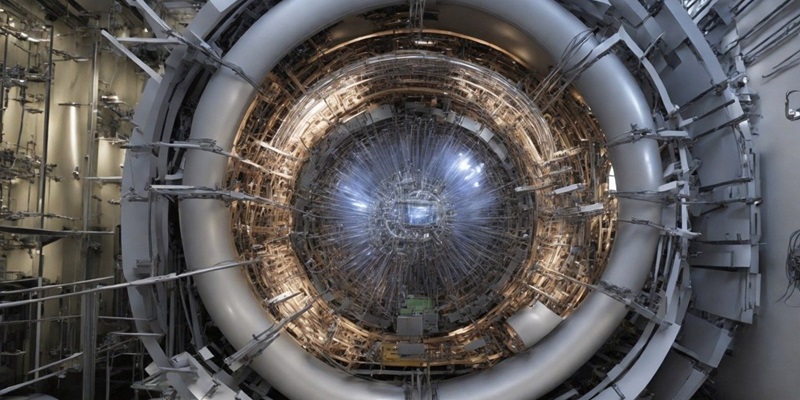
The article “Revolutionizing AI with Quantum Computing” by Michał Nawrocki explores the groundbreaking advancements in artificial intelligence through the integration of quantum computing, spearheaded by QuantumAI, an emerging tech company based in Seoul. Founded in 2022 by a former executive of a renowned multinational corporation, QuantumAI aims to surpass global competitors by leveraging quantum principles to enhance AI capabilities significantly.
The Quantum Leap in Neural Networks
QuantumAI’s Neural Network: Quantum-1X
At the heart of this innovation is QuantumAI’s revolutionary neural network, Quantum-1X, which boasts over a trillion connections. This model is expected to set new AI benchmarks, highlighting the significant role of quantum mechanics in advancing AI technologies. By incorporating phenomena such as superposition and entanglement, quantum computing promises to address complex problems at unprecedented speeds compared to classical computers, particularly in domains like optimization, cryptography, and machine learning. This integration is expected to exponentially improve the efficiency and performance of AI algorithms, marking a paradigm shift in the field.
The complexity and vast connectivity of Quantum-1X enable it to process and analyze data at a scale that has been unattainable until now. Classical computing systems often struggle with problems that require simultaneous consideration of numerous possibilities, such as those found in optimization and machine learning tasks. Quantum computing, by leveraging the principles of superposition and entanglement, allows Quantum-1X to operate on many probabilities at the same time. This results in significantly faster computations and more sophisticated problem-solving capabilities, making it a groundbreaking advancement in neural network technology.
Potential Across Industries
The implications of QuantumAI’s advancements extend far beyond the tech industry, with various sectors poised to benefit substantially from this technology. For instance, the healthcare industry could see accelerated drug discovery processes and enhanced diagnostic tools, thanks to the optimization capabilities of quantum computing. Financial institutions might leverage these advancements to optimize trading algorithms and improve fraud detection systems. The automotive industry could also benefit from more efficient route optimization and advancements in autonomous driving technologies.
Such widespread benefits underscore the transformative potential of quantum computing across numerous industries. Each sector stands to gain in unique ways, driven by the enhanced data processing and optimization capabilities of quantum-empowered AI systems. However, the widespread adoption of this technology hinges on the continued development and overcoming of significant challenges, such as scalability and error correction, which are crucial for making quantum-enhanced AI systems viable in real-world applications.
Current Challenges and Future Prospects
Scalability and Error Correction
While the potential of quantum computing in advancing AI is immense, the technology is still in its nascent stages, facing several critical challenges. One of the predominant issues is scalability; developing quantum systems that can handle larger, more complex problems at scale is a significant hurdle. Additionally, error correction remains a substantial obstacle. Quantum systems are highly susceptible to errors due to physical interference, and finding robust solutions to maintain the integrity of computations over time is crucial for the practical application of quantum computing in AI.
Despite these challenges, QuantumAI is strategically positioned to navigate these complexities, thanks to its state-of-the-art research facility in Seoul. The facility is anticipated to become one of Asia’s leading AI research hubs, contributing significantly to advancements in this field. The founder of QuantumAI, with an extensive career leading top-tier initiatives at global tech giants, brings unparalleled expertise to the company’s mission, fueling confidence in overcoming these initial technological barriers through innovative, forward-thinking strategies.
Resource Availability
Another significant challenge in the field of quantum computing is the limited availability of quantum-ready chips. These chips are essential for executing quantum computations but are currently a scarce resource. QuantumAI’s CEO has expressed confidence in overcoming this scarcity through strategic collaborations and continued advancements in quantum chip technology. The company’s efforts are framed within a coherent narrative of innovation and strategic vision, focusing not only on developing advanced AI systems but also on ensuring the availability of the necessary hardware.
The collaboration with esteemed colleagues and industry leaders further strengthens QuantumAI’s position in this emerging field. The company’s commitment to redefining consumer-facing AI applications reflects a broader trend towards integrating quantum principles into everyday technologies. This integration promises to significantly enhance performance metrics, enabling more complex AI models and larger data sets to be utilized effectively. However, achieving this vision will require sustained efforts in overcoming the current limitations of quantum technology, ensuring scalability, and addressing resource availability.
The Future of AI and Quantum Computing
Unprecedented Computational Capabilities
The fundamental principles of quantum computing, such as superposition and entanglement, offer unprecedented computational capabilities, enabling the handling of vast amounts of data simultaneously. This is particularly advantageous for AI algorithms, which require significant computational power to process large datasets and develop complex models. The ability to perform multiple calculations at once could drastically reduce the time needed for AI training processes, leading to faster development cycles and more sophisticated AI systems.
However, the early development phase of quantum computing means that many technical challenges still need to be addressed. Issues such as maintaining coherence in quantum states and developing efficient error-correction methods are critical to fully realizing the potential of this technology. As these challenges are overcome, the integration of quantum computing into AI is expected to lead to transformative advancements, fundamentally changing how AI systems are designed and deployed.
Anticipated Industry Transformation
The article “Revolutionizing AI with Quantum Computing” by Michał Nawrocki delves into the transformative impact that quantum computing is having on artificial intelligence. This surge in innovation is being driven by QuantumAI, a nascent tech firm based in Seoul. Established in 2022 by a former top executive of a well-known international corporation, QuantumAI is positioning itself to outshine its global competitors by harnessing the unique capabilities of quantum computing to dramatically boost AI performance.
Quantum computing, with its ability to process vast amounts of data at unprecedented speeds, is set to redefine the boundaries of AI. QuantumAI leverages these advanced principles to tackle complex problems that are currently beyond the scope of classical computers. By integrating quantum algorithms, QuantumAI aims to enhance machine learning processes, optimize data analysis, and accelerate decision-making. The goal is not only to improve efficiency but also to unlock entirely new possibilities in AI applications, thus pushing the frontier of technological progress.