

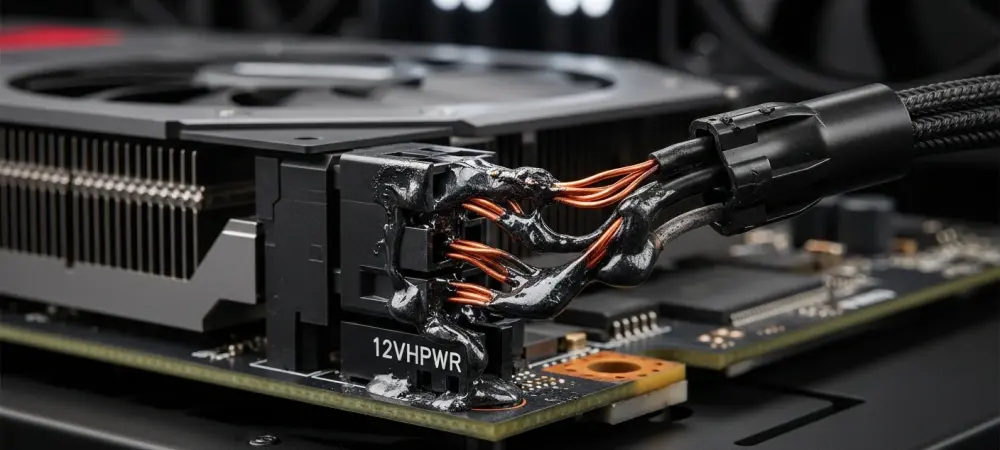
The unsettling glow of a melting power connector on a top-tier graphics card has become an all-too-familiar horror story for PC enthusiasts, a catastrophic failure that can instantly destroy one of the most expensive components in a high-performance build. This guide investigates a critical question born from this crisis: can a simple software tweak, specifically limiting the GPU’s power draw, serve as a reliable shield against this hardware disaster? By deconstructing a real-world failure, this article provides a definitive answer and offers the essential best practices to safeguard your investment.
The Million-Dollar Question Is Lowering Power a Real Fix for Overheating GPU Connectors
The persistent issue of melting 16-pin power connectors, known initially as 12VHPWR and later revised to 12V-2×6, has cast a long shadow over the last few generations of high-end graphics cards. This single point of failure has been responsible for countless ruined GPUs, sparking widespread concern and debate within the hardware community. The connector’s design, intended to deliver immense power through a compact interface, has proven to be a double-edged sword, demanding perfect installation to avoid catastrophic overheating.
Faced with this threat, many users have turned to a seemingly logical defense mechanism: manually reducing the GPU’s power limit through software. The core idea is that by capping the total wattage flowing through the cable, one can reduce the electrical load and, consequently, the heat generated at the connection point. This leads to the central question explored here: is this user-enforced power limit a genuine preventative measure, or does it merely create a false sense of security while the underlying risk remains?
To answer this question thoroughly, this guide will delve into a specific, cautionary case involving a GIGABYTE RTX 5090. Through a step-by-step analysis of this incident, it will explore the technical reasons why the connector failed despite the owner’s precautions. The goal is to move beyond speculation and provide clear, actionable advice grounded in the physical realities of electrical engineering, empowering users to truly protect their hardware.
A Legacy of Heat Understanding the 16-Pin Connector Crisis
The story of the 16-pin connector begins with the launch of the RTX 40 series, which introduced the 12VHPWR standard. Its purpose was ambitious and necessary: to streamline power delivery to graphics cards that were beginning to demand well over 450 watts, replacing the clutter of multiple 8-pin PCIe cables with a single, high-capacity solution. This simplification, however, introduced a new level of sensitivity, as the integrity of the entire power delivery system now hinged on one small, precise connection.
In response to early reports of melting, the industry quickly iterated on the design, leading to the updated 12V-2×6 standard. This revision incorporated a key safety improvement by recessing the four small sense pins. This change was designed to ensure that the main power pins were fully seated and making solid contact before the sense pins could signal to the GPU that it was safe to draw high power levels. While a step in the right direction, this revision did not eliminate the fundamental vulnerabilities of the connector.
Over time, investigations by hardware experts and community members have consistently pointed to a few primary causes for these failures. The most common culprit is an improperly seated connector, where even a slight gap can lead to a poor connection. Another significant factor is excessive cable bending too close to the connector head, which can exert uneven pressure on the pins and compromise their contact. Finally, the bundled adapter cables, which convert multiple 8-pin outputs to a single 16-pin input, have been frequently implicated due to their variable quality and the introduction of additional points of potential failure.
Anatomy of a Failure Deconstructing the 500W Meltdown
Step 1 The Users Precautionary Measure Capping the RTX 5090 at 500W
The case at the heart of this analysis involves a user who, fully aware of the risks associated with the 16-pin connector, took proactive steps to protect their new GIGABYTE RTX 5090. Understanding that high power draw equals high thermal stress, the user accessed their GPU’s control software and set the power limit to 500 watts. This represented a significant reduction from the card’s potential peak draw, which often exceeds 600 watts on high-end models.
This decision was rooted in sound, albeit incomplete, reasoning. The fundamental principle of electrical resistance dictates that as current flows through a conductor, heat is generated. By reducing the total power, the user aimed to lower the overall current, thereby decreasing the baseline thermal load on the connector and its delicate pins. In theory, this should create a wider margin of safety, making the connection less susceptible to overheating and ultimate failure. This precautionary measure was an attempt to mitigate the problem at its source: the sheer amount of energy being funneled through a single point.
Step 2 The Inevitable Outcome A Melted Connector Despite Lower Wattage
Despite the user’s careful power management, the outcome was the very disaster they sought to prevent. After a period of use, the 12V-2×6 connector on the RTX 5090 failed, with images from the user’s report showing a clear and severe meltdown. The damage was concentrated entirely on the top row of power pins, which were visibly charred and deformed, while the bottom row remained pristine. This pattern of failure provided critical clues, revealing that the problem was far more complex than just the total amount of power being used.
An analysis of the user’s setup and the damage itself points directly to the true cause of the failure. The visual evidence of one row melting while the other is untouched is a classic sign of a catastrophic imbalance in the electrical connection. This incident demonstrates that even a reduced power load becomes intensely dangerous when it is not distributed evenly across all the available conductive pathways, leading to a thermal runaway in the pins that are forced to carry the entire load.
The Critical Flaw Uneven Load Distribution
The core of this failure lies not in the 500 watts of power but in how that power was forced to travel. A perfectly seated 12V-2×6 connector distributes the electrical load evenly across all twelve of its main power pins. However, if the connector is even slightly misaligned, angled, or not fully inserted, some pins may make poor or no contact at all. In this specific case, the bottom row of pins likely had an insecure connection, forcing the entire 500-watt load to be channeled exclusively through the top row. This effectively turned six small pins into the sole conduit for an amount of power designed to be handled by twelve, causing their resistance to skyrocket and generate immense, localized heat until they melted.
The Adapters Role An Unreliable Middleman
A crucial detail from the user’s report is the use of a three 8-pin to 12V-2×6 adapter cable—the kind often bundled with graphics cards. These adapters have consistently been identified as a significant risk factor. They introduce multiple additional points of contact and potential failure between the power supply and the GPU. The manufacturing quality of these adapters can vary wildly, and their inherent design makes them more susceptible to the seating and bending issues that cause uneven load distribution. A direct, high-quality cable from an ATX 3.0 or 3.1 power supply provides a much more reliable and secure connection, eliminating the adapter as a variable in the equation.
The Real Culprit Its Physical Integrity Not Just Total Power
This case ultimately proves a vital lesson: the physical integrity of the connection is far more important than the total wattage flowing through it. A lower power limit cannot correct a poor physical connection. While 600 watts across twelve pins is safe, 500 watts concentrated on just six pins is a recipe for disaster. The root cause of the meltdown was not the GPU’s power consumption but the failure to establish a secure, even contact across all the connector’s power pins. The power limit only delayed the inevitable and tragically created a false sense of security for the user.
Key Takeaways Why Power Limiting Isnt a Silver Bullet
The analysis of this failure yields several critical conclusions that every owner of a high-end GPU should understand. First and foremost, the physical connection is paramount. The single most important factor in preventing a meltdown is ensuring the 12V-2×6 connector is fully and securely seated, creating a solid and even contact across all pins. This physical security is more critical than any software setting.
Secondly, adapters increase risk. While they provide backward compatibility with older power supplies, the bundled 8-pin to 16-pin adapters introduce extra complexity and potential points of failure. Whenever possible, the ideal solution is a direct connection using a native, high-quality 12V-2×6 cable from an ATX 3.0 or ATX 3.1 compliant power supply. This minimizes the variables that can lead to an insecure connection.
Furthermore, it is clear that uneven load distribution is catastrophic. Even a power level that seems moderate, such as 500W, becomes intensely destructive when channeled through only a fraction of the connector’s designated pins. This concentration of current creates extreme localized heat that no connector is designed to withstand. This is the mechanism that bypasses the safeguard of a reduced power limit. Ultimately, this demonstrates that power limits create a false sense of security. While capping a GPU’s power can reduce overall system heat and power consumption, it does not and cannot fix the root mechanical cause of connector melting. Relying on this software tweak as a primary safety measure is a dangerous gamble, as it ignores the fundamental problem of physical connection integrity.
The Future of GPU Power Industry Lessons and Next-Generation Challenges
The ongoing crisis with the 16-pin connector has forced a response from the hardware industry, most notably the strong push toward the ATX 3.1 power supply standard. This standard codifies the improved 12V-2×6 connector and promotes the manufacturing of high-quality, native cables designed to handle high power loads reliably. The clear message from PSU and GPU manufacturers is a move away from adapters and toward direct, purpose-built connections as the new baseline for high-performance systems.
This experience raises important questions about the future of GPU power delivery. As graphics cards continue to grow in power and complexity, will manufacturers continue to refine the 16-pin standard, or will the persistent issues prompt a more radical change? Some speculate about a return to multiple 8-pin connectors for redundancy, while others envision an entirely new, more robust connector standard designed from the ground up to prevent the types of failures seen in recent years. The industry’s path forward will be a balancing act between power, simplicity, and safety.
The crisis has also spurred the development of third-party monitoring tools, such as the ElmorLabs Wireview II Pro, which measures power draw and temperature directly at the connector. The growing popularity of such devices highlights a gap in the market and a desire from consumers for greater insight and control. It poses the question of whether this level of monitoring should be considered an enthusiast luxury or a necessary tool for anyone investing in flagship components, suggesting a future where integrated sensing and diagnostics could become standard features.
Protecting Your Investment Best Practices to Prevent a Meltdown
The evidence shows that while limiting a GPU’s power is an insufficient safeguard on its own, users are not helpless in the face of this potential hardware failure. The key to prevention lies not in software workarounds but in meticulous installation and the use of high-quality components. By focusing on the physical integrity of the power connection, the risk of a meltdown can be dramatically reduced. Adhering to a strict checklist of best practices is the most effective strategy for ensuring the long-term health and safety of a modern, high-power graphics card. A final recommendation is to prioritize a direct, secure connection with high-quality components over any software-based solution. The presented case demonstrated that no power limit can save a connector that is not making proper physical contact. Therefore, users must always follow installation guidelines with precision, ensuring that the connector is fully seated with an audible click and that the cable has sufficient slack to avoid placing any stress on the pins. This diligent approach is the true path to protecting your hardware investment.