

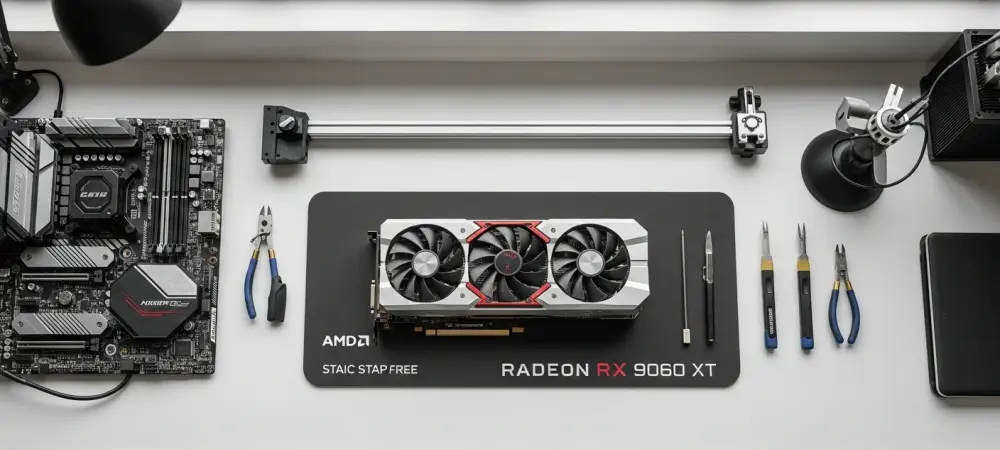
Introduction Redefining Budget Card Potential
A graphics card engineered for mainstream accessibility rarely shatters performance records typically reserved for the most expensive, elite-tier hardware. This review examines the AMD Radeon RX 9060 XT, a new budget-friendly GPU that has captured headlines with a stunning world-record overclock. The central question is whether this impressive engineering achievement translates into practical, real-world value for everyday gamers and system builders, or if it is merely a spectacle for enthusiasts.
The goal here is to determine if the RX 9060 XT is a worthy investment for its target audience. An analysis will be conducted on its performance under normal conditions, separating the hype of its extreme overclocking capabilities from its tangible, out-of-the-box utility. This assessment provides a clear picture of what consumers can realistically expect from this intriguing new entry into the competitive graphics card market.
Architecture and Core Specifications
The Radeon RX 9060 XT is built on AMD’s latest architectural foundation, designed to deliver efficient performance for mainstream gaming and content creation. It features a streamlined core configuration optimized for popular resolutions, paired with a memory subsystem that balances speed and cost-effectiveness. With a reference boost clock of 3.13 GHz, its specifications clearly position it as an accessible option for PC builders who prioritize a strong performance-to-price ratio over bleeding-edge power.
This GPU’s I/O and feature set are modern, ensuring compatibility with the latest display technologies and software ecosystems. By targeting the heart of the market, AMD has crafted a component that aims to be the default choice for budget-conscious builders who refuse to compromise on a quality gaming experience. Its technical makeup is a testament to a focused design philosophy: delivering what matters most to the majority of users.
Performance Analysis From Stock Speeds to World Records
In real-world scenarios using conventional air and liquid cooling, the Radeon RX 9060 XT demonstrates admirable performance. Capable of sustaining speeds between 3.3 and 3.5 GHz in gaming and productivity benchmarks, it delivers a smooth and responsive experience that exceeds expectations for its price point. These attainable speeds showcase the card’s practical power, proving it is more than capable of handling modern titles and demanding applications without exotic cooling solutions. However, the card’s true potential was revealed when professional overclocker Splave pushed a sample to a record-breaking 4.769 GHz using liquid nitrogen. This remarkable achievement, a full 1.6 GHz beyond its reference clock, highlights the incredible quality of the underlying silicon. It is crucial to contextualize this feat not as a daily-use scenario, but as a demonstration of AMD’s engineering prowess and the extreme headroom available to hardware enthusiasts.
Strengths and Weaknesses
The most significant strength of the RX 9060 XT is its exceptional overclocking headroom, which signals a robust and well-engineered design. This potential, combined with its solid stock performance, results in a formidable performance-per-dollar value proposition that is hard to ignore in the budget segment. For those willing to tinker, the card offers an opportunity to extract additional power well beyond its initial cost.
Conversely, the primary weakness lies in the perception created by its record-breaking overclock. This extreme potential is inaccessible to the average user who relies on standard cooling methods. Therefore, its stock performance must be judged independently of the overclocking hype. Buyers must base their decision on its out-of-the-box capabilities, treating the overclocking potential as a bonus rather than a core feature.
The Final Verdict
The AMD Radeon RX 9060 XT stands as a formidable budget graphics card, offering a compelling blend of affordability and solid baseline performance. It successfully meets the demands of its intended market, providing a reliable foundation for mainstream gaming rigs. The world-record overclock serves as a powerful testament to the quality of its engineering but should be viewed as an impressive bonus for enthusiasts rather than a defining feature for the average consumer.
Ultimately, the card’s value is found in its everyday utility. Its ability to perform well under typical conditions makes it a strong contender in its class. The headline-grabbing frequency is a fascinating footnote that underscores the potential of the architecture, confirming that AMD has built a highly capable and efficient piece of silicon.
Recommendations for Potential Buyers
The Radeon RX 9060 XT is highly recommended for extreme overclockers and hardware enthusiasts who thrive on pushing new limits. Its record-setting potential offers a new platform for those dedicated to the hobby of performance tuning. For this niche group, the card is an exciting and almost essential purchase. For budget-conscious gamers, the RX 9060 XT remains a strong contender, provided the purchase decision is based on its practical, out-of-the-box performance. It delivers excellent value and a dependable gaming experience without any modifications. Consumers looking for a reliable and affordable graphics card will find it to be a smart and satisfying investment.