

In an era where the PC hardware market is defined by scarcity and skyrocketing prices, the release of an ultra-premium graphics card can feel detached from reality. Yet, the MSI RTX 5090 Lightning Z arrives as a deliberate exception—a high-performance “halo” product that prioritizes engineering prowess over mass-market appeal. With only 1,300 units in existence and a price tag that rivals a used car, this hardware represents the absolute ceiling of current consumer technology, pushing the boundaries of power delivery and thermal management.
The following interview explores the technical extremes of this limited-edition GPU, examining the design philosophy behind such an ambitious project and the challenges of managing record-breaking power draws.
In a market where high-end components are increasingly expensive and scarce, how do you justify developing a “halo” product with a $5,000 price tag? What specific technical milestones take priority when sales volume is no longer the primary objective for an engineering team?
The justification for a product like the Lightning Z isn’t found in a traditional sales spreadsheet; it is an engineering statement designed to showcase what is possible when you remove every standard constraint. When the goal isn’t to sell millions of units, the priority shifts toward creating a technical showcase that highlights a brand’s absolute capabilities in power delivery and cooling. For this project, the milestones were about achieving a “no-limits” design, which resulted in a massive PCB featuring forty 60 A power stages and a 2,500 W BIOS capability. It functions much like a hypercar in the automotive world, serving as a lighthouse for the brand’s engineering team to flex their muscles without worrying about MSRP.
Since this hardware requires a 1,600W power supply and unique high-power connectors, what are the specific challenges of managing heat across the GDDR7 memory and power stages? How does full-card liquid cooling change the stability of binned silicon during high-intensity tasks?
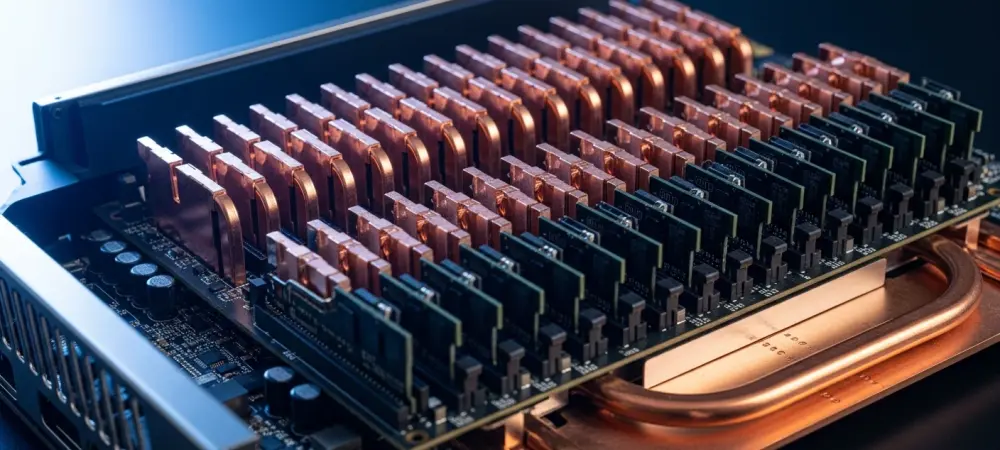
Managing heat becomes an monumental task when you are pulling 770 W or more during intensive gaming sessions like A Plague Tale: Requiem. To handle this, we utilized a true full-card liquid cooling solution where the copper cold plate makes direct contact with the GB202 die, the GDDR7 memory, and the power stages simultaneously. This approach yielded incredible results, keeping the GPU at a peak of just 54 °C at stock settings while the fans remained a whisper-quiet 1,000 RPM. By keeping the memory 12 °C cooler than competing high-end models, we provide a much more stable environment for the hand-picked, binned silicon to maintain higher clock speeds, such as the 3.25 GHz we achieved during our overclocking tests.
Integrating a large display that Windows treats as a secondary monitor presents unique usability hurdles for the end user. Why choose a traditional panel over OLED despite the visual trade-offs, and how should builders effectively manage the physical strain of a component weighing over four kilograms?
The decision to use a traditional 8-inch panel instead of OLED was a purely thermal calculation, as OLED panels simply ran too hot for this specific implementation. While the choice results in a slightly more washed-out image, it was a necessary trade-off to maintain the card’s strict thermal targets. Regarding the physical strain, this is a massive piece of hardware—the card itself is 2,673 grams and the 360 mm radiator adds another 1,293 grams, bringing the total package to nearly 4 kg. To manage this weight safely, builders must use a high-quality vertical mount and ensure their chassis has a completely open expansion area to accommodate the card’s 61 mm width and 260 mm length.
With access to extreme BIOS settings and hand-picked silicon, what performance ceiling is currently being hit by enthusiast hardware? Beyond standard benchmarks, what specific hardware modifications are necessary to bridge the gap between standard liquid cooling and world-record-breaking liquid nitrogen setups?
We are seeing a performance ceiling that is roughly 13% to 15% higher than the Founders Edition when pushed to its limits on liquid cooling, though the real gains are in thermal efficiency and noise levels. The hand-picked silicon allows for a 3 GHz base clock out of the box, which is a significant jump, but to truly bridge the gap to world-record levels, you have to move beyond the integrated AIO. Professional overclockers have already used this specific PCB to break 19 world records, but that requires stripping the card down and using liquid nitrogen to bypass the thermal limits of even the best 360 mm radiators. The hardware is built for it, featuring a dual-connector power setup that won’t even post unless it detects four 8-pin inputs via the adapter.
When binned components and leaked high-wattage BIOS files become available to the public, how does that shift the value proposition for premium hardware? What steps can manufacturers take to ensure that exclusive features remain unique to the physical product rather than being easily replicated on cheaper models?
The value proposition definitely shifts when an 800 W BIOS leaks online, as savvy users can flash that onto a more “affordable” liquid-cooled card and save upwards of $1,400. However, software can’t replicate the physical reality of forty binned power stages or the premium carbon fiber and aluminum aesthetics of a 246-gram backplate. Manufacturers maintain exclusivity through the physical presentation—the unboxing experience, the limited production run of 1,300 units, and the unique hardware-software integration of the Lightning Hub. Ultimately, while you can mimic the power limits on a cheaper card, you cannot replicate the thermal headroom and the “cream of the crop” silicon quality that comes with a hand-picked halo product.
What is your forecast for the ultra-premium GPU market?
I predict that the ultra-premium market will continue to drift away from traditional “gaming” metrics and move further into the realm of luxury collectibles and professional AI development tools. As we see with the $5,090 price tag of the Lightning Z, these cards are becoming engineering showcases rather than consumer products, and I expect future generations to lean even harder into exotic materials and integrated secondary displays. While the “standard” high-end will remain the focus for most, this “halo” tier will likely become even more exclusive, with smaller production runs and even more extreme power requirements that will eventually necessitate dedicated 240V circuits for the most ambitious home builds.