

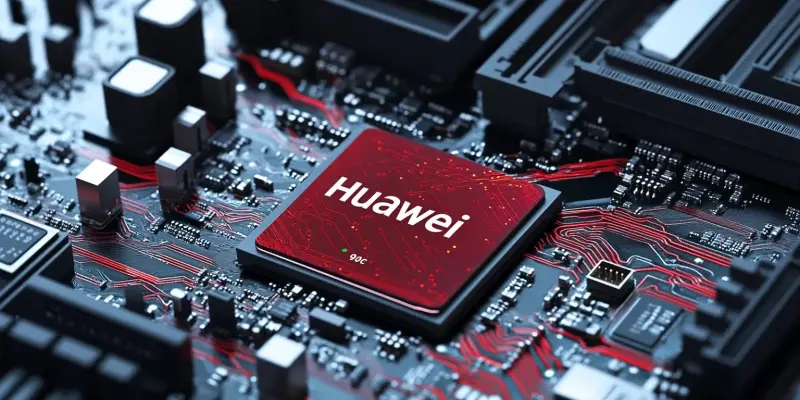
In a rapidly evolving technological landscape where artificial intelligence (AI) is at the forefront, competition among industry giants is inevitable. Huawei’s ambitious strides with its Ascend 910C AI chip present a formidable challenge to NVIDIA’s longstanding market dominance. Achieving an impressive 40% yield rate, improved from 20% last year, signifies Huawei’s leap in efficiency and production capabilities. This remarkable progress bolsters Huawei’s potential to disrupt the AI GPU market, particularly in the Chinese domain, where it seeks to match the performance benchmarks set by NVIDIA’s H00 AI GPU.
Technological Advancements and Strategic Goals
Huawei’s leap in AI technology, showcased by the Ascend 910C, marks an essential milestone. The 40% yield rate is not just a statistical achievement; it underscores Huawei’s ability to mass-produce high-quality chips, ensuring competitive performance in demanding AI tasks. This yield improvement highlights the company’s focus on refining its manufacturing processes and enhancing yield figures, which are vital for scaling production efficiently. Huawei’s strategy involves producing over 100,000 units by the close of 2025, reflecting aggressive growth intentions and an eagerness to infiltrate markets traditionally dominated by NVIDIA.
Integral to Huawei’s approach is the development of its CANN software to rival NVIDIA’s widely-used CUDA. By offering a competitive alternative, Huawei aims to cater to the specific needs of the Chinese market, potentially reducing dependency on foreign technology. This local market focus aligns with broader national goals of technological self-reliance and innovation. The strategic creation of powerful AI solutions designed for high-end tasks positions Huawei as a tech leader poised to meet the increasing demands of AI workloads. By providing more robust AI capabilities, Huawei not only serves the immediate market needs but also paves the way for future advancements.
Breaking Market Dominance
The AI GPU market has long been dominated by NVIDIA, whose GPUs are integral to numerous AI applications worldwide. However, Huawei’s Ascend 910C, combined with an improved production yield, represents a credible threat to this dominance. Huawei’s ability to leverage domestic market needs and create tailored solutions could gradually weaken NVIDIA’s stronghold in China. The production goal of 100,000 units by 2025 underscores Huawei’s intention to foster market competitiveness and innovation.
The drive to enhance profitability rates further propels Huawei’s ambitions. By improving production efficiencies and increasing yield rates, Huawei anticipates not only substantial market presence but also economic gains that can be reinvested in research and development. This reinforces the company’s commitment to staying ahead in technological advancements. Additionally, Huawei’s strategic vision is evident in its pursuit to move beyond supporting low-to-mid workloads, signaling readiness to tackle more complex, high-demand AI applications.
Paving the Way for AI Innovation
In today’s fast-paced technological environment, where artificial intelligence (AI) leads the charge, competition among industry titans is inevitable. Huawei’s significant advancements with its Ascend 910C AI chip pose a strong challenge to NVIDIA’s entrenched market position. The Ascend 910C’s impressive 40% yield rate, up from 20% the previous year, highlights Huawei’s leap in efficiency and production. This considerable progress elevates Huawei’s capacity to disrupt the AI GPU market, particularly within China, as it aims to compete with the performance standards set by NVIDIA’s H00 AI GPU. Huawei’s strategic focus on enhancing its AI hardware capabilities suggests a broader ambition to become a dominant player in the AI sector. As Huawei continues to make strides, the competitive dynamics of the AI landscape are set to shift, potentially leading to significant innovations and advancements in AI technology. Huawei’s relentless push for improvement symbolizes the intense race to lead in AI and reshape the future technological framework.