

Dominic Jainy has spent years at the intersection of artificial intelligence and hardware, helping companies understand how machine learning can transition from cold data centers into our everyday wardrobes. As an expert in artificial intelligence and machine learning, he brings a unique perspective on the practical utility and integration of emerging tech. In a world where our pockets are already full of powerful silicon, Dominic explores why the next frontier of computing isn’t in our hands, but on our faces and lapels.
This discussion delves into the tactical pivot of wearable technology, moving away from the ambitious “smartphone killer” narrative toward a more grounded, task-oriented approach. We examine the rise of smart glasses as a socially acceptable form factor and the specific productivity gains offered by AI-powered recording devices that turn conversations into organized notes. Dominic also addresses the friction points of the current market, including the monochrome limitations of early AR displays and the economic realities of subscription-based hardware. Finally, the conversation tackles the looming shadow of privacy in an era of continuous listening and ambient assistance.
Many modern wearables are shifting away from trying to replace smartphones to focusing on specific tasks like recording, translation, and reminders; how does this functional pivot change the way people integrate tech into their daily lives?
The shift is profound because it moves us away from the “screen-staring” posture that has dominated the last two decades. By focusing on specific tasks like live translation or hands-free recording, these devices become invisible assistants that allow us to stay present in the moment rather than being pulled away by a buzzing phone. Instead of digging through a pocket to find an app, a user can simply speak to their glasses to get a smart reminder or capture a quick video of a fleeting memory. This focus on functionality rather than replacement means the hardware can be smaller and more specialized, creating a more seamless experience where technology serves our needs in the background. It feels less like using a computer and more like having a helpful friend who remembers the details of a conversation so you don’t have to, ultimately making our interactions with technology feel more natural and less intrusive.
With the Ray-Ban Meta Gen 2 gaining mainstream popularity, what specific features make smart glasses a more acceptable form factor for users compared to more experimental AI pins?
The Ray-Ban Meta Gen 2 has cracked the code by prioritizing a design that looks like ordinary, stylish eyewear rather than a bulky, futuristic gadget. Users are much more comfortable wearing something that feels familiar on their face, especially when it includes high-quality open-ear speakers for music and the ability to capture photos and videos without touching a single button. The sensory experience is key here; you can hear your surroundings while listening to a podcast or get real-time menu translations while walking through a foreign city. By integrating AI assistance directly into a form factor people already use, manufacturers avoid the “social friction” that often dooms more radical, clunky designs like lapel pins. It represents a safe yet versatile entry point for someone who wants to dip their toes into the world of AI without feeling like they are wearing a science experiment on their chest.
For professionals who spend their days in meetings, tools like the Plaud NotePin S offer automated transcripts and summaries; what impact does this have on workplace productivity?
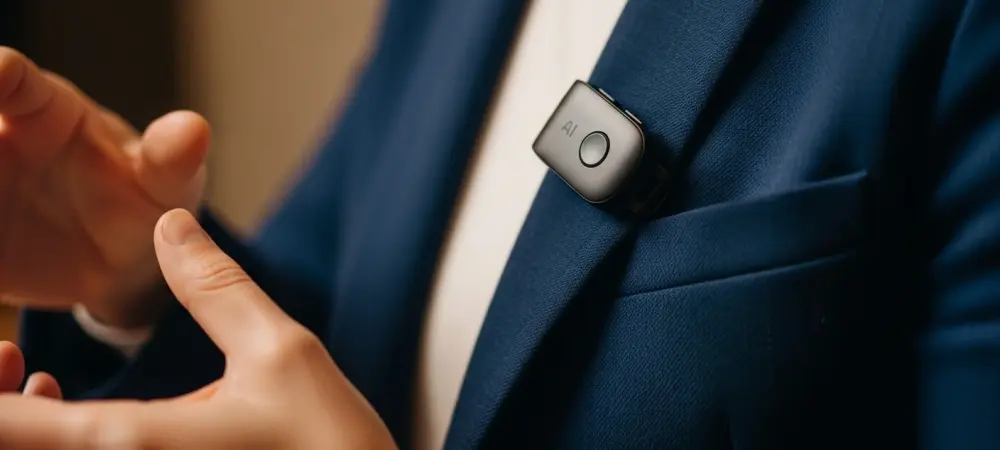
The Plaud NotePin S is a game-changer for anyone who feels the constant pressure of capturing every detail during a high-stakes interview or a fast-paced brainstorming session. With just a simple, physical click on a device that clips directly to your clothing, the AI begins the heavy lifting of turning spoken words into structured, digital data. It doesn’t just provide a transcript; it generates concise summaries and extracts actionable tasks that need to be performed, which saves hours of manual review. For a professional, this means they can actually look their colleagues in the eye and engage in the conversation rather than being buried in a notebook or laptop. The emotional relief of knowing that the “brain” of the device is organizing the important parts to remember allows for a much higher level of creative focus and collaborative energy during the workday.
The Even Realities G2 represents a leap into augmented reality with a lightweight 35-gram frame, but it still faces software hurdles; how do you see the balance between design and functionality evolving in AR?
Achieving a total weight of just 35 grams is a massive technical feat, as it makes the Even Realities G2 feel exactly like a pair of conventional prescription lenses. The challenge right now is that the software is still maturing, often manifesting as inconsistent performance or a monochrome display that might feel limited to users used to high-resolution phone screens. However, the value lies in its discretion; instead of overwhelming the user with a flood of data, it highlights important updates, directions, or even a teleprompter for public speaking in a very subtle way. As the software catches up to this sleek hardware, we will see these glasses move from being a “glimpse of the future” to a daily necessity for navigation and real-time transcription. The evolution will likely focus on making the AR overlays feel more natural and integrated into the user’s actual field of vision without sacrificing that lightweight, wearable comfort that allows for all-day use.
While Bee AI offers an affordable entry point, the hidden costs of subscription models are a concern; how should consumers weigh the initial price against the long-term total cost of ownership?
Bee AI is incredibly attractive at first glance because it is one of the least expensive ways to get into the AI wearable space, offering a versatile wristband or clip-on form factor for basic activity tracking. However, the reality of modern tech is that hardware is often just the “entry fee,” and the true power—like routine learning and deep conversation analysis—is often locked behind a monthly subscription. A consumer needs to look at the total cost over two or three years; a “cheap” device can quickly become more expensive than a premium one-time purchase if the monthly fees add up. That said, for someone who wants to explore how an AI assistant can send automatic reminders and track their daily habits, it provides a low-risk way to test the waters. The value depends entirely on whether those daily summaries and activity analyses provide enough time-saving benefit to justify the recurring drain on your wallet compared to the one-time cost of more traditional devices.
Privacy remains a significant hurdle for devices that rely on continuous listening and microphones; what steps need to be taken to build consumer trust in these ambient AI systems?
Privacy is undeniably the elephant in the room for every wearable that features an “always-on” microphone or a camera aimed at the world. To build genuine trust, companies must be transparent about where that data goes—whether it is processed locally on the device or sent to a cloud server where it might be stored indefinitely. We need to see more robust consent features, such as clear visual indicators when a device like the Ray-Ban Meta is recording, so that the people around the user aren’t caught off guard or made to feel uncomfortable. There is a delicate balance between the convenience of ambient AI that works in the background and the creepy feeling of being constantly monitored by a machine. Manufacturers who prioritize “privacy by design”—meaning they collect the minimum amount of data necessary to perform the task—will likely be the ones who win over the skeptical mainstream public in the long run.
What is your forecast for AI wearables?
I believe we are entering an era where AI will become truly ambient, moving away from the clunky apps and keyboards we’ve used for decades. Within the next few years, I expect smart glasses to become the dominant form factor, potentially rivaling the smartphone for common tasks like navigation, messaging, and information retrieval. We will see a shift toward “local AI” where processing happens directly on your wrist or face, significantly reducing privacy concerns and latency. While we are currently in the “early adopter” phase with niche products like the 35-gram Even Realities G2, the falling costs of sensors and the improvement in battery life will make these tools accessible to everyone. Ultimately, the most successful wearables won’t be the ones that try to do everything, but the ones that understand our context so well they feel like a natural, invisible extension of our own human senses.