

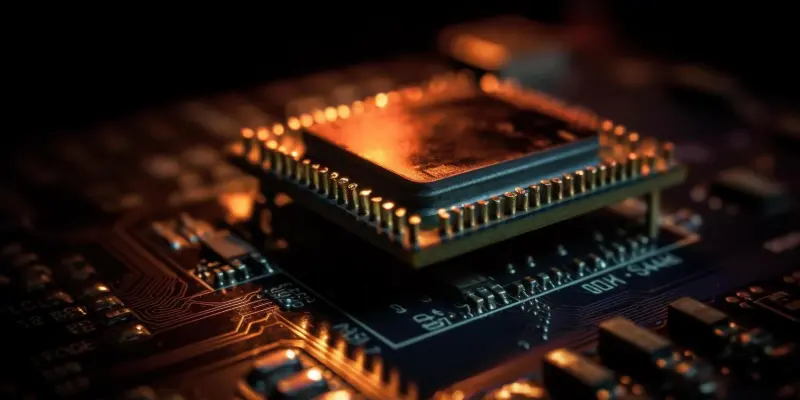
The semiconductor industry is witnessing a revolutionary turn with the advent of DRAM+, an innovative memory technology poised to transform artificial intelligence (AI) computing and potentially rekindle Europe’s chip manufacturing sector. Developed collaboratively by Ferroelectric Memory Co. (FMC) and Neumonda, DRAM+ leverages hafnium oxide (HfO₂) to introduce non-volatile memory, a departure from conventional DRAM reliant on capacitors. Unlike traditional DRAM, DRAM+ retains data even when power is lost, enhancing energy efficiency and ensuring data persistence while maintaining high performance. These remarkable capabilities have set the stage for significant advancements not just in AI computing but in various industries including automotive, medical technology, consumer electronics, and industrial systems.
Harnessing the Potential of Hafnium Oxide
Hafnium oxide’s ferroelectric properties are central to DRAM+’s development, positioning it as a superior alternative to the previous ferroelectric memory technology, lead zirconate titanate (PZT). PZT faced scaling limitations and integration challenges with standard Complementary Metal-Oxide-Semiconductor (CMOS) processes, but HfO₂ circumvents these issues. DRAM+ technology is fully CMOS-compatible and scales below 10 nanometers, allowing integration with existing semiconductor manufacturing processes. This brings about higher memory densities and performance levels competitive with conventional DRAM, paving the way for devices with gigabit or gigabyte capacities. Such capabilities are crucial for the demands of AI computing, which relies on massive data processing and real-time performance. The shift to HfO₂ not only enhances the functional attributes of the memory technology but also aligns with the growing need for environmentally energy-efficient solutions. As devices and applications mature in complexity and scope, the ability to sustain data without continuous power supply becomes increasingly critical. DRAM+ addresses this requirement effectively, positioning itself as a cornerstone for next-generation advancements in AI and other industries needing robust, high-performing memory solutions.
The Strategic Partnership
The collaboration between FMC and Neumonda signifies a strategic alliance aimed at revitalizing the European semiconductor industry, with an emphasis on Germany. The region had witnessed a decline in dynamic random access memory production due to unsustainable economics. FMC and Neumonda’s partnership, however, brings together substantial expertise in memory technology and testing, respectively. FMC, with its deep understanding of hafnium oxide’s properties, couples its technological prowess with Neumonda’s decades-long experience in memory design and testing. Neumonda contributes by employing advanced testing platforms such as Rhinoe, Octopus, and Raptor. These systems are designed for low-cost, energy-efficient testing, crucial for evaluating memory performance under real-world industrial conditions. The testing methodologies reduce costs and energy consumption compared to traditional approaches, offering detailed analyses that help in predicting performance accurately. The integration of these technologies showcases the potential for high-yield production and supports the resurgence of semiconductor manufacturing on European soil. This partnership ultimately aims to establish a localized ecosystem that fosters innovation and production of advanced memory products.
DRAM+ and AI Computing
FMC’s CEO Thomas Rueckes emphasizes the transformative potential of DRAM+ in AI computing, underscoring its ability to elevate traditional DRAM into a non-volatile, low-power solution without compromising on performance. AI computing demands high-speed data processing and storage solutions that can efficiently manage vast amounts of information. DRAM+ addresses these requirements by offering a robust combination of high performance, durability, and energy efficiency. The technology’s promise of non-volatile storage ensures data integrity and reliability, important for AI applications that need uninterrupted data flow and swift accessibility.
Neumonda’s CEO Peter Poechmueller highlights the synergy between FMC’s innovative products and Neumonda’s testing platforms, showcasing the capability to deliver high-quality memory solutions through collaborative ingenuity. This partnership not only seeks to revolutionize AI computing but also aims to meet the critical demands of various sectors relying on memory technology. From autonomous vehicles that require real-time data processing to medical devices necessitating consistent data retention, DRAM+ is positioned to set new benchmarks in performance and reliability.
Perspectives on Europe’s Semiconductor Future
The introduction of DRAM+ by FMC and Neumonda illuminates the possibility of reestablishing Europe, especially Germany, as a leader in semiconductor memory innovation. Once afflicted by economic challenges, the industry now finds itself on the precipice of resurgence, driven by groundbreaking technological advancements and strategic partnerships. The localized production of DRAM+ not only promises economic revival but also aligns with Europe’s broader objectives of technological self-sufficiency and sustainability. DRAM+’s impact transcends immediate technological benefits; it signifies a shift toward innovation-driven growth. The high-performance, energy-efficient, non-volatile memory solutions offered by DRAM+ are set to meet the dynamic and evolving needs of AI computing, automotive industries, and various other sectors. As this memory technology gains traction, a ripple effect is expected across the global semiconductor landscape, placing Europe back on the map as a key player in cutting-edge memory technologies.
Future Directions and Implications
Hafnium oxide’s ferroelectric attributes are key to the advancement of DRAM+ technology, positioning it as a superior alternative to traditional lead zirconate titanate (PZT) ferroelectric memory. PZT encountered scaling issues and integration difficulties with standard CMOS processes, but HfO₂ sidesteps these problems. DRAM+ is entirely CMOS-compatible and scales below 10 nanometers, enabling integration with current semiconductor manufacturing processes. This results in higher memory densities and performance levels capable of competing with standard DRAM, making it possible for devices to possess gigabit or even gigabyte capacities. These capabilities are essential for AI computing, which depends on vast data processing and real-time performance. The transition to HfO₂ not only boosts the memory technology’s functional aspects but also meets the growing need for energy-efficient solutions. As devices and applications evolve in complexity, maintaining data without continuous power becomes more critical. DRAM+ effectively addresses this need, establishing itself as a cornerstone for future advancements in AI and other industries requiring reliable, high-performing memory solutions.