

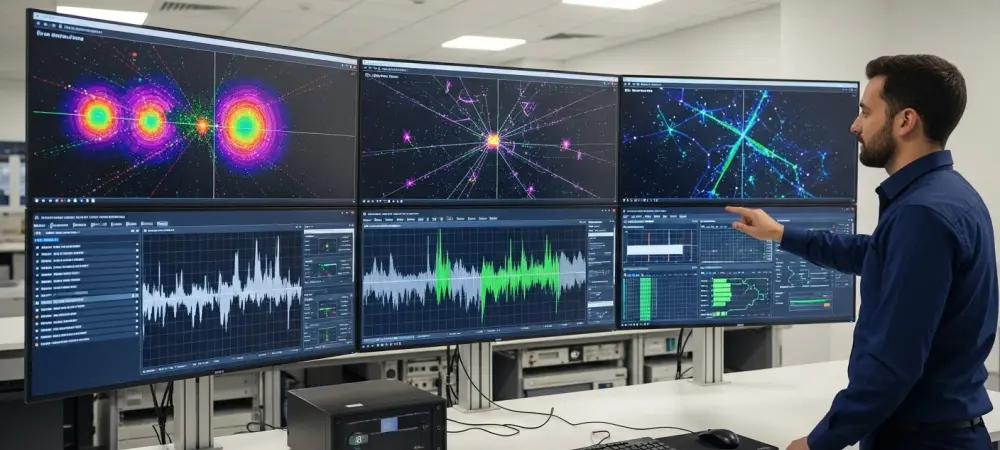
The quiet hum of a laboratory floor belies the invisible chaos of billions of data packets screaming through virtual airwaves, all within a simulated world that exactly replicates the physical complexity of a sprawling modern city. This simulation is not a game, but rather the foundational testing ground for a telecommunications revolution that is currently redefining how the world connects. As the industry advances beyond the capabilities of 5G, the focus has shifted toward 6G, a generation defined not just by speed, but by an architectural soul built entirely on artificial intelligence. However, the transition to an AI-native network requires more than just clever algorithms; it demands a radical new way to train and validate the intelligence that now governs the global infrastructure.
The Shift From Peripheral Intelligence to a Central Nervous System
The transition from 5G to 6G marks a definitive departure from utilizing artificial intelligence as a peripheral optimization tool to establishing it as the core “central nervous system” of the network. In previous iterations, AI served primarily as an add-on, a layer of logic designed to refine specific, isolated functions such as beamforming or traffic steering. In contrast, 6G is designed to be AI-native, meaning that intelligence is baked into the very fabric of the architecture. This structural change empowers the network to manage its own operations autonomously, reacting to shifts in demand and environmental interference without human intervention.
At the heart of this autonomous operation lies the RAN Intelligent Controller (RIC), a programmable platform that orchestrates both near-real-time and non-real-time applications. The RIC enables the deployment of specialized software, often referred to as xApps and rApps, which handle complex network management tasks with unprecedented precision. While this vision offers the promise of a self-healing and self-optimizing network, a significant reliability gap persists. The ultimate hurdle for engineers is ensuring that these AI models can scale safely in the unpredictable, high-stakes environment of a live, real-world network where failure can have cascading social and economic consequences.
The Data DilemmWhy Historical Logs Fail Modern Networks
A persistent problem in the development of AI-native systems is the phenomenon of “AI drift,” where static models lose their effectiveness as the real-world conditions they were designed to manage inevitably change. AI models are only as robust as the data used to train them, and in the telecommunications sector, that data has historically been backward-looking. Traditional call traces, performance logs, and fragmented snapshots of network history provide a map of where the network has been, but they offer little guidance for the novel challenges of the future. Reliance on these static datasets often leads to models that struggle when faced with new traffic patterns or emerging cyber threats.
Furthermore, the move toward Open RAN has introduced a secondary challenge involving security and privacy barriers. Third-party developers who create innovative network applications often lack access to high-quality, real-time data from live sites due to strict commercial sensitivities and regulatory restrictions. This creates a bottleneck in innovation, particularly when attempting to prepare for 6G frequency shifts, such as the move into Frequency Range 3 (FR3). Without access to a diverse array of “edge case” data, including rare network failures or sophisticated denial-of-service attacks, AI models remain ill-equipped to handle the volatility of a truly modern digital landscape.
The RAN Digital Twin as a Strategic Virtual Sandbox
To overcome the limitations of historical data, the industry has embraced the RAN digital twin as a high-fidelity virtual representation of physical network behavior. This technology creates a mirror image of the radio access network, allowing engineers to experiment in a risk-free environment that behaves exactly like the real world. By implementing a hybrid data strategy, operators can blend real-world performance metrics with emulated traffic patterns. This creates a rich, multifaceted dataset that is both grounded in reality and flexible enough to simulate future scenarios that have not yet occurred in the physical realm.
The primary engine behind this strategy is the AI RAN Scenario Generator, or RSG, which serves as a powerful factory for synthetic data. The RSG allows developers to generate massive amounts of training data on demand, providing zero-latency access to information that would otherwise take months or years to collect from a live network. This virtual sandbox is essential for testing radical new configurations or identifying how a network might respond to extreme congestion. Because these experiments take place in a virtual space, there is no risk of disrupting service for actual users, making it the ideal laboratory for the aggressive R&D required for 6G deployment.
Environmental Fidelity and the Hybrid Data Layer
A digital twin is only as effective as its ability to replicate the messy, physical realities of the world, which is why environmental fidelity has become a critical focus. Advanced digital twins now incorporate sophisticated ray-tracing technology to model how radio signals interact with physical objects like hills, trees, and complex urban structures. By creating site-specific geographic models, engineers can visualize and predict signal propagation with surgical accuracy. This level of detail is necessary because 6G frequencies are particularly sensitive to physical obstructions, meaning a model that ignores the specific geometry of a city street is essentially flying blind. This environmental awareness is what truly enables agentic AI—autonomous workflows capable of making multi-step decisions based on the physics of their local surroundings. For example, an AI agent managing a specific cell site might decide to adjust its tilt and power levels based on the current foliage density or the construction of a new skyscraper nearby. This collaborative approach to environmental modeling was a major highlight at MWC earlier this decade, where industry leaders demonstrated how integrating physics-based simulations with network data could lead to more resilient and adaptive signal management strategies.
Combating Model Decay Through Closed-Loop Validation
Ensuring that an AI model remains reliable over time requires a process of continuous, closed-loop validation to establish necessary guardrails. Without these safety mechanisms, an AI system might make unacceptable trade-offs, such as significantly reducing power consumption at the expense of critical service quality. To prevent such outcomes, the RSG provides a real-time feedback loop where any change proposed by an AI application is first tested within the digital twin. If the proposed optimization causes a dip in key performance indicators, the system can reject or refine the change before it ever touches the live network.
The central component of this oversight is the App Validation Engine, which monitors the long-term interactions between various AI applications and the digital twin. This engine tracks “guardrail KPIs” to ensure that as the AI learns and evolves, it stays within the bounds of stability and efficiency. By quantifying these metrics, operators can maintain a precise balance between innovation and reliability. This iterative process ensures that the network remains self-aware and capable of self-correction, effectively neutralizing the threat of model decay and ensuring that the network’s performance remains consistent despite the inherent unpredictability of human behavior and hardware wear.
Stress Testing the Unknowns of 6G Pre-Deployment
As the industry moves closer to full-scale 6G deployment, the ability to de-risk the research and development process has become a strategic priority. Digital twins allow for extensive “what-if” experiments that test the boundaries of the unknown, such as how spectrum might be shared between existing 5G bands and new 6G allocations. These simulations identify potential interference patterns and allow engineers to develop mitigation strategies years before the hardware is actually installed on towers. This proactive approach significantly reduces the time-to-market for new technologies by replacing expensive and time-consuming field trials with rapid digital validation.
Stress testing also extends to the realm of security, where digital twins are used to simulate large-scale network congestion and sophisticated cyber-attacks. By subjecting the virtual network to massive, coordinated Denial of Service (DoS) attacks, operators can observe how their AI-native defenses respond under pressure. This allows for the hardening of network infrastructure in a way that was previously impossible. Through these simulations, the industry has transformed the R&D phase from a process of reactive troubleshooting into one of predictive engineering, ensuring that 6G arrives not as a fragile experiment, but as a robust and battle-tested utility.
Empirical Evidence: Efficiency and Throughput Breakthroughs
The practical application of digital twins has already produced empirical evidence of significant performance improvements across several key metrics. In recent energy efficiency case studies, the use of agentic AI within a digital twin framework allowed operators to implement intent-driven power savings that traditional methods could not achieve. By modeling traffic lulls with high precision, the AI was able to put specific radio components into deep sleep modes, resulting in substantial energy reductions without impacting the user’s quality of experience. This proved that a digital twin could turn environmental goals into measurable operational savings.
Furthermore, a landmark study by DOCOMO demonstrated the power of digital twins in optimizing beam control through predictive network quality. By using the twin to anticipate user movement and signal blockage, the base station reduced the radio control overhead typically required for device reporting. This optimization resulted in a twenty-percent improvement in uplink throughput, effectively clearing more space for actual data transmission. These practical frameworks were successfully applied to live sites, proving that the insights gained from virtual simulations translate directly into faster, more efficient connectivity. The journey toward an AI-native future was solidified by these breakthroughs, marking a transition from theoretical potential to a standardized reality of high-performance networking.