

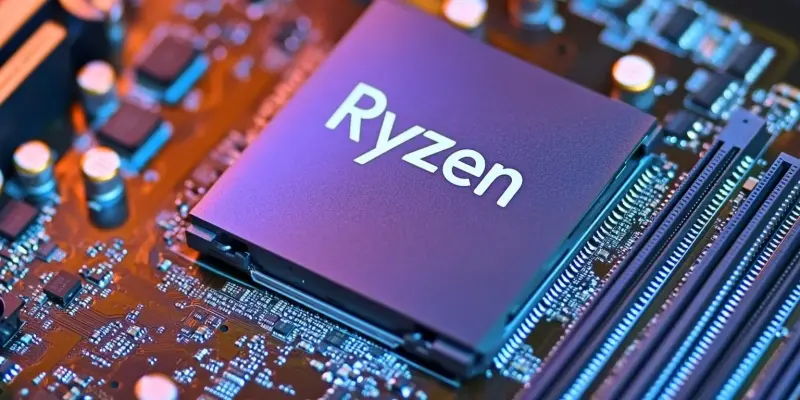
In a competitive market filled with top-tier processors, AMD’s Ryzen 7 9800X3D has made a remarkable entry and has managed to capture the attention of many consumers. Since its launch on November 7, 2024, this advanced chip quickly became a favorite among gaming enthusiasts, demonstrating formidable sales performances. This is evidenced by German retailer Mindfactory, which reported having sold 8,650 units so far, a figure that impressively outstripped the combined sales of all other Ryzen 9000 series CPUs.
Despite being priced at an initial MSRP of $479, the Ryzen 7 9800X3D’s impressive capabilities justified the price for many buyers. This demand was so intense that many major retailers sold out rapidly following the launch. The supply shortage led to a significant secondary market craze where prices on platforms like eBay surged to a staggering $1,500 before eventually settling around $600. This secondary market activity highlights the chip’s high demand and the value consumers place on its performance capabilities.
Nevertheless, the 9800X3D faces a considerable challenge if it aims to match the enduring success of its predecessor, the Ryzen 7 7800X3D. During its time, the 7800X3D was a blockbuster, and Mindfactory managed to sell an outstanding 78,420 units. This significant sales disparity points to the high benchmark set by the earlier model and illustrates the hurdles the 9800X3D must overcome to achieve similar acclaim and market penetration.
AMD’s future prospects seem promising with the company’s intent to maintain its market momentum through continuous innovation. The product pipeline includes anticipated 3D V-Cache chips like the Ryzen 5 9600X3D and potential 12- and 16-core X3D processors, indicating a commitment to catering to diverse consumer needs. As CES approaches, scheduled to commence on January 7, 2025, the tech community eagerly awaits further announcements that could include more details on AMD’s expanding processor lineup. This event could provide critical insight into AMD’s strategies to sustain its advantageous position in the consumer CPU market.
Reflecting on the success of the Ryzen 7 9800X3D, AMD’s robust market positioning and successful product launches herald a positive growth trajectory. This is bolstered by their strategic development of new, high-performance CPUs poised to meet varied consumer demands and further entrench their market leadership. While the 9800X3D has shown promise, the future holds key events and product releases that will determine whether it can ultimately match or surpass the popularity of its famed predecessor.