

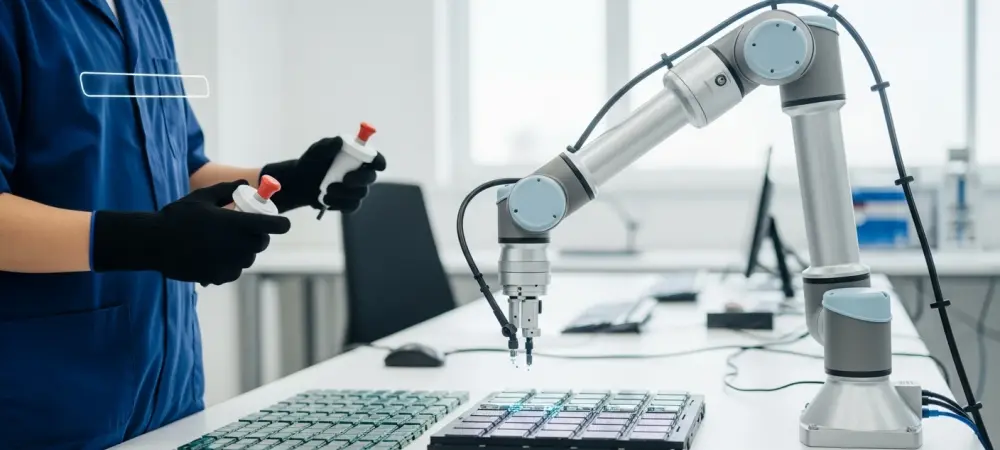
The global manufacturing landscape remains tethered to an unexpected limitation: the sophisticated machinery capable of lifting tons of steel often fails when asked to plug in a simple ribbon cable or snap a plastic clip into place. This “industrial dexterity gap” represents a multi-billion-dollar bottleneck where the sheer strength of automation meets the insurmountable finesse of human fingers. While high-speed robotic arms have dominated assembly lines for decades, they have historically lacked the nuanced sensory perception required to handle the slight variations and tactile uncertainties that define delicate manual labor.
The Trillion-Dollar Paradox: Why Modern Factories Still Rely on Human Fingers
Despite the proliferation of heavy-duty automation, the world’s most advanced electronics and automotive facilities still employ thousands of workers for final assembly tasks. Traditional industrial robots are marvels of repetitive precision, but they operate within a vacuum of common sense. If a component is tilted by a few millimeters or a wire is slightly out of position, the machine crashes or fails the task. This lack of adaptability is the primary reason why human hands remain the default tool for intricate work, creating a paradox where the most expensive factories are still limited by biological constraints.
Manufacturers have long been trapped between two extremes: the blinding speed of rigid automation and the unmatched adaptability of a human workforce. While humans are slower and more prone to fatigue, their ability to “feel” a part into place—a process known as haptic feedback—is something traditional code has struggled to replicate. As production cycles shorten and product designs become more complex, the cost of this reliance on manual labor grows, prompting a desperate search for a mechanical middle ground that can handle the “messy” reality of the factory floor.
The Rigidity Trap: Why Traditional Automation Fails in Unstructured Environments
Standard automation operates on a “blind” execution model, where success depends on a perfectly structured environment. Every part must be presented in a specific orientation, and every movement is pre-defined by thousands of lines of code. This rigidity works for welding a car chassis or palletizing boxes, but it falls apart in the assembly of sub-components. When a robot encounters a flexible part or a misaligned connector, it lacks the cognitive flexibility to adjust its grip or wiggle the piece into its housing, leading to costly downtime and rejected parts.
Historically, the financial barrier to solving this problem was as high as the technical one. Programming a traditional robot to handle every potential variable in a complex assembly task required weeks of specialized engineering and high-cost simulation. For many mid-sized manufacturers, the return on investment simply was not there. The complexity of the real world—where components vary in shape and surfaces are not always uniform—created a “rigidity trap” that effectively locked out automation from the final stages of the manufacturing process.
Bridging the Gap with Tactile Intelligence and Dual-Arm Coordination
The emergence of semi-humanoid systems, such as those developed by technology firms like Perceptyne, signals a departure from pre-programmed motion toward sensory-driven intelligence. By integrating advanced visual sensing with tactile feedback, robots like the PR-DUO and PR-OMNI can now “feel” their way through a task. Instead of following a fixed, unyielding path, these machines use dual-arm coordination to manipulate objects in real-time. This allows them to perform complex maneuvers, such as smartphone component testing or the assembly of intricate braking systems, with a level of grace previously reserved for humans.
This evolution is fundamentally changing the definition of mechanical dexterity. By mimicking the way a human operator uses two hands to stabilize and insert a part, these AI-driven systems provide a versatile “automation layer.” They are no longer just tools for repetition; they are becoming intelligent agents capable of navigating the unstructured gaps in production. This shift enables factories to automate high-variability tasks that were once considered impossible for machines, finally bridging the divide between mechanical power and human-like precision.
Teleoperation and the End of Expensive Programming Cycles
One of the most significant breakthroughs in modern robotics is the move away from manual coding toward “learning by doing.” Through teleoperation, human experts can wear haptic gloves or use controllers to guide a robot through a specific movement, allowing the AI to record and internalize the motor skills required for the task. This bypasses the need for months of software development, as the robot learns the “nuance” of the job—such as the specific pressure needed to snap a connector—directly from a human mentor.
This approach drastically reduces the time needed to deploy new systems on the factory floor. Furthermore, the shift toward a “robot-as-a-service” model and the arrival of more affordable hardware—sometimes priced 40% lower than traditional imports—is democratizing access to high-tier dexterity. Small and medium enterprises can now integrate these agile machines into their existing workflows without needing to rebuild their entire infrastructure. By lowering both the technical and financial hurdles, teleoperation is effectively ending the era of expensive, inaccessible programming cycles.
Implementing Adaptive Robotics: A Strategic Framework for Manufacturers
To successfully transition into this new era of dexterity, manufacturers should adopt a phased integration strategy that targets specific high-variability bottlenecks. The process begins by identifying areas where human labor is currently indispensable due to the complexity of component insertion or delicate packaging. By utilizing an OpEx financial model, companies can pilot semi-humanoid systems with minimal upfront risk, allowing the AI to learn the specific nuances of the local factory environment before scaling the technology across the entire production line.
This modular approach creates a more resilient workforce where robots handle repetitive precision and humans transition into supervisory roles. As these systems move from prototype phases to multinational deployments, the focus shifted toward building a flexible automation layer that can pivot between different product lines with minimal reconfiguration. Ultimately, the successful implementation of AI-driven robotics proved that the solution to the industrial dexterity gap was not more power, but more perception, allowing manufacturers to finally harmonize human intelligence with mechanical efficiency.