

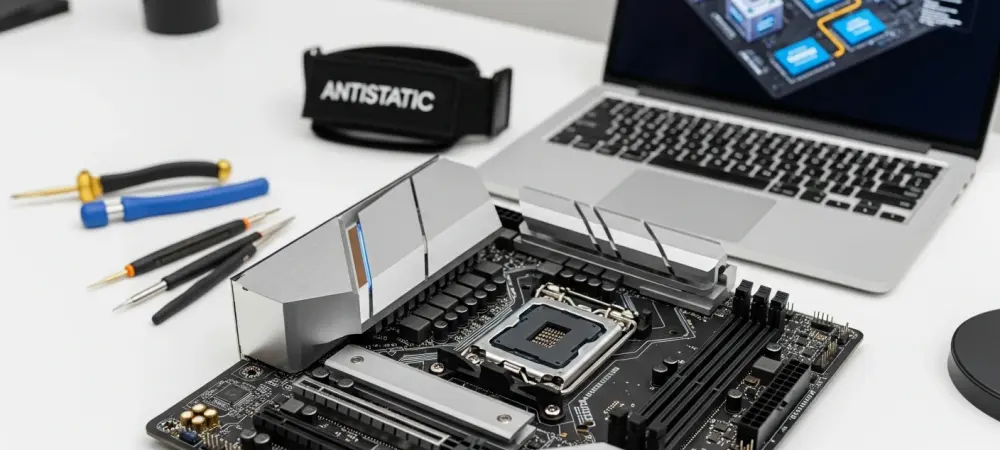
The persistent boundary between consumer hardware and enterprise-grade silicon has traditionally served as a firm firewall intended to segment market demands and maintain corporate profit margins. However, recent breakthroughs in firmware manipulation have begun to chip away at these digital barriers. A hardware enthusiast recently demonstrated this by successfully installing a “Bartlett Lake” processor—an enterprise-exclusive chip—onto a standard ASUS Z790-AYW OC WIFI consumer motherboard. This specific processor, the Core 9 S273PQE, represents a departure from modern hybrid architectures by offering a pure 12 Performance-core configuration. While Intel has increasingly pushed its mainstream users toward a mix of performance and efficiency cores, this experiment reveals a deep-seated desire among enthusiasts for high-count, high-frequency P-core designs. The project underscores the technical feasibility of cross-pollinating hardware tiers that were never meant to communicate.
Engineering the Impossible: Overcoming Firmware Restrictions
Bridging the gap between a consumer motherboard and an enterprise CPU requires more than just physical compatibility with the LGA 1700 socket. The ASUS Z790-AYW OC WIFI lacks any official microcode to recognize the Bartlett Lake architecture, necessitating a manual overhaul of the BIOS firmware. To accomplish this, the developer utilized specialized AI-assisted tools to inject the necessary instructions into the motherboard’s existing software framework. This modification allowed the system to bypass initial security checks and successfully initialize the Core 9 S273PQE silicon. On paper, the specifications of this chip are formidable, boasting a single-core boost of 5.9GHz and an all-core boost of 5.3GHz, supported by 36MB of cache. Unlike the latest consumer-grade chips that have abandoned hyperthreading to streamline efficiency, this enterprise variant retains the feature, providing a total of 24 threads. This raw power highlights why the enthusiast community remains so invested in unlocking restricted silicon.
The Current Barrier: Navigating Driver and Boot Stability
Although the initial boot sequence reached the BIOS interface and correctly identified the processor, the project encountered significant stability issues during the transition to a functional operating system. A persistent USB device error acted as a primary roadblock, preventing the loading of drivers required for Windows or Linux environments. This failure suggested that while the core microcode was accepted, the underlying communication between the chipset and the enterprise-specific I/O remained fractured. Resolving these conflicts will likely require further iterations of firmware patching or the development of custom drivers to synchronize the motherboard’s peripheral controllers with the unique requirements of the S273PQE. Future efforts should prioritize the isolation of the USB subsystem and perhaps the utilization of PCIe-based input devices to bypass the onboard controller limitations entirely. The successful resolution of these errors would provide a blueprint for users seeking to maximize the longevity and performance of their existing LGA 1700 platforms through the year 2028.