

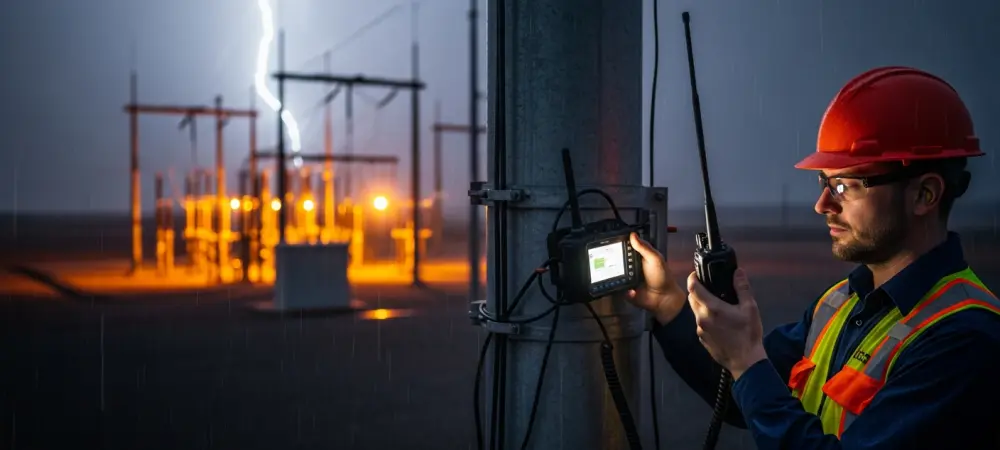
When a massive storm surge compromises the stability of a regional power grid and every second spent waiting for a signal feels like an eternity, the fundamental difference between standard connectivity and survival-grade communication becomes starkly apparent. In these high-pressure scenarios, the psychological comfort of seeing high signal strength on a commercial device quickly evaporates if the underlying network fails to grant immediate, priority access. For the utility crews restoring power or the emergency teams navigating a blackout, the focus shifts from the theoretical speed of data to the absolute certainty of the communication channel. The primary question facing modern operations is no longer which technology offers the highest peak performance, but which one remains standing when the infrastructure around it begins to crumble.
This transition toward a data-driven operational landscape has forced a reexamination of the tools that have long served as the bedrock of public safety. While cellular advancements suggest a future of seamless connectivity, the reality of mission-critical work involves a unique set of requirements that consumer-grade networks were never designed to meet. As organizations integrate new capabilities, they must weigh the allure of high-speed multimedia against the unyielding necessity of reliable voice communication. The resulting discourse clarifies that while the technology stack is expanding, the core principles of resiliency and availability are more relevant now than ever before.
The Reliability Paradox: Survival in High-Stakes Environments
The paradox of modern connectivity lies in the fact that the most advanced networks are often the most dependent on the very infrastructure that fails during a crisis. For first responders and utility managers, the ability to reach a lifeline is a non-negotiable requirement that transcends the capabilities of standard consumer broadband. In a world where a hurricane can level local towers or a wildfire can disrupt the electrical supply to a hundred square miles, the number of bars on a smartphone screen becomes a secondary concern. The true measure of a mission-critical system is its ability to guarantee access when the public network is saturated or the power grid is offline.
Reliability in this context is defined by a “push-to-talk” immediacy that Land Mobile Radio (LMR) has perfected over decades of field use. In high-stakes environments, communication is not just about the exchange of information; it is a mechanism for safety and command. When a worker in a remote substation or a fire captain in a dense urban canyon triggers a call, the system must respond within milliseconds, regardless of how many other users are trying to upload video or browse the web. This inherent priority is a fundamental characteristic of dedicated radio spectrum that 5G, despite its sophisticated slicing capabilities, is still working to replicate at a similar scale of consistency.
Hardened Infrastructure: Ensuring the Necessity of Constant Availability
The structural integrity of a communication network is often the deciding factor in its survival during a catastrophic failure. Mission-critical workflows rely on infrastructure that is purpose-built with site hardening—a process involving physical reinforcements, specialized antennas, and extensive battery or generator backups designed to outlast the storm. LMR towers are frequently independent entities, standing as resilient outposts that remain operational even when the terrestrial fiber and local power lines they connect to are severed. This physical independence provides a layer of security that is difficult to find in the interconnected web of public 5G deployments.
Public 5G networks, in contrast, are generally tied to the same fragile commercial infrastructure as the rest of the community. While they offer incredible capacity for data, they often lack the extreme redundancy required for absolute availability during a disaster. If the local fiber backhaul is damaged or a central switching office loses power, the high-speed cell site becomes an island of useless technology. This difference in architectural philosophy establishes LMR as the resilient backbone of operations, while positioning 5G as a high-capacity enhancement that adds value without assuming the full burden of primary life-safety communication.
Multimedia Layers: The Evolution of Situational Awareness
The shift from simple voice exchanges to a data-rich environment has redefined what it means to be aware of an operational landscape. 5G serves as a vital supporting layer in this new ecosystem, enabling the transmission of high-definition video feeds, real-time drone telemetry, and complex diagnostic maps that voice-only radio simply cannot accommodate. This capability allows a command center to see exactly what a technician sees at the top of a transmission tower or to monitor the heart rate of a responder in a hazardous environment. These layers of information provide the targeted visual context necessary for a more sophisticated and informed response to complex incidents.
In a hybrid communication model, the synergy between voice and data creates a more comprehensive safety net. LMR remains the primary tool for the initial incident contact and the urgent, short-form commands that drive immediate action. This dual-path approach ensures that the most critical instructions are delivered with absolute reliability, while the supplemental data provides the nuance required to solve problems faster and with greater precision than was possible with voice alone.
Performance Realities: Addressing the Shared Vulnerability of Public Networks
Despite the significant industry buzz, the practical application of 5G remains inconsistent across different geographic regions. Recent statistics suggest that a substantial portion of mobile subscriptions globally still rely on older standards, and rural areas—where many utility assets are located—often lack the density required for 5G to be truly reliable. For a utility company managing thousands of miles of transmission lines, the promise of 5G is often limited by a lack of coverage in the very places where its assets are most vulnerable. This reality reinforces the continued necessity of dedicated, independent radio spectrum that can reach deep into the backcountry.
Furthermore, a shared vulnerability exists between public broadband and the power grid that experts frequently point out. Because cellular networks often share the same power and backhaul pathways as the commercial sector, a grid failure can lead to a cascading network outage. Maintaining a separate, dedicated radio network mitigates this risk by ensuring that the communication channel remains isolated from the failures of the public infrastructure, providing a reliable fallback that 5G cannot yet guarantee.
Strategic Evaluation: A Framework for Modernized Operational Workflows
To successfully integrate 5G without compromising safety, operations leaders must apply a structured assessment before deploying new technology. The first step involves identifying specific connectivity gaps where current voice-only workflows are failing to provide necessary clarity. This is followed by a strict categorization of tasks into mission-critical functions, which are essential for life and safety, and business-critical functions, which are essential for operational efficiency. By making this distinction, leaders can ensure that the most vital communications remain on the most resilient channels.
The evaluation also requires a realistic look at data requirements to determine if a specific workflow truly necessitates high-bandwidth video or if simple voice is more effective for the task at hand. Finally, the security architecture must be assessed to decide between using public 5G access or implementing a private 5G installation. A private network offers greater control over coverage and security, allowing an organization to tailor the connectivity to its specific geographic and operational needs. This strategic approach transformed the communication landscape from a series of isolated tools into a unified, resilient ecosystem.
The transition toward a unified communication environment demonstrated that the most effective strategy involved a deep integration of legacy resilience and modern intelligence. Operations leaders discovered that while 5G expanded the horizons of situational awareness, it functioned best when anchored by the proven reliability of radio. By treating these technologies as complementary parts of a single chain, organizations successfully maintained safety during the most challenging conditions. This balanced approach ensured that the move toward a data-rich future did not come at the expense of the fundamental promise to always be reachable in a crisis. The successful modernization of these workflows relied on a clear-eyed understanding that speed is only valuable if the connection is guaranteed to exist.