

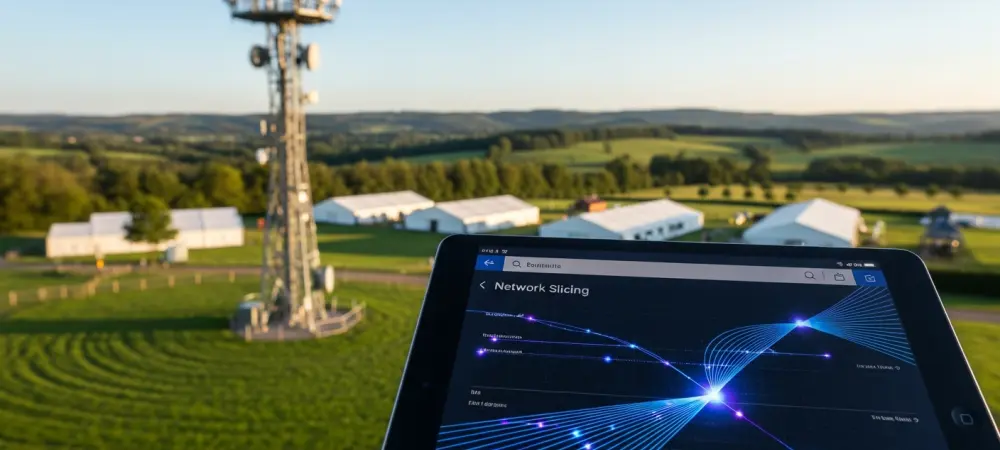
The sheer volume of mobile data traffic generated during massive public gatherings frequently pushes modern cellular infrastructure to its absolute breaking point, leaving attendees frustrated and businesses unable to process essential transactions. At the most recent iteration of the Royal Welsh Show, one of the United Kingdom’s premier agricultural events, this recurring challenge met a sophisticated technological solution through a collaborative pilot program between BT and the Royal Welsh Agricultural Society. By deploying advanced 5G+ network slicing, the partnership sought to demonstrate how specialized digital infrastructure could maintain mission-critical services even when thousands of devices compete for the same local bandwidth. This trial represents a significant departure from standard connectivity models, focusing on the specific needs of high-definition livestreaming and secure payment processing within a saturated environment. The initiative showcased a shift toward more intelligent, prioritized networking that could redefine the logistical backbone of rural economic hubs.
Advanced Technology for High-Density Environments
Engineering Resilience: The Mechanics of Network Slicing
The technical sophistication of 5G+ network slicing allows for the creation of multiple virtual networks on top of a single physical infrastructure, which provides a tailored experience for different user groups. In a traditional 5G setup, every smartphone, tablet, and point-of-sale terminal shares the same pool of resources, often leading to a “best effort” delivery that fails when the crowd size exceeds the tower’s capacity. Network slicing bypasses this limitation by carving out a dedicated, isolated “lane” with its own guaranteed parameters for latency, speed, and security. This virtualization is managed through a software-defined networking layer that allocates specific radio frequency portions and core network processing power exclusively to the designated slice. For the Royal Welsh Show, this meant that critical show operations could function in a protected digital environment that remained entirely insulated from the heavy social media usage and general web browsing activities of the visitors.
Furthermore, the implementation of this technology ensures that even during peak usage hours, when thousands of users are simultaneously uploading high-resolution video content, the dedicated slice remains stable. Standard mobile networks usually suffer from “noise” and interference as the number of active connections increases, but 5G+ slicing utilizes rigorous quality-of-service protocols to maintain a constant throughput. This level of reliability is particularly vital for organizations that require a deterministic network response for real-time applications. By decoupling the performance of essential services from the erratic behavior of public data traffic, BT has created a model where reliability is no longer a luxury but a fundamental utility. This approach allows event organizers to plan complex digital integrations without the fear of a total network collapse. Such resilience is the primary differentiator between consumer-grade connectivity and the enterprise-level solutions being tested at major regional exhibitions.
Operational Efficiency: Ensuring Seamless Performance
The operational success of the Royal Welsh Show depends heavily on the ability of staff and emergency services to communicate and share data without delay across a sprawling and densely packed venue. In previous years, the sheer density of attendees often led to significant communication lags, making it difficult for organizers to manage crowd flow or respond to logistical issues in real time. The introduction of 5G+ network slicing provided a robust framework for internal communications, ensuring that high-priority data packets were always processed first. This prioritization is achieved through advanced scheduling algorithms that recognize the specific identifiers of mission-critical devices. Consequently, the show’s management team could utilize data-heavy applications, such as real-time location tracking for livestock and vehicle management systems, without experiencing the jitter or latency that typically plagues rural events.
Beyond simple communication, the pilot explored the integration of secure, automated systems that require consistent connectivity to function as intended. For instance, security teams utilized the dedicated network slice to monitor high-definition surveillance feeds across the site, providing a level of oversight that was previously impossible due to bandwidth constraints. The ability to stream 4K video from remote cameras directly to a central command center without buffering changed the security dynamic of the show entirely. This capability demonstrates that 5G+ is not just about speed, but about the intelligent allocation of resources to where they are most needed at any given moment. By providing a stable platform for these sophisticated tools, the technology helped the Royal Welsh Agricultural Society move toward a more data-driven approach to event management. The success of these internal operations proved that even in the most remote locations, advanced networking can provide the same level of service.
Socioeconomic Impact and Regional Infrastructure Development
Commercial Viability: Empowering Local Vendors and Media
Local businesses and vendors operating at the event experienced a significant boost in operational efficiency thanks to the reliability of the 5G+ slice. Companies such as Radnor Hills and Fire and Flank relied on point-of-sale systems that required a constant connection to process credit card and mobile wallet payments. In a typical high-density scenario, the failure of a POS terminal due to network congestion can lead to long queues, frustrated customers, and significant revenue loss. By utilizing a dedicated slice, these vendors maintained a frictionless transaction process, ensuring that every sale was authorized instantly regardless of how many thousands of people were using their phones nearby. This reliability provided small business owners with the confidence to transition away from cash-only operations, which are increasingly rare in a digital-first economy. The economic benefit of guaranteed connectivity is clear, as it directly supports the financial viability of local enterprises.
The media and storytelling aspect of the Royal Welsh Show also underwent a transformation as a result of the enhanced connectivity provided by BT’s pilot program. Media teams and official show ambassadors used the dedicated network to livestream high-definition content to a global audience, bypassing the usual technical bottlenecks associated with rural broadcasting. In the past, capturing and uploading 4K video during a live event often required expensive satellite uplinks or specialized hardware, but the 5G+ slice allowed these creators to broadcast directly from their mobile devices. By removing the barriers to high-quality content creation, the technology effectively amplified the show’s reach and cultural impact. This demonstrates how next-generation networks can democratize media production.
Strategic Investment: Bridging the Digital Divide
This pilot program at the Royal Welsh Show is a cornerstone of BT’s broader strategic initiative to invest £500 million in the improvement of mobile and fixed-line connectivity across Wales. This massive capital expenditure, which is ongoing from 2026 through the current cycle, aims to modernize the digital landscape of regions that have historically been underserved by major telecommunications providers. By collaborating closely with the Welsh Government, BT is working to eliminate the digital divide that often separates rural communities from urban economic centers. The deployment of 5G+ network slicing is not merely a temporary trial for a single event but a proof-of-concept for a national rollout that will eventually benefit businesses and residents throughout the country. This investment reflects a long-term commitment to providing the infrastructure necessary for the modern economy to thrive, ensuring that rural businesses have access to the same technological advantages as urban ones. The successful pilot of 5G+ network slicing at the Royal Welsh Show demonstrated that dedicated virtual lanes effectively solved the problem of network congestion in high-density rural environments. Stakeholders observed that the technology provided a seamless experience for both vendors and media teams, proving that mission-critical services could remain isolated from general public traffic. To capitalize on these results, industry leaders suggested that event organizers and local governments prioritized the integration of sliced network architectures into their future infrastructure planning. By adopting this technology, businesses improved their operational resilience and ensured that technical bottlenecks no longer hindered economic growth. The lessons learned from this trial paved the way for a wider commercial launch, offering a clear roadmap for how telecommunications companies supported complex events. Future implementations focused on expanding these services to other sectors to maximize the socioeconomic benefits.