

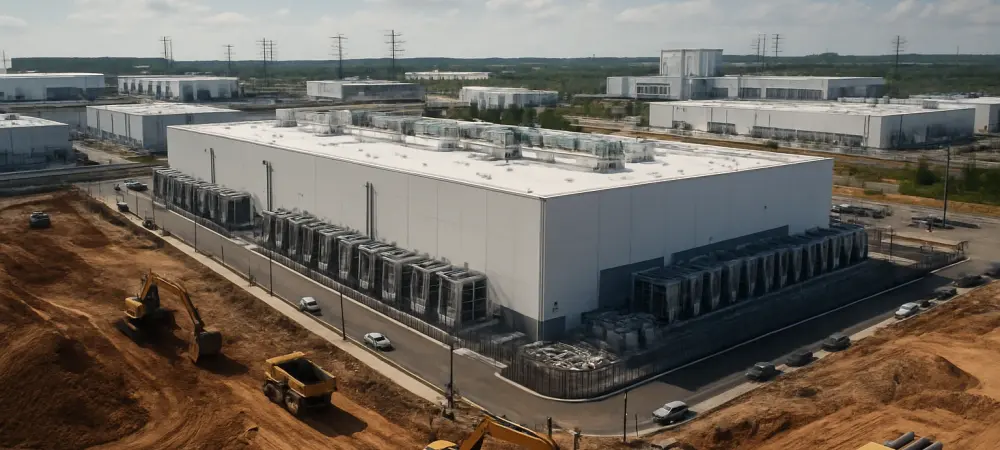
In an era where artificial intelligence is reshaping industries at an unprecedented pace, a staggering forecast has emerged that underscores the sheer scale of infrastructure needed to support this technological revolution. A leading global investment firm has projected that the AI sector will drive a monumental $7 trillion in spending on data centers, chips, power, and related technologies over the next decade. This prediction highlights the critical role of AI infrastructure in powering everything from advanced machine learning models to everyday digital interactions. As demand for computing power skyrockets, the implications of this growth extend far beyond tech companies, touching on energy consumption, urban planning, and global economic trends. This transformative wave promises to redefine how industries operate, making it essential to understand the drivers and challenges behind such an ambitious outlook.
Unpacking the Massive Investment Forecast
Breaking Down the $7 Trillion Projection
The projected $7 trillion investment in AI infrastructure over the next ten years represents a seismic shift in global technology spending, with distinct allocations shaping the future landscape. Approximately $4 trillion is expected to flow into chip development, encompassing manufacturing facilities and intricate supply chains that fuel AI’s computational needs. Another $2 trillion is slated for the construction and enhancement of AI data centers, often dubbed “AI factories,” while $500 billion each will bolster power and transmission infrastructure, as well as ancillary technologies like fiber connectivity and advanced cooling systems. This breakdown reveals a comprehensive approach to building a robust ecosystem capable of supporting AI’s insatiable demand for resources. The scale of this financial commitment signals confidence in AI’s long-term value across sectors, from healthcare to finance, where data processing capabilities are becoming a competitive edge.
Energy Demands and Capacity Growth
A critical aspect of this forecast centers on the explosive growth in power capacity required to sustain AI data centers, reflecting the energy-intensive nature of cutting-edge technologies. Current estimates suggest that AI-focused facilities will achieve a power capacity of around 15 gigawatts (GW) soon, with projections indicating a dramatic surge to 82 GW by 2034, marking a more than fivefold increase. This expansion is driven by a projected rise in the installed base of GPUs, expected to grow from current levels to 45 million units by 2034. Such growth necessitates a rethinking of energy infrastructure, as traditional grids may struggle to meet these demands without significant upgrades. The focus on sustainable power solutions will likely become a priority, as stakeholders grapple with balancing technological progress with environmental responsibilities in an increasingly scrutinized global landscape.
Strategic Trends and Challenges in AI Infrastructure
Evolving Data Center Designs for Future Needs
As AI applications diversify, the design of data centers is undergoing a profound transformation to accommodate new computational paradigms, particularly the shift toward high-volume inference tasks. Unlike earlier focuses on large-scale training jobs, modern data centers are being optimized for inference, which is anticipated to constitute 75% of AI compute demand by 2030. This shift is compounded by the rise of complex AI agents that require multiple model calls for single tasks, further intensifying resource needs. Modular designs are becoming essential, allowing for frequent upgrades in power and cooling systems to keep pace with rapid advancements in chip technology. This adaptability ensures that infrastructure remains relevant amidst swiftly evolving hardware requirements, preventing obsolescence in a field where innovation cycles are notoriously short and investment risks are high.
Emerging Service Models and Technological Risks
The rise of GPU-as-a-service models marks a pivotal trend in making AI computing power more accessible, reflecting a broader move toward flexible, on-demand solutions that minimize capital expenditure. Market projections indicate that this sector could expand from $30 billion currently to over $250 billion by 2034, driven by companies offering scalable access to high-performance computing. However, this rapid technological advancement introduces significant challenges, as infrastructure must continuously adapt to new chips and software demands. The risk of building facilities that quickly become outdated looms large, necessitating strategic planning and investment in future-proof designs. Additionally, the competitive landscape is heating up, with firms vying to capture market share in a space where differentiation often hinges on efficiency and scalability, pushing the boundaries of what data centers can achieve.
Reflecting on a Transformative Decade Ahead
Lessons from an Ambitious Vision
Looking back, the ambitious forecast of a $7 trillion investment in AI infrastructure revealed a landscape poised for extraordinary change, driven by relentless technological advancement. The detailed breakdown of spending across chips, data centers, and power systems painted a picture of an industry that had to evolve rapidly to meet soaring demands. Discussions around capacity growth and energy needs highlighted the intricate balance between innovation and sustainability that defined this era. The optimism surrounding minimal risks of overbuilding, fueled by expanding AI use cases, underscored a collective belief in the technology’s enduring relevance. This period demonstrated how strategic foresight could transform challenges into opportunities, setting a precedent for how industries adapted to disruptive forces with bold, calculated moves.
Navigating the Path Forward
As this transformative decade unfolded, the focus shifted to actionable strategies that ensured sustained growth in AI infrastructure. Stakeholders were encouraged to prioritize modular, adaptable designs that could accommodate future technological shifts without incurring prohibitive costs. Investment in sustainable energy solutions emerged as a cornerstone, addressing the immense power demands while mitigating environmental impact. Collaboration between tech firms, energy providers, and policymakers became vital in scaling infrastructure responsibly. The rise of on-demand service models offered a blueprint for democratizing access to AI capabilities, suggesting a future where innovation was not constrained by capital barriers. Reflecting on this journey, the emphasis on adaptability and strategic partnerships provided a roadmap for navigating the complexities of an AI-driven world, ensuring that the foundation laid was robust enough for the next wave of digital evolution.