

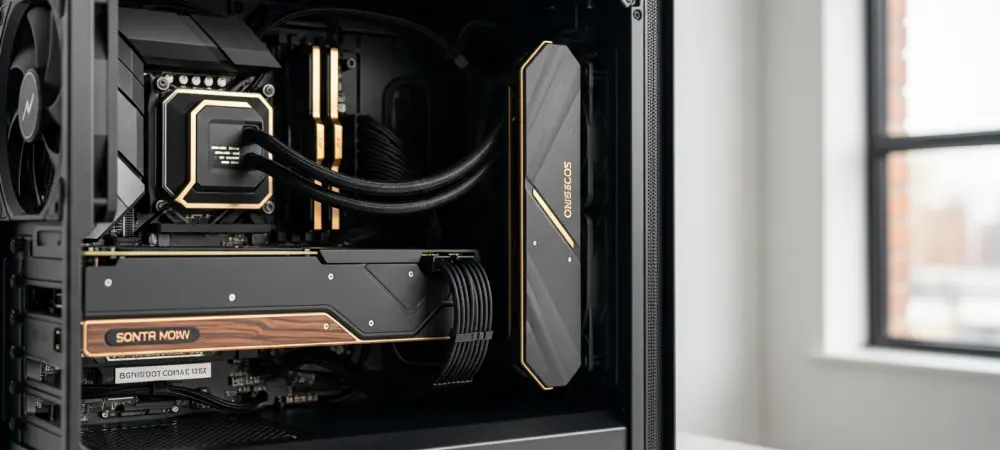
The high-end graphics card market has long been dominated by massive, glowing behemoths that prioritize aggressive aesthetics over professional utility, yet the recent introduction of the Asus ProArt GeForce RTX 5090 32GB GDDR7 OC Edition proves that flagship-grade power no longer requires a bulky, oversized chassis. This specific model represents a strategic shift in hardware engineering, moving away from the “bigger is better” philosophy that has defined top-tier GPUs for the past several cycles. Instead, it focuses on the needs of creators, engineers, and AI researchers who require maximum computational throughput without sacrificing the physical versatility of their workstations. By distilling the immense capabilities of the “Blackwell” architecture into a more refined and compact form factor, the ProArt series addresses a growing demand for high-density computing solutions that can fit into diverse environments, from specialized studio racks to sophisticated small-form-factor home setups.
The central challenge in developing this card was maintaining the extreme performance levels of the RTX 5090 chipset while adhering to a strict physical profile that supports modern, space-constrained workflows. As software tools for generative artificial intelligence and high-resolution video rendering become increasingly resource-intensive, the hardware must evolve to provide the necessary headroom without becoming a literal obstacle in the machine’s assembly. This ProArt iteration serves as a specialized tool for a specific demographic that values streamlined industrial design as much as raw numerical performance. By targeting this niche, the design team has managed to balance the thermal and electrical requirements of a flagship processor with a footprint that respects the practical constraints of professional hardware integration, effectively bridging the gap between enthusiast gaming gear and industrial-grade workstation components.
Market Positioning: Premium Pricing and Sector Demand
Entering the high-end hardware landscape with an elite price point of approximately $4,099, the Asus ProArt RTX 5090 positions itself well above standard flagship models designed for the general consumer. This significant financial investment is not merely a reflection of the brand’s premium status but is also a direct consequence of the overwhelming demand for high-VRAM hardware within the artificial intelligence and data science industries. As development in large language models and local machine learning training continues to accelerate between 2026 and 2028, the hardware required to run these operations has become increasingly valuable. This card effectively shares many of the critical specifications found in professional-grade server hardware, making its price a calculated reflection of its utility as both a top-tier creative engine and a powerful asset for commercial research and development.
While the high cost might initially seem prohibitive for a single component, the ProArt branding offers a specific value proposition that justifies the expenditure for dedicated professionals and corporate entities. These buyers are not simply looking for high frame rates in the latest software; they are investing in a refined aesthetic, a comprehensive multi-year warranty, and a physical design that facilitates complex multi-GPU configurations. In high-stakes professional environments where time is the most expensive commodity, the ability to install two or even three of these cards into a single mid-tower workstation provides a level of parallel processing power that larger, four-slot cards cannot physically accommodate. This capability allows studios to scale their rendering or training capabilities significantly within their existing infrastructure, providing a clear path to increased productivity that justifies the initial capital outlay.
Architecture: Core Counts and Memory Breakthroughs
At the heart of the ProArt RTX 5090 lies the sophisticated Blackwell architecture, manufactured using the advanced TSMC 4N process node to house a staggering 21,760 CUDA cores. This architectural leap provides a massive increase in parallel processing power compared to previous hardware iterations, enabling the card to manage the most complex computational tasks with unprecedented fluidity. Whether a user is conducting real-time ray-traced architectural previews or running intricate mathematical simulations for scientific research, the core density ensures that the system remains responsive under heavy load. This efficiency is critical for modern workflows where the boundary between design and final output is increasingly blurred by the need for instant visual feedback and rapid iteration cycles in high-resolution environments. Complementing the massive core count is the transition to 32GB of high-speed GDDR7 memory, which serves as a transformative upgrade for memory-intensive applications. Utilizing a wide 512-bit memory bus with data transfer speeds reaching up to 1,792 GB/s, this card provides double the memory capacity found in the mid-range flagship options like the RTX 5080. Such a massive frame buffer is no longer a luxury but a necessity for professionals working with 8K video timelines, high-resolution 3D textures, or massive localized datasets for AI inference. This overhead ensures that large-scale projects can be manipulated without the risk of system instability or performance bottlenecks caused by memory overflow. For the professional creator, this means the difference between a seamless creative process and one plagued by constant caching and slow data retrieval.
Compact Engineering: Design for Modern Workstations
The most distinctive physical characteristic of the ProArt RTX 5090 is its refined dimensions, which adhere to a 2.5-slot thickness and a total length of 304mm. In a market where traditional flagship models frequently exceed 3.5 or even 4 slots in width, effectively blocking adjacent PCIe slots and requiring massive, specialized cases, this slimmed-down design is a significant achievement. The “SFF-ready” designation indicates that this card meets the rigorous guidelines required for high-performance components that can be integrated into small-form-factor builds without compromising the underlying power of the Blackwell chip. This allows users to build incredibly powerful systems that occupy a fraction of the space required by traditional full-tower workstations, making it an ideal choice for mobile production units or compact studio desks.
From an aesthetic perspective, the card departs from the typical “gamer” look by completely eliminating RGB lighting in favor of a sophisticated, professional appearance. The deep black palette is accented by subtle gold highlights, and the inclusion of a unique wood-patterned trim allows the hardware to blend naturally into high-end studio environments or modern office settings. Beyond its visual appeal, the card incorporates several functional design choices that enhance its daily utility for professionals. An angled 16-pin power connector simplifies cable management in tight spaces, while the built-in USB-C display output caters to the needs of modern creators who utilize high-end pen displays or complex multi-monitor configurations. These details emphasize a focus on a clean, organized workspace where the hardware supports the creative process rather than distracting from it.
Thermal Management: Solutions and Acoustic Challenges
To manage the massive heat output of the RTX 5090 chip, the card utilizes a sophisticated combination of a large-scale vapor chamber and liquid metal thermal interface material. These technologies work together to pull heat away from the GPU die more efficiently than traditional copper heat pipes alone. Furthermore, the backplate is designed with a double-vented structure that allows air to flow directly through the heatsink and out the top of the card. This “pass-through” design is particularly effective in compact cases where the accumulation of stagnant hot air can quickly lead to thermal throttling and reduced performance during long rendering sessions.
Despite the impressive cooling hardware, the physical limitations of a slim design do introduce certain acoustic and thermal trade-offs that users should be aware of. The card maintains a commendable level of quietness during operation, with fan noise typically peaking at a relatively low 36dB under standard conditions. The smaller heatsink area means that internal temperatures can run approximately 10°C higher than those observed on much bulkier, air-cooled versions of the same chipset. Additionally, the massive amount of power being funneled through the compact frame can sometimes lead to audible coil whine—a high-pitched electrical buzzing—during periods of intense computational load. While the fans themselves remain unobtrusive, this electrical noise is a common characteristic of high-power hardware being pushed to its limits in a streamlined form factor.
Performance Metrics: Creative and Gaming Capabilities
In professional benchmarking scenarios, the ProArt RTX 5090 establishes itself as a dominant force, consistently outperforming the previous generation’s flagship by approximately 40% in rendering speeds. In industry-standard applications such as Blender, OctaneRender, or the Geekbench suite, the card’s combination of high core counts and massive memory bandwidth allows it to set new records for consumer-available hardware. For AI developers, the specialized Tensor cores have been optimized to handle local model training and inference with the kind of speed and efficiency that was previously only available through expensive, cloud-based server instances. This localized power gives developers the freedom to experiment and iterate on complex models without the latency or recurring costs associated with remote computing.
While the ProArt line is primarily marketed toward the creative and professional sectors, it remains the most powerful gaming GPU currently in existence. It easily handles the most demanding software at 4K resolution, maintaining exceptionally high frame rates even when advanced features like full path tracing and cinematic lighting are enabled. Although the $4,000 price point makes it an unlikely choice for a machine dedicated solely to entertainment, its ability to master the most taxing visual environments ensures its longevity as a top-tier gaming component. For the professional who works during the day and engages in high-end gaming in their off-hours, this card provides a single-system solution that excels in both worlds, offering a level of versatility that few other pieces of hardware can hope to match in the current market.
The launch of this streamlined flagship demonstrated that the industry was capable of moving beyond the bloated dimensions of previous high-performance components. This development favored professionals who required the raw power of the RTX 5090 but were constrained by the physical limits of their existing workstation environments. Users should consider prioritizing high-airflow case designs that can compensate for the card’s smaller thermal mass, ensuring that the 575W heat output is moved away from the motherboard efficiently. Integrating this hardware into a system with a modern PCIe 5.0 interface will also ensure that the massive bandwidth of the 32GB GDDR7 memory is fully utilized, preventing any data bottlenecks during complex simulations or high-resolution video exports.
Moving forward, the shift toward “SFF-ready” flagship hardware likely indicates a long-term trend where efficiency and power density become the primary metrics of success for professional GPUs. As workstations continue to shrink and the demand for multi-GPU AI processing grows, the ability to fit maximum performance into a 2.5-slot design will be a critical differentiator for hardware manufacturers. Organizations and independent creators looking to upgrade their infrastructure should evaluate their current power delivery systems to ensure they can support the high wattage requirements of the Blackwell architecture. Investing in high-quality 12VHPWR power supplies and ensuring proper cable management will be essential steps in maintaining the long-term reliability and stability of these high-density professional machines through the 2026 to 2028 hardware cycle.