

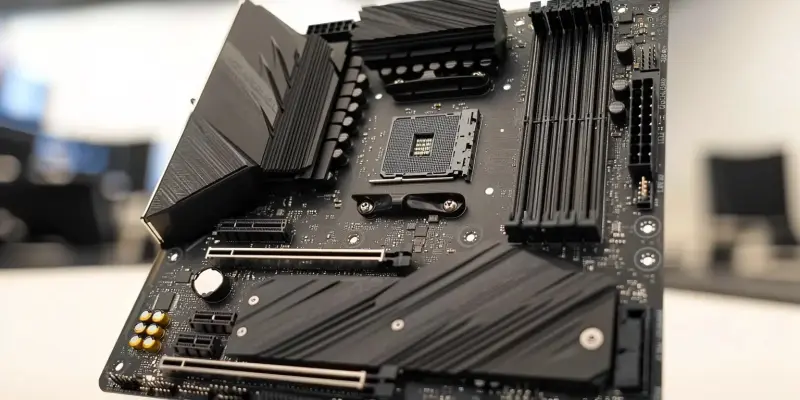
ASRock has officially introduced its B650M Pro X3D WiFi motherboard, targeting budget gamers seeking high performance without a hefty price tag. The launch of this motherboard brings significant enhancements to budget-friendly segments, particularly with its compatibility with AMD’s latest Ryzen 9000X3D processors. Now listed at approximately $179, it offers an appealing proposition with advanced features packed into a cost-effective solution, making it an ideal option for gamers and productivity enthusiasts alike.
Advanced Features and Design
With the release of the B650M Pro X3D WiFi motherboard, ASRock aims to cater to the growing demands of users equipped with Ryzen 9 9950X3D and 9900X3D CPUs. These processors are well-regarded for their impressive gaming and productivity capabilities, and the new motherboard ensures that users can unlock their full potential without requiring extravagant investments in high-end VRMs. The design follows the successful B850M Pro RS model, retaining component compatibility while integrating a refreshed B650 chipset.
One of the standout features of this model is its native support for PCI-E 5.0 for both graphics cards and SSDs. This feature, often absent in other B650 motherboards, provides future-proofing for users looking to upgrade their systems. Alongside this, the motherboard supports CPU and memory overclocking, contributing to the versatility and flexibility that budget-conscious gamers seek. The 8+2+1 power phase design facilitates stable and efficient power delivery, ensuring reliable performance across various workloads.
Connectivity and Compatibility
The B650M Pro X3D WiFi motherboard doesn’t compromise on connectivity. It boasts comprehensive options, including WiFi 6E, a LAN 2.5 GbE port, and multiple USB A and Type C ports, ensuring seamless connectivity for all peripherals and devices. This robust array of connectivity solutions aligns with the needs of modern gaming and productivity environments, where stable and high-speed connections are paramount.
Compatibility is also a key highlight. The motherboard supports a broad range of AMD Ryzen processors from the 7000, 8000, and 9000 series, covering both X3D and non-X3D variants. This makes it an adaptable option for users looking to build or upgrade their systems with various Ryzen CPUs. Memory support is equally impressive, with the capacity to accommodate up to 256 GB of memory operating at speeds up to 8000 MT/s. Despite its micro-ATX form factor, designed to fit smaller cases, the board maintains its capability and versatility, appealing to a wide range of users.
A Viable Choice for Budget-Conscious Gamers
ASRock has officially unveiled its B650M Pro X3D WiFi motherboard, specifically designed for budget-conscious gamers who still aim for high performance without breaking the bank. This motherboard is a game-changer in the budget segment, offering enhanced features tailored to meet the demands of modern gaming and productivity tasks. One of the most compelling aspects of this board is its compatibility with AMD’s latest Ryzen 9000X3D series processors. This compatibility ensures that users can access cutting-edge performance at a fraction of the cost of high-end models. Priced at around $179, the B650M Pro X3D WiFi stands out as an attractive option, packed with advanced capabilities. Whether you’re a gamer looking to optimize your gaming experience or a productivity enthusiast requiring robust performance, this motherboard offers a cost-effective solution, blending affordability with high-end features. Thus, it is set to appeal to a broad range of users seeking both value and performance in their computing hardware.